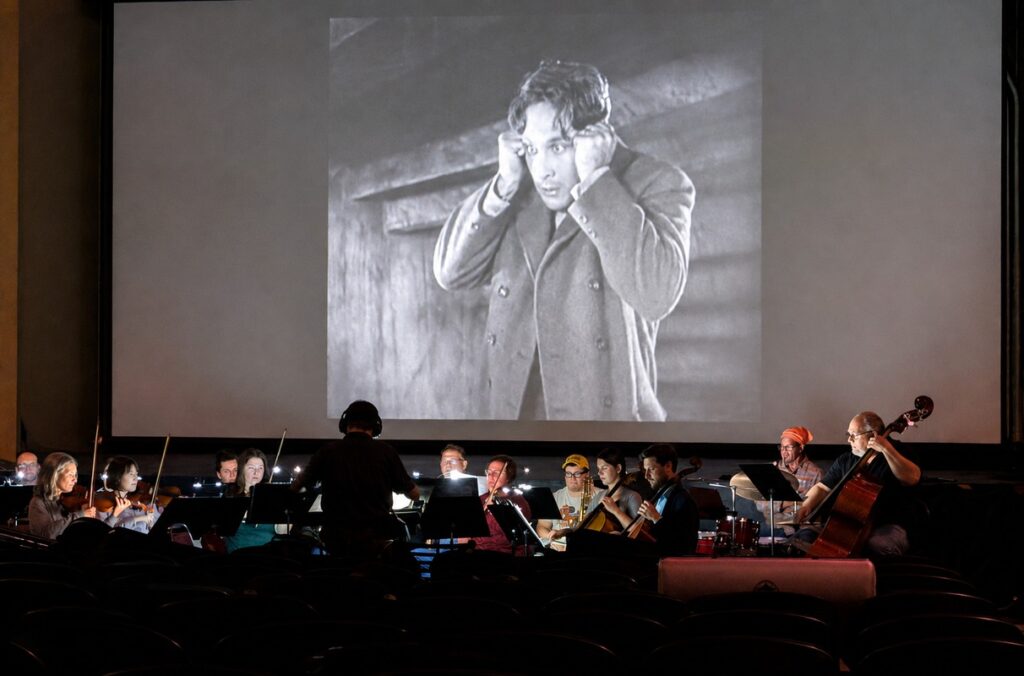
When the lights dim at Moscow’s Kenworthy Performing Arts Centre on Sept. 2, 13 musicians from the Washington Idaho Symphony will have one chance to synchronize more than an hour of newly composed music with a century-old film that will not stop for mistakes.
“We get one shot,” said Danh Pham, a Washington State University professor of music and conductor of the symphony. “That’s the mortifyingly frightening part about the whole thing.”
Drawn primarily from WSU and the University of Idaho, the musicians will perform Oregon composer Isabella Morrill’s new score for King Vidor’s 1928 drama The Crowd as part of the Kenworthy’s fourth annual Silent Film Festival.
The festival will also feature a new score by WSU composition student Tristan Donaldson for Charlie Chaplin’s The Immigrant on Sept. 9. Donaldson, who worked with WSU music professor Christian Kim, earned the $1,000 commission through a competitive, juried selection process. Kim said the score gives the film a contemporary voice while bringing out its humor and humanity.
“The saxophone quartet creates a fresh sound world that connects this classic film with today’s audiences,” Kim said.
Both performances begin at 7 p.m., with tickets priced at $12 for students and $20 for the general public.
Silent films were created to be accompanied by live music, sometimes performed by full orchestras. Much of that music, however, disappeared along with the films themselves, said Colin Mannex, executive director of the Kenworthy.
Rather than attempting to recreate what moviegoers might have heard in the 1920s, the festival invites contemporary composers to interpret the films for audiences today.
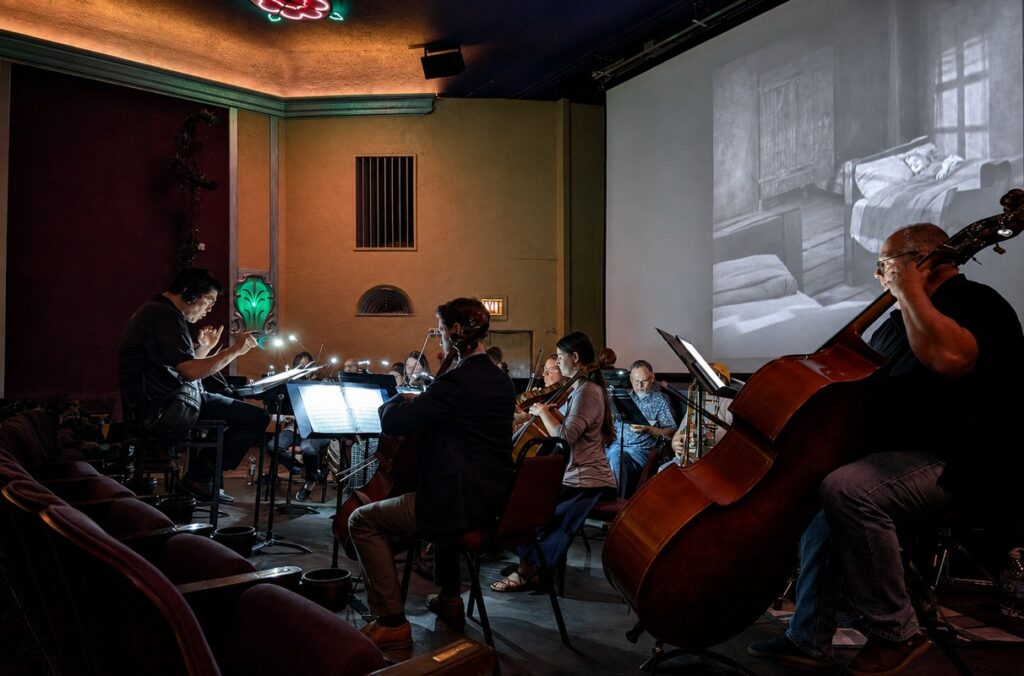
“We’re emphasizing new music and new voices,” Mannex said. “We don’t believe these films are just stuffy museum pieces. They deserve the kind of engagement that comes from hearing living artists make a contribution.”
The commissions also give emerging composers professional credits, an opportunity to hear their work performed before an audience and music they can take to other venues. Productions developed through the festival have gone on to be presented at Gonzaga University, the University of Oregon and in Boise.
Mannex has wanted to present The Crowd since launching the festival in 2023. Although it lacks the name recognition of silent classics such as Nosferatu and Metropolis, he considers it an “unsung masterwork” whose influence can be seen in generations of filmmakers. Its examination of marriage and gender dynamics also remains surprisingly relevant nearly a century later.
Audiences will see a new 4K restoration of the film while Morrill’s score is performed continuously below the screen. A click track delivered through an earpiece will help keep the conductor and musicians aligned with the action. If they fall even half a second behind, the discrepancy can grow as the movie continues.
The format also changes the relationship between the musicians and their audience. There are no pauses for applause, and some of the most meaningful feedback comes during the quietest scenes, when the performers can hear people laugh, sniffle or cry.
“In those moments, we get to listen to the audience,” Pham said. “That’s what I’m most excited for: the musicians witnessing how the audience reacts.”
For Mannex, that emotional connection demonstrates why these films still belong on the big screen.
“I think people will be surprised by just how fresh these films feel,” he said, “even 100 years after they were made.”