A new, Washington State University-led approach to fish breeding could help U.S. aquaculture grow safely and profitably, with support from a Foundation for Food & Agriculture Research (FFAR) Growing Impact Award and matching funds from WSU and Troutlodge.
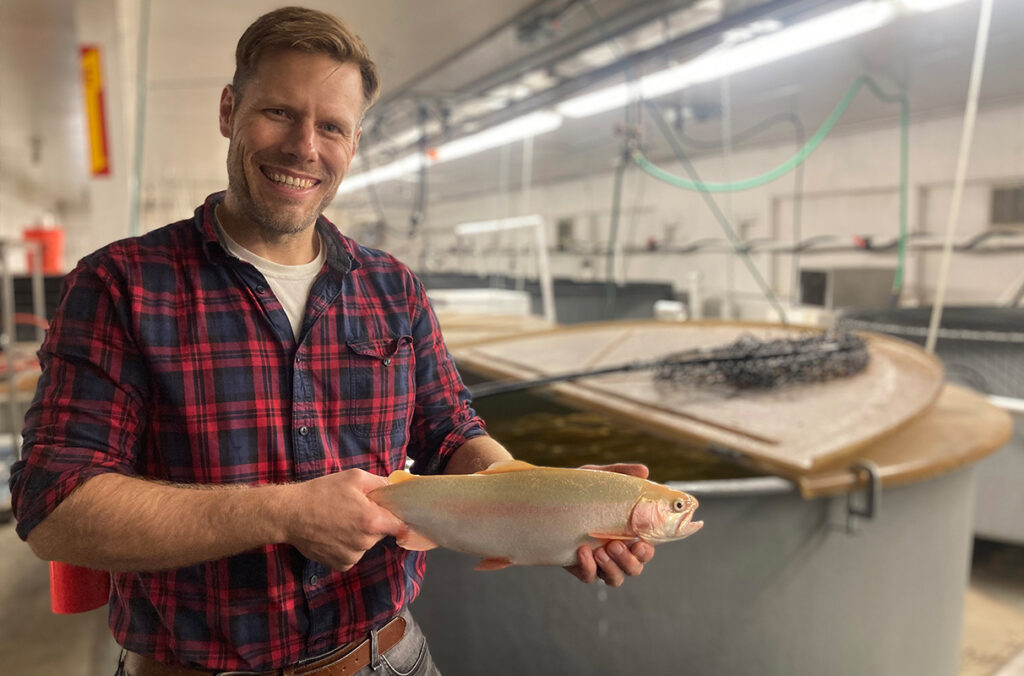
The three institutions are providing a combined $1,566,716 to WSU researchers who are developing a practical way to produce healthy, sterile farmed rainbow trout. Sterility allows fish to devote more energy to growth, increasing farm productivity. It also prevents escaped farmed fish from breeding with wild fish and spreading traits that could disrupt ecosystems.
Current methods for inducing sterility in farmed fish are limited to adding an extra set of chromosomes, a method that is not fully effective and can cause fish health and production problems.
Led by Michael Phelps, an associate professor in WSU’s Department of Animal Sciences, the research builds on his 2021 FFAR New Innovator in Food & Agriculture Research Award, which found that rainbow trout could be sterilized by preventing reproductive cells from developing. Although that method was too complex for commercial use, it helped his team identify two promising and potentially scalable approaches that use the trout’s natural biology to control fertility.
Under the first approach, specially produced male trout pass down a trait that makes their female offspring sterile. The second uses female trout whose eggs produce offspring that cannot make eggs or sperm. The researchers are breeding and studying the most viable offspring produced from these methods over several generations, tracking their fertility, health and growth. Successful approaches will then move into larger trials with Troutlodge, a commercial trout producer, and could eventually guide similar work in other farmed fish species.
“Healthy, sterile fish would be a win for farmers and the environment,” said Dr. Jasmine Bruno, FFAR scientific program director. “Through the Growing Impact Award, FFAR is advancing this innovative research to put a practical breeding tool into the hands of fish farmers that reduces ecological risk and supports the productivity of U.S. aquaculture.”
Catfish, trout and tilapia accounted for most of the nearly $820 million in sales generated by U.S. fish farms in 2023. Even so, the nation imported about 7.4 billion pounds of fish that same year, highlighting an opportunity for domestic aquaculture to supply more of the fish Americans eat. This research could help fish farmers raise healthier, more productive fish, while protecting wild populations and natural ecosystems by preventing escaped fish from reproducing.
“Nature may have already solved part of this problem for us,” said Phelps. “By studying infertility that occurs naturally in trout, we hope to find traits fish farmers can use to produce sterile fish of other breeds on a large scale.”
The Growing Impact Award is a competitive program that helps successful research previously supported through FFAR’s Seeding Solutions and New Innovator Award programs move closer to practical use. By supporting high-performing projects aligned with FFAR’s Research Strategy, the program accelerates innovation, strengthens public and private partnerships and expands the benefits of FFAR-funded research for U.S. agriculture.
“This latest partnership between WSU scientists, FFAR, and the aquaculture industry demonstrates how the land-grant missions continue to find solutions that benefit wild fish and our food supply,” said Raj Khosla, Cashup Davis Family Endowed Dean of the College of Agricultural, Human, and Natural Resource Sciences at WSU. “Through innovations in the Phelps Lab, we’re growing our capacity as a national center for aquacultural discovery.”
FFAR is investing in this research to complement U.S. Department of Agriculture’s Research and Development Priority of Increasing Profitability of Farmers and Ranchers.