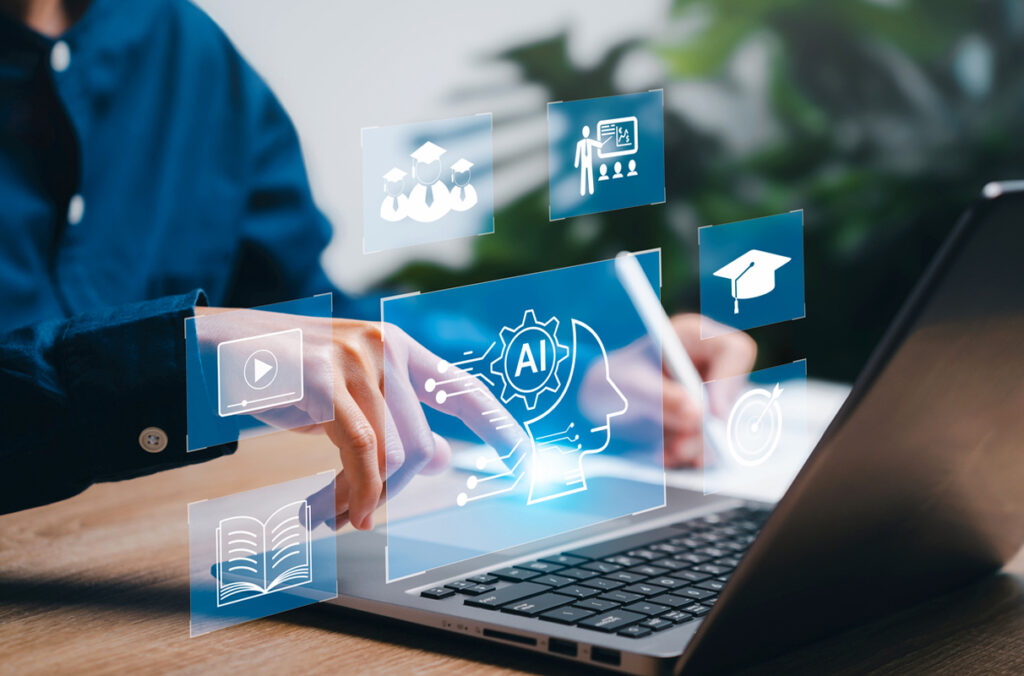
Washington State University researchers have received a grant through the artificial intelligence company, Nvidia, to develop an AI-driven framework to support teaching and learning.
Led by Parteek Kumar, associate professor in the School of Electrical Engineering and Computer Science, the WSU researchers will design an intelligent system that can function as a virtual teaching assistant. Peng He, scholarly assistant professor in science education, is a co-primary investigator on the project.
As part of the grant, Nvidia will provide computing hours along with access to its developer ecosystem. The company’s grant program supports academic research and innovation in artificial intelligence, accelerated computing, and data science.

Students in the School of Electrical Engineering and Computer Science will help to build the virtual teaching assistant. They will also work with the virtual TA, chatting with it regarding their course content. Expected outcomes include AI-powered educational tools, integration into coursework and workshops, research publications, and expanded opportunities for student involvement in advanced AI research.
“The project will help students better understand complex concepts while also supporting instructors in delivering more adaptive and personalized learning experiences,” said Kumar. “We are reaching a point where we can use AI in a responsible way for making teaching and learning more engaging.”
Research shows that with its availability around the clock, a virtual teaching assistant along with traditional teaching support can improve overall interaction and the learning experience for the student. The researchers will be analyzing how well the virtual TA helps the students in courses.
“This project will help us to improve our teaching-learning practices at WSU along with the capability of the students to build and train the system,” he said. “The students will be creating a full system from scratch, so they get exposure for building that type of system.”
The researchers are also exploring how the virtual TA might be integrated eventually with the company’s Deep Learning Institute certificate program.
“This work aligns with WSU’s broader efforts to expand research and education in AI-driven learning, agentic AI systems, and applied machine learning, while strengthening collaboration with industry partners,” said Kumar. “This grant allows us to rethink how artificial intelligence can actively support learning not just as a tool, but as a collaborative partner in the classroom. Our goal is to make advanced AI more accessible, interactive, and meaningful for students across disciplines.”