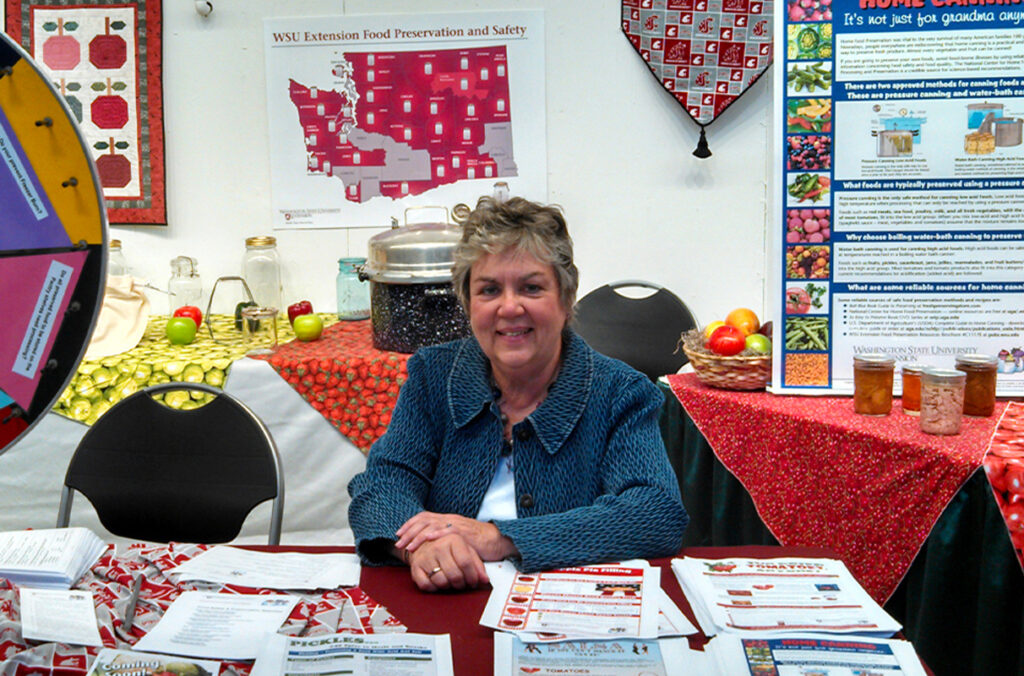
Though the content of Margaret Viebrock’s Extension coursework has changed since she started working for Washington State University in 1970, the mission of strengthening her community never has.
Believed to be WSU’s longest-serving employee, Viebrock, director of Chelan-Douglas County Extension, has helped educate fellow Washingtonians for over 55 years. She received university, national, and state awards for her length of service and impactful outreach this past fall.
“I like to connect with people,” Viebrock said. “I began with teaching people how to cook with microwaves safely. Then, as now, we use university research and information to guide our educational work. I’m most proud of the many people we’ve helped.”
Prior to receiving WSU’s length-of-service award, the National Extension Association of Family and Consumer Sciences (NEAFCS) bestowed their Hall of Fame Award to Viebrock. Then, Washington Association of Family and Consumer Sciences also awarded her and the Chelan-Douglas SNAP-Ed Nutrition Education program the 2025 Group Contributing to the Betterment of Families award.
For over 55 years, Margaret’s leadership has elevated the Extension profession and delivered measurable benefits to families and communities, setting a national bar for innovation, service, and excellence.
Vicki McCracken, director
Washington State University Extension
“These awards represent rare and distinguished honors that celebrate sustained, transformational impact across our state and nation,” said WSU Extension Director Vicki McCracken. “For over 55 years, Margaret’s leadership has elevated the Extension profession and delivered measurable benefits to families and communities, setting a national bar for innovation, service, and excellence. These awards speak to that remarkable achievement.”
In her time, Viebrock has led educational outreach including everything from ServSafe classes on food safety to parenting strategies and youth development programs with 4-H and Strengthening Families, an evidence-based family skills training curriculum.
“That ‘aha’ moment from people of ‘oh, that’s why food preservation has to be done this way,’ or ‘that’s how you communicate with youth and set limits’ — you really see people digesting what you’ve taught,” she said. “Later, it’s exciting when they report back that your recommendations worked.”
Other notable achievements in Viebrock’s career include leading the state’s SNAP-Ed program and the Women in Agriculture program in the early ’90s.
“When I started working for WSU Extension, not many women were farm owners,” she said. “Now, nearly half of the farms in Washington list a woman as the main operator. I’m proud we could help support women-owned farms in my time with WSU.”
Viebrock believes she was awarded honors in part for her commitment to understanding challenges facing local residents.
“Find out what’s important to your community and what it needs, then figure out the way you’re going to approach it,” she said. “To attract an audience, be creative, and make the subject exciting.”
For Viebrock, the key to success, then as now, is a focus on the mission.
“I reassess every three years to see what’s working in our programming or if we can do something differently,” she said. “You need to stay innovative to be impactful.”