Dr. Boel Fransson, head of the small animal surgery section at Washington State University’s Veterinary Teaching Hospital, has been named the new William R. Jones Endowed Chair in Companion Animal Medicine and Surgery.
Fransson, who joined WSU’s faculty in 2006 after completing her internship and residency training at WSU, takes over the position from Dr. Michael Court, the inaugural endowed chair since 2012.
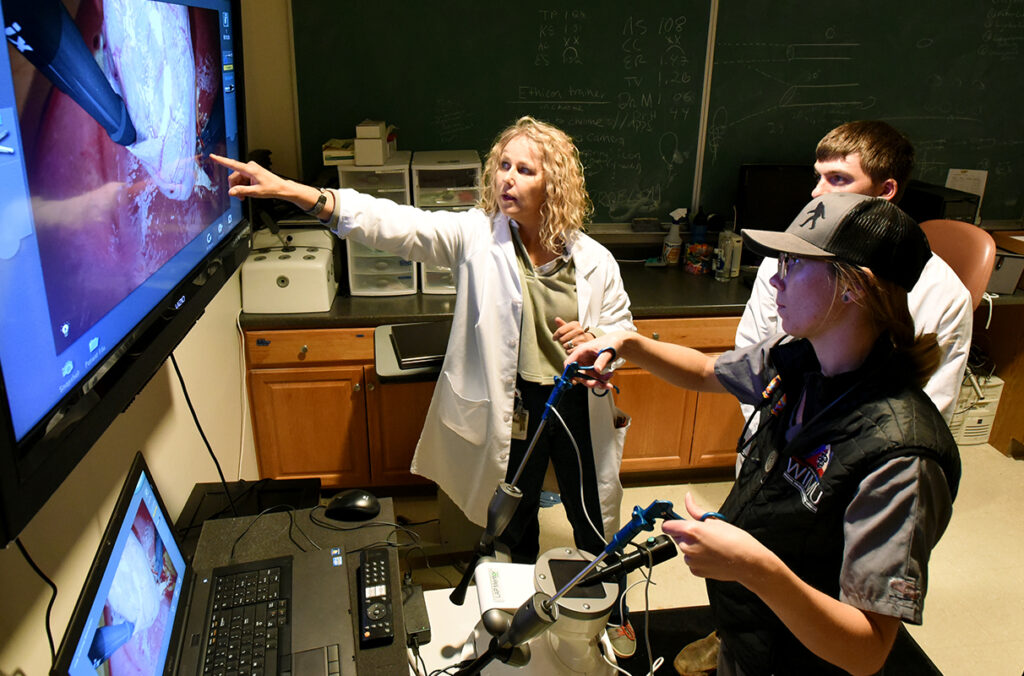
She plans to use the new chaired position to strengthen the minimally invasive surgery portion of WSU’s veterinary curriculum, which will not only improve surgical skills of WSU-trained veterinarians, but may also limit the number of open surgeries and ease the physical burden and recovery times for pets.
“Refinement of training and technology has the potential to impact thousands of pets that may get to have minimally invasive surgery instead of open surgery,” Fransson said. “Think about all the pain and discomfort, and all the pets that could eventually benefit because veterinarians are receiving a thorough training in minimally invasive surgery.”
The William R. Jones Endowed Chair in Companion Animal Medicine and Surgery was established to honor Dr. William Jones’ lifelong commitment to veterinary medicine. Dedicated to advancing small animal care, the endowment supports research, education, and innovation in the field — ensuring Jones’ legacy continues to benefit future veterinarians and their patients.
Born in Seattle in 1911, Jones earned his Doctor of Veterinary Medicine from Washington State College in 1935. Over the course of his distinguished career, he worked for the U.S. Department of Agriculture and the U.S. Army before establishing the first small animal hospital in Trinidad, where he spent 35 years improving veterinary care on the island. His compassion, humor, and devotion to lifelong learning continue to inspire through the endowment that bears his name.
For Fransson, who has spent most of her professional life at WSU, the Jones chair represents an opportunity to expand her work in minimally invasive surgery — a field where she is widely recognized for her innovation and leadership.
I want surgeons to have all the critical information — anatomy, pitfalls, decision making — that people need to be able to do surgery.
Dr. Boel Fransson, William R. Jones Endowed Chair in Companion Animal Medicine and Surgery
Washington State University
While Fransson plans to start by improving the minimally invasive surgery education for veterinarians at WSU, her end goal is to enhance it for those in the veterinary field as a whole.
Fransson said her focus as the Jones chair will be to build on her existing work with the Veterinary Assessment of Laparoscopic Skills (VALS) program, which has become the national standard for assessing minimally invasive surgical proficiency.
While textbooks are helpful and Fransson authors the text for minimally invasive surgery, she hopes to develop a more interactive, video-based curriculum that will serve as a comprehensive educational platform for surgeons in training.
“I want surgeons to have all the critical information — anatomy, pitfalls, decision making — that people need to be able to do surgery,” Fransson said. “I want to create a system that teaches what people need to know, and also an assessment system for that as well. That’s how I plan to use resources that will come from the Jones chair.”
Fransson said she’s energized, humbled, and honored by the opportunity the endowment provides and the potential impact her work could have on surgical education and patient care.
Beyond education, Fransson also hopes to advance new and refined surgical techniques at WSU, continuing the hospital’s reputation as a leader in innovation.
“I really want people to, when they see WSU, think about us as the leader in anything instructional for minimally invasive surgery,” she said.