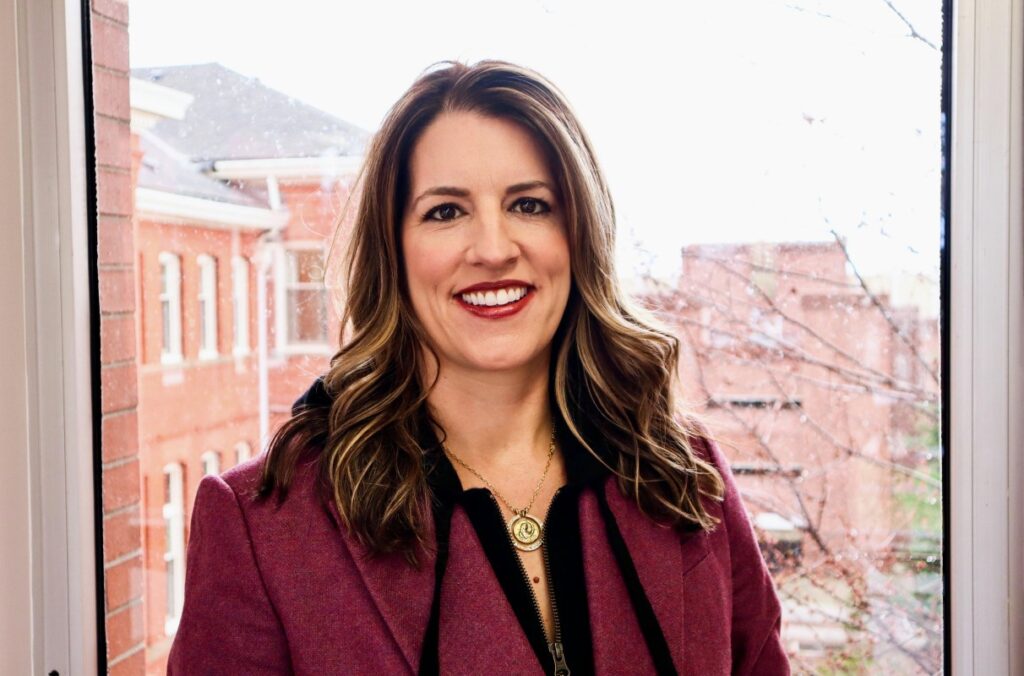
Jennifer Henrichsen, who studies how shifting media landscapes and emerging technologies affect journalism and democracy, is Washington State University’s first faculty member selected to the prestigious Andrew Carnegie Fellows Program.
Henrichsen, who holds a PhD from the University of Pennsylvania’s Annenberg School for Communication, is among 26 fellows across the nation selected to receive $200,000 to support research that enhances understanding of political polarization in the United States. She plans to study how journalists, embedded in resource-challenged newsrooms across the state as part of the Murrow News Fellowship program, can reduce political polarization and strengthen civic engagement.
“I want to know to what extent journalism fellows’ stories are meeting audiences’ critical information needs and how having that information contributes to increased civic engagement and a reduction in political polarization,” Henrichsen said. “In doing so, I hope to learn whether this state-led policy intervention could be a model for other states to adopt as a means of encouraging civic understanding and participation, to ultimately reduce polarization and strengthen democracy.”
Henrichsen’s project will involve analyzing more than 1,000 news articles written by Murrow Fellows for critical information needs content, interviewing journalists and editors, measuring audience engagement with outlets and comparing it with civic participation data, and surveying subscribers to local news outlets to understand perceptions of emotional trust in local news. Her Carnegie project builds on her recent work assessing the media landscape across the state of Washington.
I want to know to what extent journalism fellows’ stories are meeting audiences’ critical information needs and how having that information contributes to increased civic engagement and a reduction in political polarization.
Jennifer Henrichsen, assistant professor
Edward R. Murrow College of Communication
Washington State University
As the research director for the Washington News Ecosystem Project, Henrichsen’s team recently produced the most comprehensive examination of the local news landscape in the state. They found that less populous rural communities are particularly lacking in local news outlets, and that many of the outlets that do serve communities have limited financial resources. The team’s recent report identified two counties with no local news outlets, also known as news deserts, and a further five counties with just one outlet, indicating limited media diversity in many parts of the state.
Combating political polarization is critical for democracy, Henrichsen explained, and begins at the local level. While recent studies have found stark differences in the trust levels people have of the media, local journalism tends to be more trusted than journalism at the national level. And yet local news outlets have suffered from diminished resources for decades, as more people turn to free and less reliable content posted online and as the funding model for journalism continues to struggle.
Without reliable sources of factual information, Henrichsen said, people start to live in wholly different perceived realities. An understanding of facts is necessary to have a shared understanding of what is true in the world. Without facts and truth, people don’t know who or what to trust. And yet, trusting relationships are needed for collaboration that can alter broader social norms and practices necessary to improve democratic life, Henrichsen concluded.
The Murrow Fellows program began in 2023, brings enhanced civic affairs coverage to underserved communities. This is done by pairing early-career journalists with media outlets across the state. The communities being served see more coverage that has a direct impact on their lives, while the journalists involved receive essential experience and guidance from seasoned editors. The two-year program received $2.4 million from the Washington State Legislature, and has so far placed 16 fellows with TV, radio, and print media organizations across the state.
In addition to serving as an assistant professor with the Edward R. Murrow College of Communication, Henrichsen is senior personnel with the VICEROY Northwest Institute for Cybersecurity Education and Research (CySER). She is also an affiliated fellow at Yale Law School’s Information Society Project and an affiliated fellow at the University of Pennsylvania’s Media, Inequality & Change Center. She is the author or co-editor of more than 30 publications, including three books. She is currently working on another book focused on the digital repression of journalists and how journalists can combat these digital attacks through the development of information security cultures.
Since 2015, the Andrew Carnegie Fellows Program has honored nearly 300 fellows and made $59 million in philanthropic investments. The Andrew Carnegie Fellows Program award is for a period of up to two years and the anticipated result is generally a book or major study. Fellows have received honors including the Nobel Prize, Pulitzer Prize, and National Book Award.
“Through these fellowships Carnegie is harnessing the unrivaled brainpower of our universities to help us to understand how our society has become so polarized,” said Dame Louise Richardson, president of the Carnegie Corporation of New York. “Our future grantmaking will be informed by what we learn from these scholars as we seek to mitigate the pernicious effects of political polarization.”