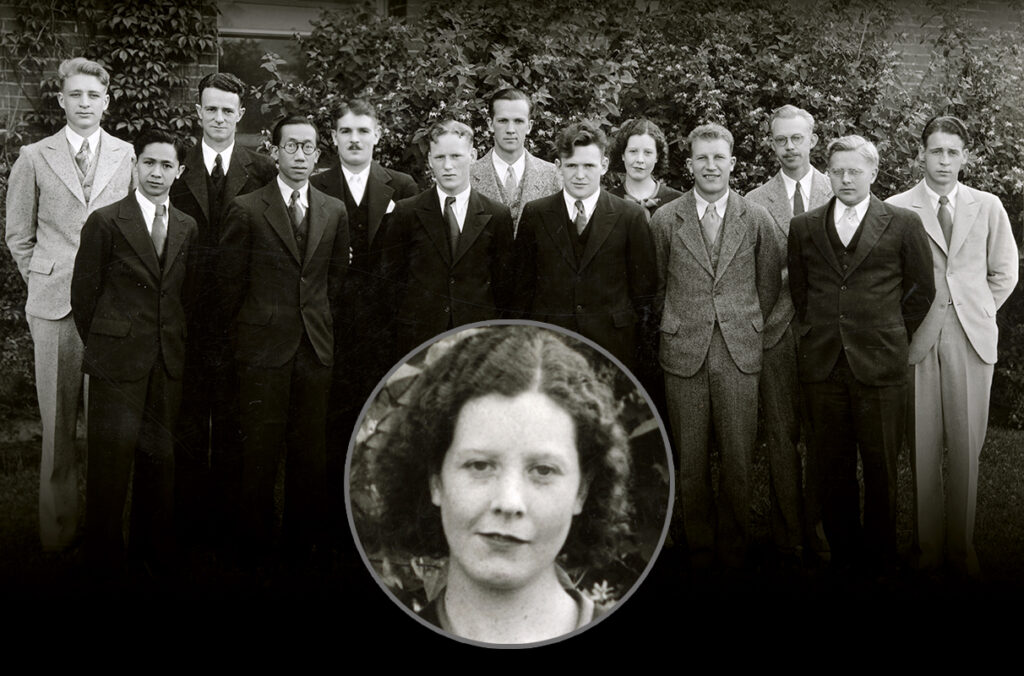
Catherine Roberts Frasier, the first woman graduate of Washington State’s College of Veterinary Medicine, wasn’t one to mince words.
Frasier called her first husband “a fool” and the second husband “a jerk.” She said one university administrator was “a real old battle-ax,” and confessed that she “was never enchanted” with the practice of veterinary medicine, though she did like treating large animals well enough.
Though Frasier died in 1985, we know these opinions — and many others — thanks to the work of another WSU College of Veterinary Medicine graduate, Lorain (Miller) Abel, a member of the class of 1987 who is still practicing in Grants Pass, Oregon. Frasier sent Miller a 10-page, typewritten biography in 1977, which the younger woman used as the basis for a prize-winning high school essay.
Frasier, who was known as Catherine E. Roberts at the time, graduated in 1933 from Washington State College. A veterinary medicine career hadn’t been her first choice, but her stepfather was a vet in California and persuaded her to follow in his footsteps. She had to earn her way through, which she did by tutoring other students. Also, “I took notes of all the lectures in class in shorthand and typed out copies and sold them to all the boys,” she wrote.
She loved her experience in Pullman, saying the faculty “seemed to be quite pleased to have a girl in the classes.” Other women were part of the program by the time she graduated.
“We were a small class, only 13 in number, and we worked closely together for four years,” she wrote. “Times had been tough, the Depression had gone into full swing, and it was unbelievable how little some of the boys got along on, like $25 a month. I missed those guys for months after we parted.”
She returned to California, becoming the first woman granted a veterinary license in that state. She went into practice with her stepfather, but they were both strong-willed and she left to practice in Eureka soon after.
One of my pet peeves is people who gush, ‘Oh, I always wanted to be a veterinarian because I just love animals.’ There is so much more to it than that.
Catherine Roberts Frasier, 1933 graduate
Washington State’s College of Veterinary Medicine
Frasier built a thriving practice, helped by her third husband, Lew Frasier. But shoulder pain and the advent of World War II put an end to her veterinary career, though she worked as a government poultry inspector for a time after the war. Eventually she put her biomedical education to use as a licensed vocational nurse, which she said she enjoyed.
She never experienced discrimination because of her gender, she said in 1977. “There was no question as to my acceptance anywhere, professionally or socially.” Yet, she struggled with gendered expectations.
“No matter what a woman’s profession or how much money she makes, she some way gets stuck with washing, ironing, dish-washing and other housekeeping chores, all of which I hate,” Frasier wrote.
She also cautioned Miller, the student who wrote to her, to think about why she wanted to become a veterinarian.
“One of my pet peeves,” Frasier wrote, “is people who gush, ‘Oh, I always wanted to be a veterinarian because I just love animals.’ There is so much more to it than that. The brains to learn all you should know in order to do the best for the animals. The compassion and empathy with the animals in order to feel how they are feeling when they can’t say ‘I have a headache.’ The stamina to stay with the job until it is done even if it takes seven hours of back-breaking labor in heat or mud or rain…
“Examine your motives for desiring to be a veterinarian, then if you are sure that is what you want, give it all you’ve got.”