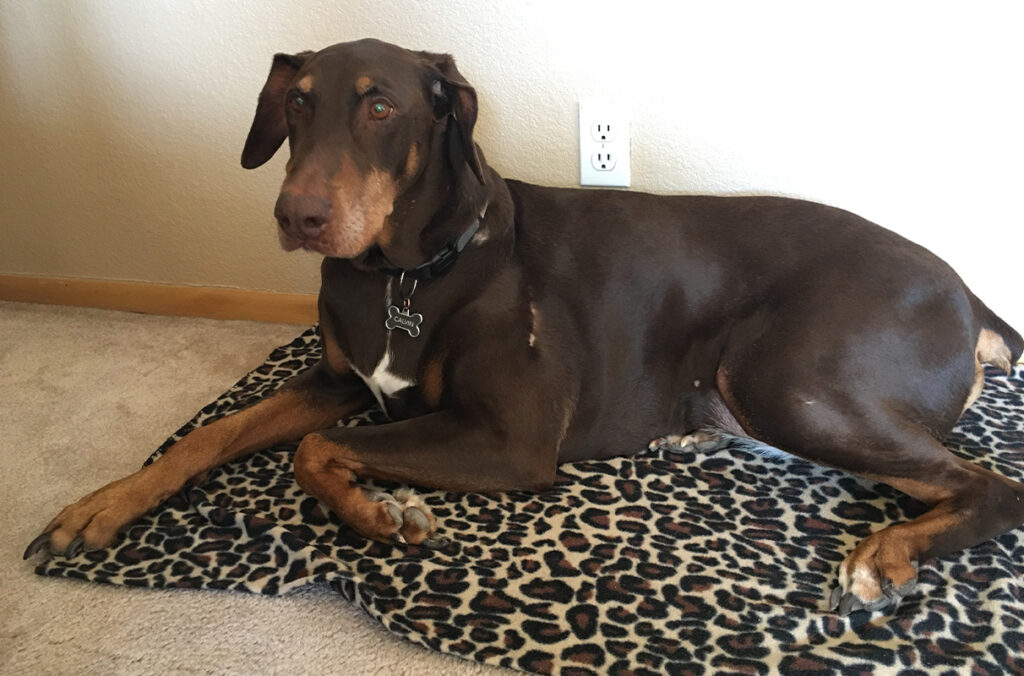
When Brenda Adams noticed her Doberman, Calvin, limping, she naturally assumed he had something stuck in his paw.
The limp, however, was a sign of something far more serious. Calvin, then 8 years old, had osteosarcoma, a deadly and aggressive bone cancer in his left shoulder. The standard treatment would have been amputating his entire leg, but due to a prior hip injury, that was not an ideal option for Calvin.
Instead, veterinarians at Washington State University’s Veterinary Teaching Hospital elected for a complex and rarely performed procedure in which Calvin’s scapula — his shoulder blade — was removed, along with all traces of the tumor while keeping his leg intact and functional. Nearly a year later, Calvin is thriving.
“He’s over 9 years old now, and that’s getting up there for a Doberman, but he’s still cancer free and happy,” Adams said. “We couldn’t ask for anything more.”
Osteosarcomas are the most common bone tumors in dogs and are known for metastasizing, or spreading, to other areas of the body. They can be quite painful and can appear in any bone. Amputation to remove the tumor, combined with chemotherapy, is the most common treatment. About half of the dogs treated in this manner are alive one year after diagnosis.
Calvin first showed symptoms in March 2024, just two months after Adams and her husband had taken him in from a family member who could no longer care for him. Despite the short time together, Calvin had already made his way into their hearts.
“We had only had him a very short time, but we fell in love with him,” Adams said. “He is the best dog — just a big, fun, goofy guy. Everybody who meets him just loves him.”
After Calvin was diagnosed by his veterinarian, Dr. Brooke Wicks, at a local clinic in Walla Walla, Washington, Adams sought treatment from a holistic veterinarian in Seattle. As the cancer progressed, however, Wicks encouraged Adams to seek treatment with a referral to WSU.
WSU’s surgical team removed the tumor by performing a scapulectomy — a procedure in which only the shoulder blade is removed. The surgery has rarely been performed at WSU and elsewhere.
There, Calvin was evaluated by oncologist Dr. Rance Sellon and small animal surgeon Dr. Bettina Darveshi and surgical resident Dr. Natalie Heape. A typical treatment would have involved amputating his left leg, but Calvin’s history complicated the decision. Years earlier, he had jumped from the back of a moving pickup, sustaining severe injuries to his pelvis and back hip that required surgery to remove the femoral head, or top of his thigh bone. The loss of his front leg would have severely affected his mobility and quality of life.
Instead, WSU’s surgical team proposed removing the tumor by performing a scapulectomy — a procedure in which only the shoulder blade is removed. The surgery has rarely been performed at WSU and elsewhere.
During the four-hour procedure, the team carefully removed Calvin’s scapula while preserving the surrounding nerves and muscles and reattaching the upper part of the leg bone to the rib cage, allowing the leg to remain in its correct location.
Calvin was slow to use his leg in the weeks following the procedure, but a fellow four-legged creature would provide motivation.
“My mom’s cat would walk past our sliding glass door, and Calvin loved to bark and jump around at it,” Adams said. “One day, we noticed he was using that leg like crazy as he tried to chase after the cat. After that, he started using it more.”
Now, Calvin is left with only a large scar as a reminder of his tumor. After undergoing five rounds of chemotherapy and routine doses of the Yale vaccine — an experimental immunotherapy designed to treat certain types of canine cancer — he has remained cancer free.
Adams is forever grateful for WSU.
“There’s such a top-notch group of people there — every doctor, every student, every surgeon,” she said. “We couldn’t be more blessed with the outcome Calvin has had. It is truly remarkable.”