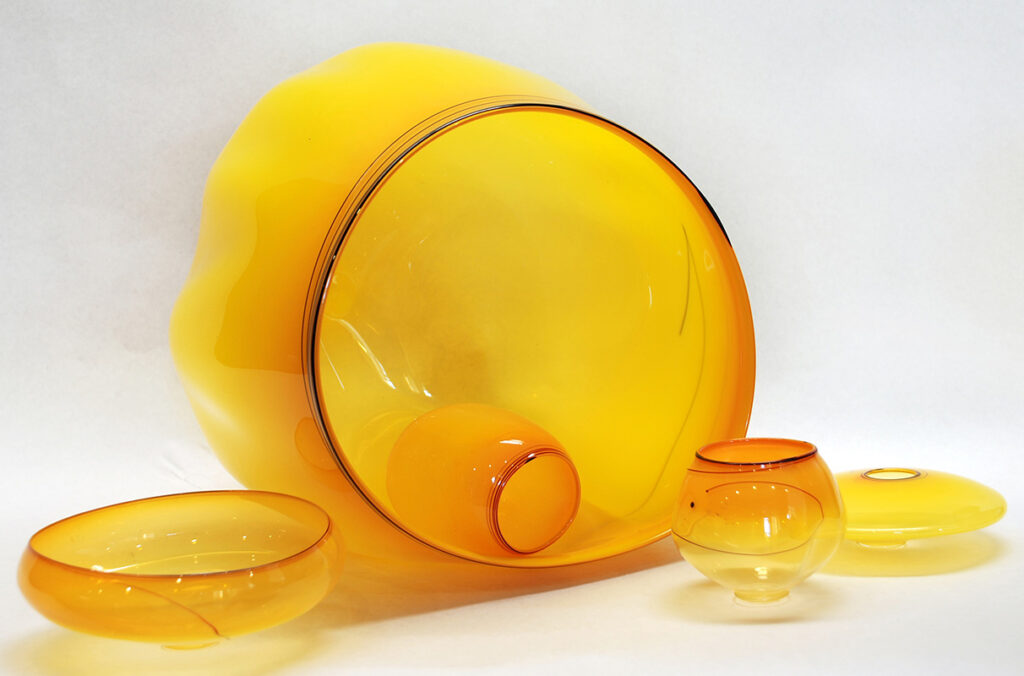
Members of the public were invited to view and discuss pieces by some of the most influential glass artists of the Pacific Northwest at a recent event on the Washington State University Pullman campus.
Hallie Meredith, an assistant professor in the WSU Department of Art, led the Community Perspectives Tour of selected glass works at the Jordan Schnitzer Museum, which is celebrating its 50th anniversary this year. The tour included exhibits from the Marian E. Smith Collection which features artwork by Dale Chihuly, Brian Rubino, John de Wit, and others.
“My overriding interest is in craftspeople, both in the ancient world and today,” Meredith said. “My research and teaching focus has been on technical art history and experiential learning.”
Meredith’s research specialties include late antique work, craft production, and ancient technologies with an emphasis on glass.
“When I first arrived (to WSU), I was excited to see the Smith Collection displayed and not in a cloistered museum space,” Meredith said. “I immediately began a project with undergraduates to write a short catalog for the pieces on display.”
Since then, Meredith has undertaken several collaborations between the museum and other community arts groups, including inviting glassblowers from the Tacoma Museum of Glass to the Pullman campus for public demonstrations and lectures on the history and chemistry of glass.
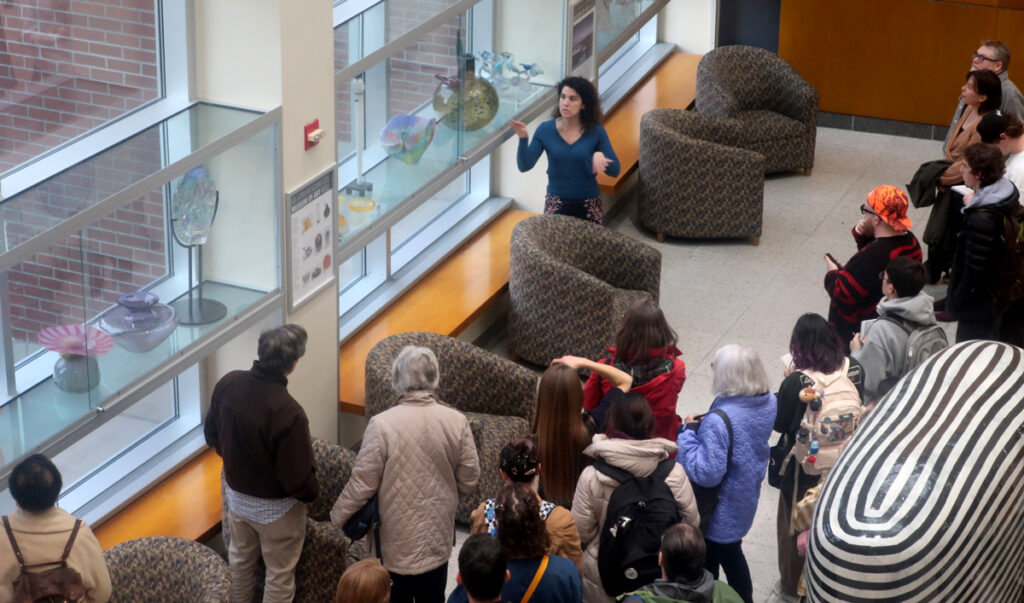
“The way I approach the history of art is not like most historians, it’s more like a maker,” said Meredith, a former hot glass studio artist. “I’ll look at pieces inside out and upside down, because there’s something about actually doing the process yourself that I think gives you insights like nothing else.”
Meredith’s path to art history wasn’t always clear. “By chance, I took an undergraduate elective in glassblowing, and it was a complete accident I was in the department. But after that I was hooked. I was addicted,” she said. “For a while I was majoring in ceramics and glass, and pre-med at the same time. I ended up researching the history of glass, and it’s taken me in various directions. I think it’s that undergraduate elective that sealed my fate.”
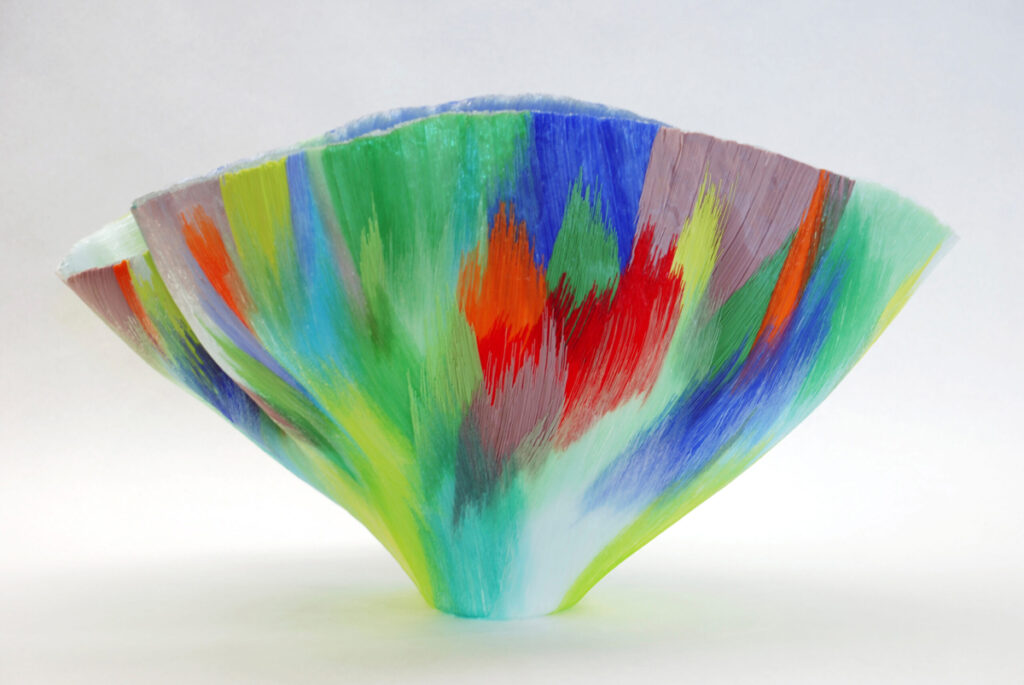
Meredith received her doctorate in classical archeology from Lincoln College, University of Oxford. “There were many different forms of glass before the Romans, but the Romans invented glassblowing and the actual inflation,” she said.
Meredith’s current scholarship focuses on glass symbols previously dismissed as decorative, but which may actually be workshop production marks. These symbols are found on drinking vessels from the 4th century, which have toasts in Latin and Greek embossed with carved lettering. One of these particular symbols has been dismissed as decorative script, but Meredith thinks that the symbol may instead refer to a specific creator or workshop. “I’ve had to go and get new images from various museums because they don’t have digital images of these little symbols,” Meredith stated. “There’s something about the carved glass that I’ve always found really fascinating.”
Her latest publication, The Unknown Roman Craftworker in Late Antiquity: A History of Producers of Glass and Related Industries, will be released by Cambridge University Press in the coming months. Meredith’s additional publications include Objects in Motion: The Circulation of Religion and Sacred Objects in the Late Antique and Byzantine World, and Word Becomes Image: Openwork Vessels as a Reflection of Late Antique Transformation.