Martin Churuvija partnered with Australian researchers this summer to integrate artificial intelligence (AI) into his prototype tree-pruning robot.
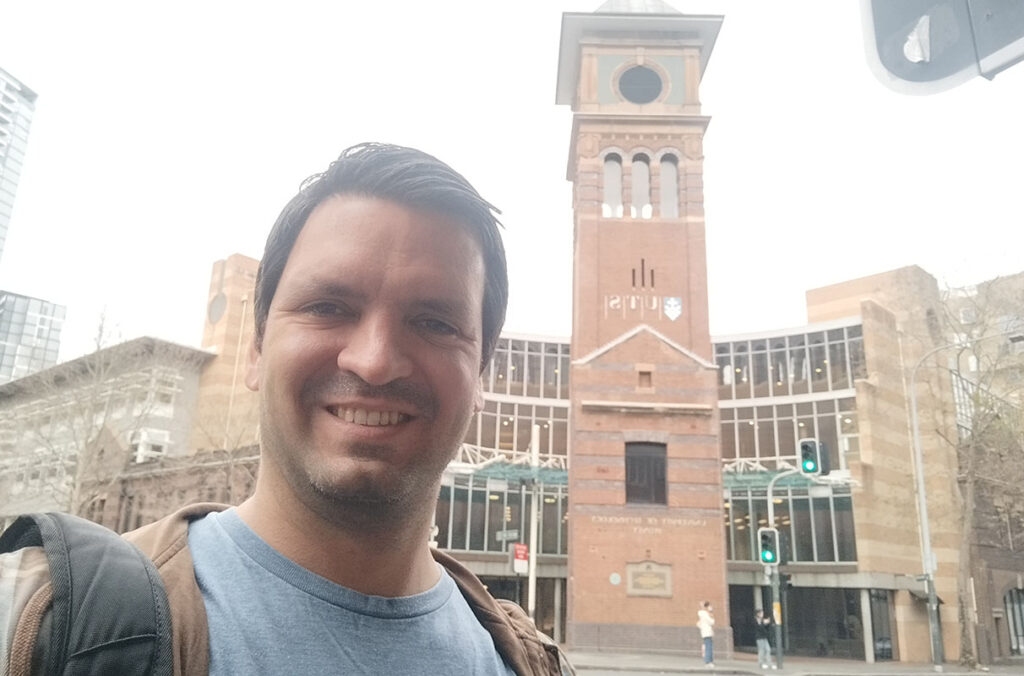
The Washington State University biological systems engineering PhD student had the opportunity to work with scientists at the University of Technology Sydney (UTS) thanks to a partnership between WSU and the Australian university focused on robotics.
He spent two months in Sydney this summer working with UTS experts to figure out how to get his robot’s operating system to recognize and accommodate deformations in apple trees, which can affect how the trees are pruned.
Under the advisement of UTS Professor Alen Alempijevic, Churuvija updated the operating system of his robot to the latest software, enabling it to work with a newer camera system. Churuvija said the algorithms developed by UTS help his robot accommodate for minor tree movements while it scans.
Alempijevic said Churuvija had great technical abilities and was pleased to see the research start to make inroads into agriculture automation.
“Working together with Martin, and WSU, allows us to develop systems more rapidly,” Alempijevic said. “Being in opposite hemispheres — UTS in Australia, WSU in the USA — has the advantage of more deployment opportunities which are critical to increasing the robustness of systems.”
Churuvija’s original system assumed a static tree structure — which worked in a controlled lab environment at the Irrigated Agriculture Research Extension Center in Prosser. Occasionally though, scans in the orchard would show odd, 3D pictures of a tree branch in a cone shape due to the wind disturbing a scan. Adding AI elements helps the robot piece together missing information and brings it closer to real-world development.
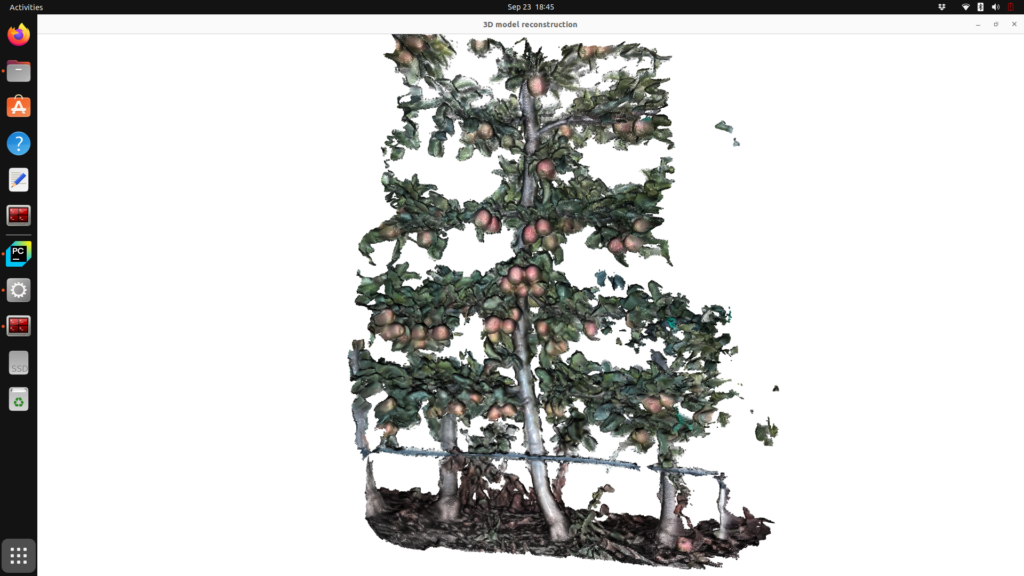
“Using robots in orchard environments is extremely challenging,” Churuvija said. “Unlike indoor settings, outdoor conditions bring a range of obstacles. For example, our vision system — which uses cameras to perceive the world in 3D like humans — must recognize tree structures despite inconsistent lighting and wind.”
Churuvija’s work, which is guided by his PhD advisor Professor Manoj Karkee, is still in the research stage, but his ultimate goal is to help develop robots that can pick fruit as well as prune plants. He is currently focused on finalizing the development of the pruning robot and plans to run trials this winter.
Churuvija’s trip to Australia wasn’t solely centered on lab time. He got to visit several Sydney landmarks such as the opera house and the zoo. Even though it’s on the other side of the globe from his lab in Prosser, Sydney felt comfortable, and it reminded Churuvija of his home city of Buenos Aires, Argentina.
“Luckily the weather is similar to the weather from the place where I have lived the most,” he said. “It’s a big city so I got to interact with people from all over the place and visit the iconic places.”