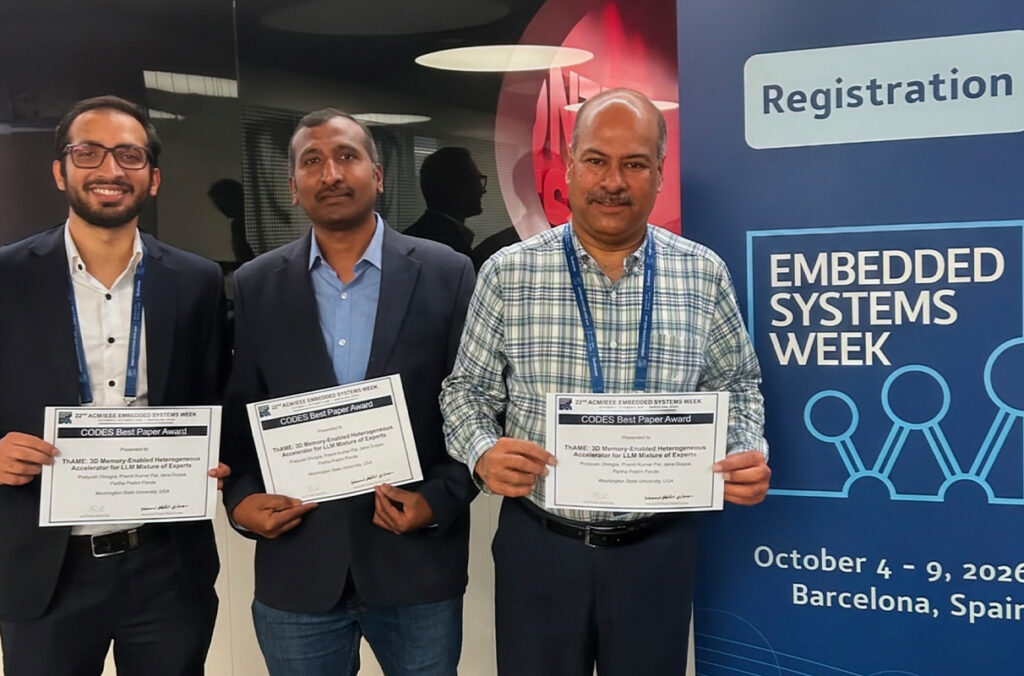
School of Electrical Engineering and Computer Science researchers recently received a best paper award at the International Conference on Hardware/Software Codesign and System Synthesis at ACM/IEEE Embedded Systems Week (ESWEEK).
The conference held in September in Germany is a premier event in system-level design, hardware/software co-design, modeling, analysis, and implementation of modern embedded systems, cyber-physical systems, and Internet-of-Things (IoT). It brings together academic research and industrial practice related to system-level and hardware and software co-design, according to their website.
The paper, entitled “Florets for Chiplets: Data Flow-aware High-Performance and Energy-efficient Network-on-Interposer for CNN Inference Tasks” is a collaboration between WSU and University of Wisconsin researchers. In the work, the researchers proposed a novel Chiplet-enabled computer architecture that reduced energy usage and improved performance while being able to execute datacenter-scale machine learning workloads.
Machine learning is both computing and memory intensive, requiring a lot of processing power and storage, so designing hardware platforms for machine learning applications is important, said corresponding author Partha Pande, Boeing Centennial Chair in Computer Engineering.
“We have demonstrated that we outperform any existing competitive architectures for the same application space,” said Pande.
Pande was elated when he found out his team was receiving the award.
“As a professor, this is all about the success of my students,” he said. “This is the top most embedded system conference. It was a very proud moment for me.”
WSU PhD student Harsh Sharma was lead author on the paper and worked with WSU faculty members Partha Pande, Jana Doppa, and Ananth Kalyanaraman. Additional co-authors are Lukas Pfromm and Umit Ogras from University of Wisconsin, Madison, and Rasit Onur Topaloglu, from Topallabs.