For Steve Hines, it was Mrs. Ellen Walters, his fifth- and sixth-grade teacher at Walter Shade Elementary School in West Carrollton, Ohio, that brought together his love for animals and science.
“Mrs. Walters loved science and that love was infectious,” Hines said. “We can all identify teachers who have made a profound difference in our lives in some way or another, but it has largely not been recognized or rewarded in higher education.”
Dr. Hines, a longtime WSU professor and veterinarian, is looking to change that by exploring new ways of assessing teaching performance and awarding promotions at the collegiate level.
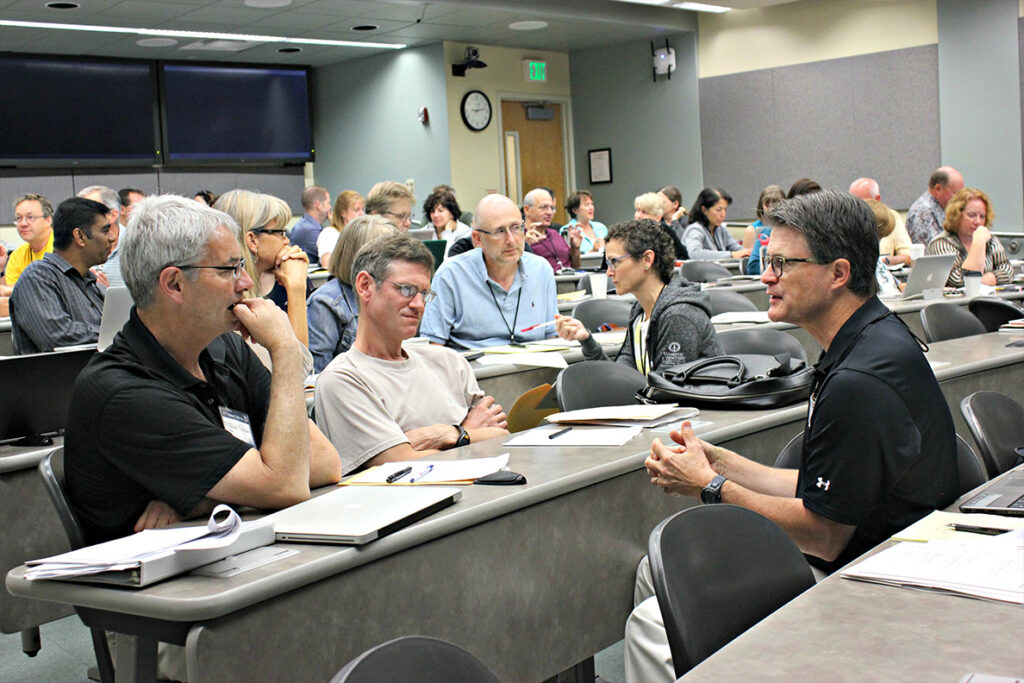
He is working with members of the Teaching Academy of the Consortium of West Region Colleges of Veterinary Medicine on the project.
Faculty from research-heavy colleges have historically been promoted and awarded tenure based on publications in high-impact journals and grant funding, Hines said, but that can be disadvantageous to faculty with more of a focus on the classroom.
“If you are doing a lot of teaching you typically aren’t doing the research that leads to publications. You might make a dramatic difference in someone’s life, but it’s not the thing that gets you promoted, not traditionally,” he said.
The Teaching Academy of the Consortium of West Region Colleges of Veterinary Medicine was created in 2011 by deans and faculty from veterinary colleges at WSU, Colorado State University, Oregon State University, University of California-Davis, and Western University of Health Sciences after Hines pitched the idea.
The program is modeled after the Teaching Academy at WSU’s College of Veterinary Medicine. It started with 10 educators representing the five schools but has since expanded to seven veterinary colleges with the addition of Midwestern University and the University of Arizona. The academy now has 76 collaborating faculty members.
With a slogan of “making teaching matter,” the academy has worked to rewrite promotional parameters at its institutions to include teaching and to include faculty evaluators who aren’t research scientists first and foremost.
“That old grant-publication currency doesn’t apply very well to people whose primary responsibility is teaching,” Hines said. “So, what does apply? Innovative and new ideas, adopting proven high impact practices, influencing students, developing new programs – things that make a difference but don’t often lead to publications. We have to figure out how to report this work and better measure the outcomes.”
The effort at WSU is also supported by academic coordinator Rachel Halsey, clinical associate professor Phil Mixter, and Associate Dean Leslie K. Sprunger.
“Change is hard, but we are starting to see people promoted based on high-impact teaching,” Mixter said. “You have to find points of leverage, use a consensus of many institutions and move forward together.”
Hines and Mixter said one of the academy’s most significant products could be its external review process.
“A teacher goes into the class and the only people who know what goes on there are the students and the one instructor,” Hines said. “When you can share ideas and experiences and things that did work, or didn’t work with other educators, you start to get better and grow.”
Mixter said the academy has helped him grow firsthand.
“It’s helped me tell my own professional story, while coaching others across the country on ways to structure their professional strengths and gather evidence of effective teaching,” he said. “The world of veterinary colleges is a small world and it has been so rewarding to collaborate and find new ways we are connected and challenged on the same topics.”