In the struggle to save endangered fish species, culverts don’t usually come to mind as a way to make a difference.
But while manmade culverts protect roads from erosion or flooding, they also can make it difficult or impossible for fish to swim against strong currents or to pass obstacles.
With a $215,000 grant from the Washington State Department of Transportation (WSDOT), a WSU research team led by Nick Engdahl, an assistant professor in Civil and Environmental Engineering, is working to rewrite the book on how to prevent culverts from becoming fish migration barriers.
In 2018, a group of 21 tribes won a lawsuit that requires Washington to replace the culverts to fulfill treaty-protected fishing rights. Approximately 60 percent of the transportation agency’s 3,000 culverts don’t allow for adequate fish migration, according to the Washington Department of Fish and Wildlife, and the transportation agency wants to fix more than 800 of the structures in the next 10 years.
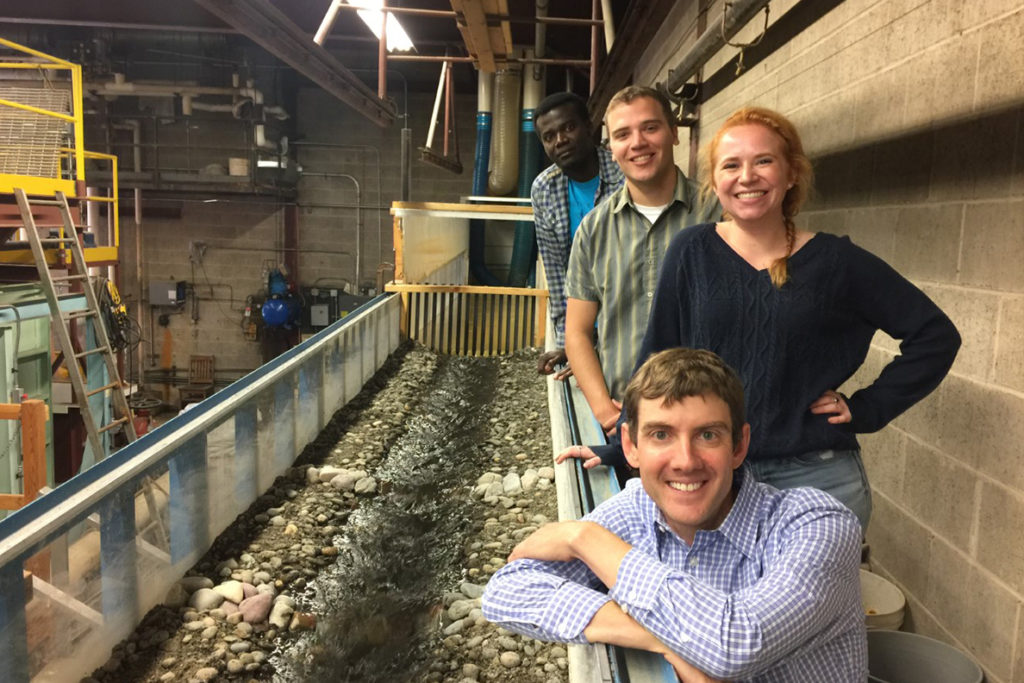
The WSU research team is simulating Asotin Creek’s streambed at the Albrook Hydraulics Lab at the Pullman campus, one of only a handful of such facilities in the world. The group is testing the use of coarse bands of sediment as a way to enhance the stream channel’s stability and slow the water.
“The goal of this project is to help establish the future guidelines on how to use these coarse bands in culverts to maintain the shape of the stream channel and promote fish passage,” Engdahl said.
Apart from the water’s speed, turbulence and instability of the stream channel also cause problems for fish.
The team starts by preparing a U-shaped channel, which is then stressed by running water through at various speeds. Without coarse bands, the channel profile is destroyed by erosion. Adding coarse bands has helped preserve the original channel shape and this means fish can still pass upstream even at low flows.
“We’re essentially testing flood events and finding the optimal configurations of the coarse bands to help the channel bed hold up in its original U-shape,” said Bailee Kelty, a senior studying civil engineering who has been involved with the project.
The team will come up with recommendations for the layout, dimensions and streambed composition to maximize its longevity. They will also be working to create a standardized procedure for quantifying a streambed’s performance.
“The final design involving the coarse bands should not only generate the right speeds, but also the right depth, width and slopes for optimal fish passage,” said Kelty.
The WSU team will be submitting their report to WSDOT with their recommendations by August and are also in the process of publishing academic papers based on their work.