Three Washington State University researchers have received faculty Early Career awards from the National Science Foundation.
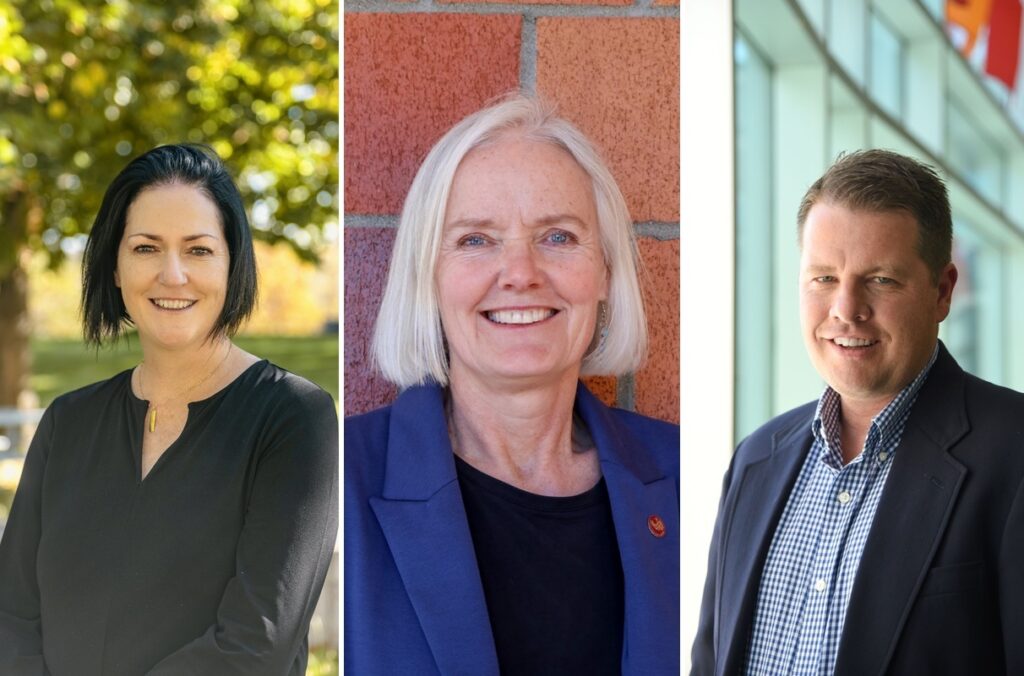
Venera Arnaoudova, Anamika Dubey, and Subhanshu Gupta, faculty members in the School of Electrical Engineering and Computer Science (EECS), each received the five-year awards. The grants, which are about $500,000 each, are intended to provide significant research support to young faculty beginning their careers who have the potential to serve as academic role models in research and education.
“These awards are a testament to WSU’s growing research enterprise in computer science, computer engineering and power engineering and to the high quality of research from our rising faculty members in these fields,” said Mary Rezac, dean of the Voiland College of Engineering and Architecture. “They address societal challenges and promise to have significant impact, especially in the state of Washington, which leads the country in high-technology growth.”
Demand for graduates in computer science and engineering has skyrocketed in the past decade. Arnaoudova, Dubey, and Gupta were all hired as part of a state-funded faculty expansion to help meet that growing need. Since 2015, research expenditures in WSU’s School of Electrical Engineering and Computer Science have nearly doubled, as have the number of graduates from its program.
The CAREER awardees include:

Anamika Dubey
Power system outages due to natural disasters cost a staggering $18-33 billion per year and cause significant safety and security concerns, especially during extended outages and extreme weather events. The need for resilience is particularly critical for the aging mid- and low-voltage power distribution systems, responsible for approximately 90 percent of outages.
Leveraging recent smart grid advances, Dubey’s project will develop a plan to manage disruptions and improve the resilience of power distribution systems. The proposed innovations add flexibility for bottom-up restoration using distributed energy resources (DERs) and enhanced distribution automation capabilities, allowing for faster recovery of critical services during natural disasters. The project aims to improve public safety and reduce the cost of natural disasters to the economy, encourage DER integration, and help reduce the US carbon footprint. The project will also include a well-integrated education plan to address the critical need for a skilled, interdisciplinary, and inclusive workforce for a future power distribution grid.
Dubey has been with WSU since 2016. She holds a Ph.D. and MSE from the University of Texas at Austin and a B.Tech from the Indian Institute of Technology, Roorkee.

Subhanshu Gupta
Extremely large antenna arrays made of hundreds of antenna elements promise to provide unprecedented spatial resolutions for critical infrastructure technology as well as for exciting futuristic ideas like holographic surfaces for multi-user wireless communications, six-dimensional positioning for autonomous vehicles, high-speed communication for deep-space exploration, and automobile radars for detecting multiple objects. However, the signal processing for these large-scale arrays require large amounts of energy and can be inaccurate, and because of the highly complex signal processing required, conventional transceivers don’t work well. Gupta’s project will be working to enable the next generation of multi-antenna array systems that will be more precise, energy efficient and faster, using novel integrated circuits and systems design techniques to develop a delay-compensating spatial signal processor to handle very large bandwidth for large antenna arrays.
The research could have broad impacts on wireless communications, space communications, and radar for autonomous vehicles.
With WSU since 2015, Gupta holds a Ph.D. and M.S. from the University of Washington, and a B.E, National Institute of Technology, Trichy, India.

Venera Arnaoudova
Software developers spend most of their time reading and understanding software. While academic and industry experts have published information on best practices in the field, the information is largely based on the experts’ own opinion and experience rather than scientific evidence.
Arnaoudova’s research will study how human behavior impacts the cost and quality of software development. This project specifically targets practices related to software design, code, and review. The researchers will evaluate the impact of existing practices on developers, use objective measures to identify new software development practices, and develop better guidelines for software development and maintenance.
At the same time, they will be working to incorporate the findings of this project into the curriculum to create a better trained workforce in software development.
With WSU since 2015, Arnaoudova holds a Ph.D. from Canada’s Ecole Polytechnique, a master’s degree from Concordia University, and a bachelor’s degree from France’s Polytech’Lille.