A plastic composite made partly from waste coffee grounds is a tough but environmentally friendly material for 3D printing, according to new Washington State University research.
The work could lead to new applications for 3D printing as well as make better use of waste materials. Reporting in the journal, ACS Sustainable Chemistry and Engineering, the researchers found that their material, made from up to 20 percent coffee waste, had a more than 400 percent increase in toughness over pure poly‑lactic acid (PLA), the type of plastic that is most commonly used in 3D printing.
“Spent coffee grounds provide an excellent addition to the field of renewable resource and energy applications,” said Yu‑Chung Chang, a graduate student who led the work.
PLA is a popular plastic material used for many medical and consumer products, such as in drug delivery, tissue engineering, food packaging, as well as for 3D printing. Made from corn starch, it is biodegradable. But, when used for 3D printing applications, products made from PLA lack strength and break easily. Products that are 3D printed, in fact, are almost entirely limited to being toys, trinkets, or display models.
“They are not high performance products,” Chang said. “I want to change that.”
Researchers have been looking to add low‑cost additives, such as wood fiber, silica, or clay, to enhance the material’s performance as well as to reduce manufacturing costs. Such additives from renewable sources could also keep waste materials from ending up in a landfill and creating additional pollution.
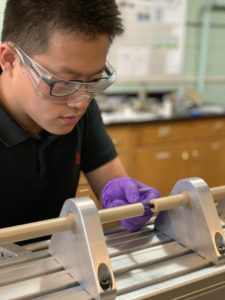
For their study, the WSU researchers decided to add coffee ground waste to the PLA. People around the world drink more than two billion cups of coffee every day, so waste coffee grounds are abundantly available.
“We have a virtually limitless supply of coffee grounds,” Chang said. “Our goal is to extend the life cycle for these waste products. We looked at what is overproduced and tried to make something useful out of it.”
The researchers didn’t use actual coffee grounds. Rather, they used a dry and odorless material that is left over after the coffee oil had been removed and used for biodiesel production.
“It is a waste, waste product,” Chang said.
After mixing their coffee material with the PLA, they printed out and tested their specimens.
“The oil‑extracted spent coffee grounds can not only increase the impact toughness, but they also reduce the cost of overall 3D printing materials,” Chang said.
The researchers are hoping to continue the work and conduct further study on how the material will degrade in the environment.