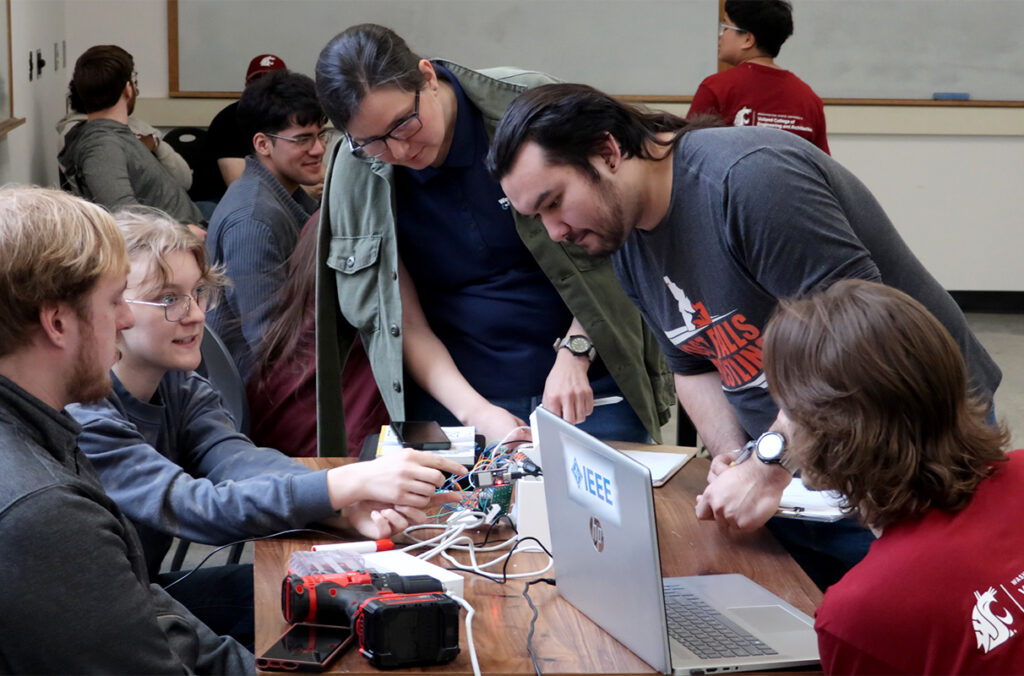
Photo: Fish reproduction group members include, Gary Throgaard, Doug Call, Dan Rodgers, Kevin Snekvik. (Photo by Bekcy Phillips)
Issues surrounding the question of salmon demise in the Northwest seem as murky as the Snake River during spring runoff. Is it because of the dams? The sea lions? Loss of habitat? What about household, pharmaceutical and industrial chemicals being dumped into the water?
The only clear point of agreement seems to be that the native salmon and steelhead populations of the Pacific Northwest are in danger — and efforts to restore them have not been entirely successful.
Hoping to help untangle this complex situation, a group of five WSU researchers has joined forces with scientists at the University of Idaho and the Northwest Fisheries Science Center in Seattle to form the Fish Reproduction Program through the WSU/UI Center for Reproductive Biology. Though members of the group have individual interests and projects, their collective research is poised to make much needed headway into understanding the basic science and immunology of fish.
Stress response
“People are making decisions concerning salmonid restoration without understanding the basic biology of the fish,” said Dan Rodgers, assistant professor in the Department of Animal Sciences. “Studies have shown that there is an intricate interplay between environmental stressors and their relationship to growth and reproduction in fish.”
Kevin Snekvik, clinical assistant professor in the Department of Veterinary Microbiology and Pathology and the Washington Animal Disease Diagnostic Laboratory, agreed.
“Not only do we need to look at the environment these fish live in, but also the biology and pathogens involved. When changes occur in the environment, it can lead to changes in the stress level fish will experience, which in turn may lead to changes in pathogen susceptibility. All of this is interconnected with immune function and the ability to fight off disease and parasites.”
Compared to mammals, the fish immune system is not well understood. According to Snekvik, there are many unknowns in the way fish respond to stress or to assaults by virus and bacteria.
For example, under stressful situations, Rodgers’ research revealed that myostatin — a hormone that inhibits muscle growth in fish — increases significantly, leading to loss of muscle mass.
Unlocking the genome
Over the past 25 years, Gary Thorgaard, professor in the Department of Biological Sciences, has cloned several lines of rainbow trout in an effort to determine the genetic basis of stress response. He explained that although conservation of wild salmonid populations is one of his goals, his research applies to fish farming and human medicine as well.
“We are making small steps toward the question of how the stress response differs — and is inherited — between hatchery fish and wild fish,” he said. “This is important because we want to raise fish for captivity that have a low stress response — while for re-establishing natural populations, we want to breed those with a higher stress response useful for avoiding predators.”
Working closely with Thorgaard, Ruth Phillips, adjunct research professor in the School of Biological Sciences at WSU Vancouver, recently received a $450,000 grant from the U.S. Department of Agriculture to expedite genome mapping of the Atlantic salmon and rainbow trout.
“We are trying to identify the genetic basis for desirable traits like growth, disease resistance … and immunity,” she said.
Potential economic impacts
Phillips sees a future for increased salmon farming in the Northwest.
“Salmon is really big in the market right now,” she said. “The U.S. is importing salmon from Chile, Norway and Canada. Raising a fast-growing strain of salmon in tanks and pools in Washington could be good for our economy and also be environmentally sound.”
Trout and steelhead are also important parts of the regional economy.
“Southern Idaho is the largest producer of trout in the U.S.,” said Doug Call, associate professor in the Department of Veterinary Microbiology and Pathology.
Call, together with Ken Cain at UI and Snekvik, is working to develop diagnostic tests and vaccines for bacterial infections, such as cold water disease, that affect many hatchery fish. The group recently developed a novel test suitable for identifying Flavobacterium, the causative agent for cold water disease. The team also is making progress on what it hopes will be the first commercially available vaccine for the disease, which could benefit both conservation and fish-farming interests.
Funding needed
Yet funding for these and the other research projects has been spotty.
“Right now, we are each seeking individual grants,” said Call. “The group framework is there but we just need the funding to push forward on these studies.”
Rodgers agreed: “If we can work together we may be able to actually do something to help restore the salmon runs — and we could have a direct impact on the economics of the Pacific Northwest.”
About the Fish Reproduction Program
To consolidate the work of scientists scattered across the Pacific Northwest, the Fish Reproduction Program was created through the Center for Reproductive Biology in the late 1990s. Faculty from WSU and the University of Idaho have teamed with researchers from the Northwest Fisheries Science Center — part of the National Oceanic and Atmospheric Administration — in Seattle.
Using an interdisciplinary approach, researchers are studying the basic biology of fish reproduction, hoping to identify conditions that may jeopardize survival. The group strives to provide information to aid officials making decisions affecting native salmonid stocks in the Northwest.
For more information please visit, www.nwfsc.noaa.gov/index.cfm, www.nmfs.noaa.gov, www.reproduction.wsu.edu.