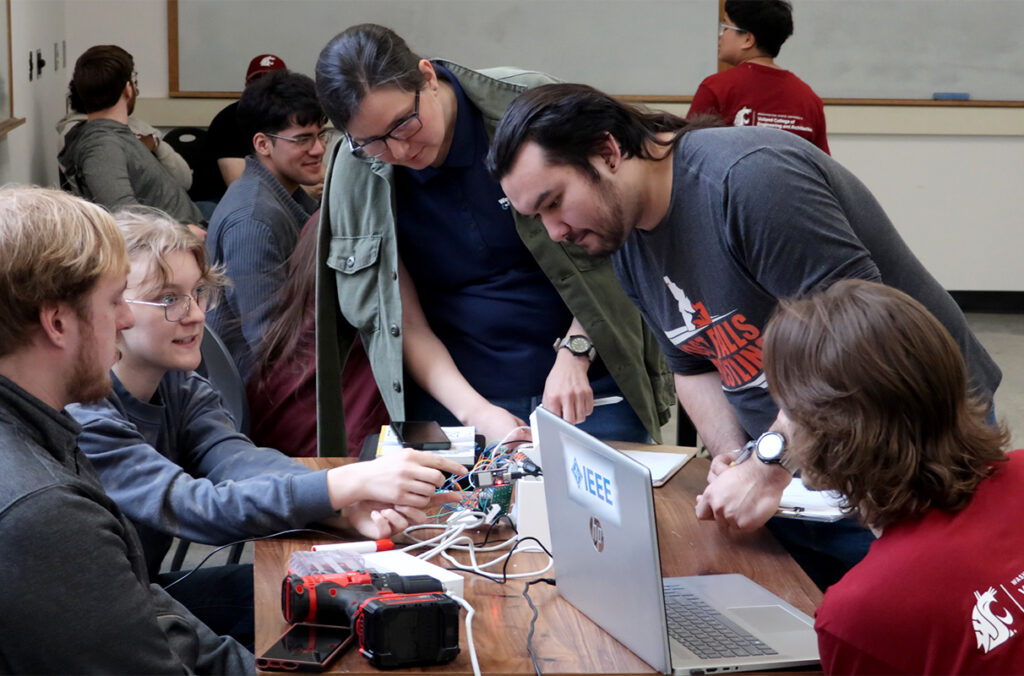
Five Washington State University vice presidents presented themselves to staff and faculty Sept. 24 to offer updates on their specific areas of oversight and to field questions. The Vice Presidents’ Forum was in part an effort to fulfill a goal of WSU’s strategic plan to improve internal communications.
Though some at WSU don’t always know what it is a vice president does, “if it weren’t done, you would know it,” said Sally Savage, vice president for University Relations, in her opening statement. To fit into the alloted lunch-hour time frame, the vice presidents kept their remarks relatively succinct:
Richard Frisch, vice president for University Development and president of the WSU Foundation, explained the foundation’s main jobs as securing private gifts for WSU and managing the assets of the university’s $180 million endowment.
His staff identifies prospective donors, cultivates relationships with them, asks for gifts and responds in many ways with thanks. A total of $48.8 million in gifts and private grants was received during 2002-03, the second highest in the foundation’s history.
Mary Doyle, vice president for Information Technology, said her staff is concerned with student and employee information systems, and educational telecommunications and technology such as WHETS, campus public broadcasting and the new portal, a single Web-based location for access to all WSU information.
Security has kept her staff busy with the recent string of virus attacks, Doyle said. She ended with the upbeat news that 15 buildings now have wireless capabilities as the process of installing such a system continues campuswide.
Charlene Jaeger, vice president for Student Affairs, reported a “booming year,” with the large incoming class of freshmen, increases in the amount of financial aid awarded and numbers of recipients, relocation of Multicultural Student Services under Student Affairs, and receipt of grants to help high school students in Washington prepare for college.
She welcomed new registrar Julia Pomerenk, and commended Al Jamison, associate vice president for Student Affairs, and Glenn Ford, associate vice president for Business and Finance, for their work as liaisons with academic, community and business interests.
Jaeger said her staff already is working to recruit the incoming class of 2004 and beyond.
The various Student Affairs outreach programs, Jaeger said, “are building a pipeline across the state to attract the students we want to draw to WSU.”
Greg Royer, vice president for Business Affairs, said his staff “runs the business part of the university,” such as construction, maintenance, facilities, utilities, purchasing, payroll and emergency services. “We collect all the money and pay all the bills,” he explained.
He highlighted how Business Affairs works in conjunction with areas represented by his colleagues, such as real estate and investments (with the WSU Foundation), city chambers of commerce (with University Relations), state-of-the-art buildings and technology (with Information Technology), and student housing, dining and recreation centers (with Student Affairs).
Savage explained that University Relations focuses on two main areas: external relations and internal communications. Working to advance WSU’s strategic plan, her staff focuses on “uniting the university community around the plan, while also communicating the plan and its goals to external communities.”
In answer to a question about progress of the Implementation Council, which oversees the teams working on the four goals that comprise the strategic plan, Savage said the council was set to meet later that week for the first time this year. She expressed confidence the teams had each identified at least five or six things to work on, adding that the Vice Presidents’ Forum was the result of a team recommendation.
Reiterating the importance of internal communication, Savage invited WSU staff with suggestions for improvements to e-mail her at savage@wsu.edu.