March 31 – June 27
Tuesday through Saturday, 10 a.m. to 4 p.m.
Closed Sunday, Monday
In 2016, the museum commissioned Trimpin, a ground-breaking composer and sculptor, to design and create a major new work for the WSU community. Ambiente432 debuted at the inauguration of the Jordan Schnitzer Museum of Art and has now entered the museum’s permanent collection.
Comprised of 12 motion-responsive resonator horns suspended from the ceiling and organized in strategic configurations, this site-responsive installation explores the sound-space continuum, demonstrating how an architectural environment may coexist and harmonize with a kinetic sound sculpture. Trimpin’s installation combines ancient methods with scientific principles and 21st century technology. Ambiente432 is tuned precisely to 432Hz. Known as Verdi’s ‘A’, this vibration frequency recurs in the tuning of ancient Tibetan singing bowls, Stradivarius instruments, and 20th century physicist W. O. Schumann calculated the Earth’s rhythms at a cycle close to the fundamental frequency of 432Hz. Ambiente432 is ‘played’ by visitors themselves as they move through and activate the space, impacting their own immersive spatial and aural experience.
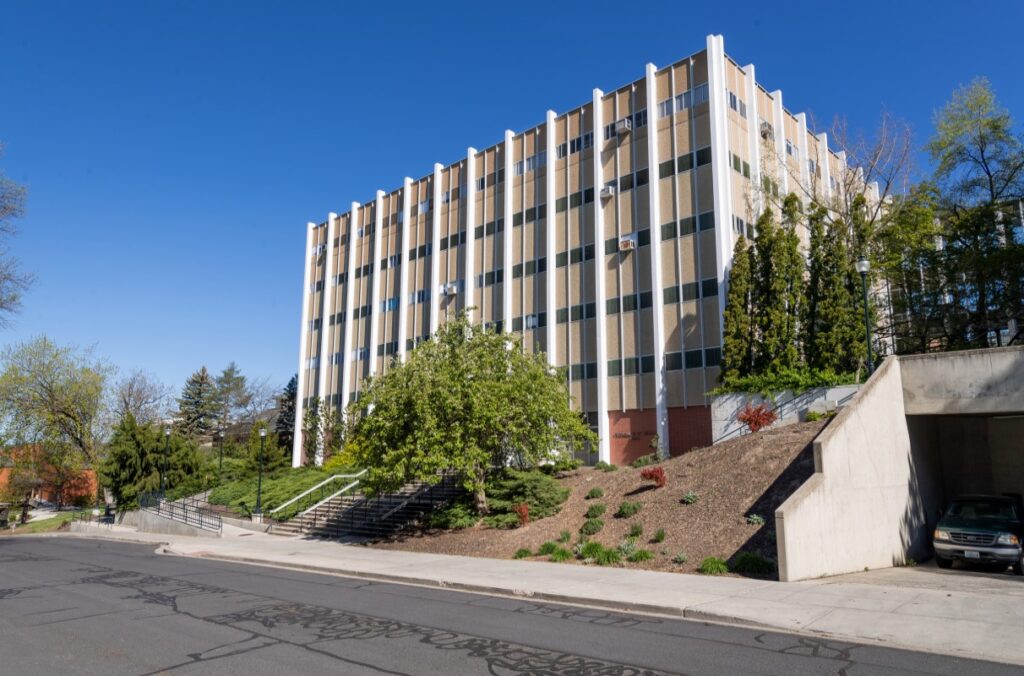
Location: The Jordan Schnitzer Museum of Art WSU is located in the Crimson Cube (on Wilson Road across from Martin Stadium and the CUB) on the WSU Pullman campus.