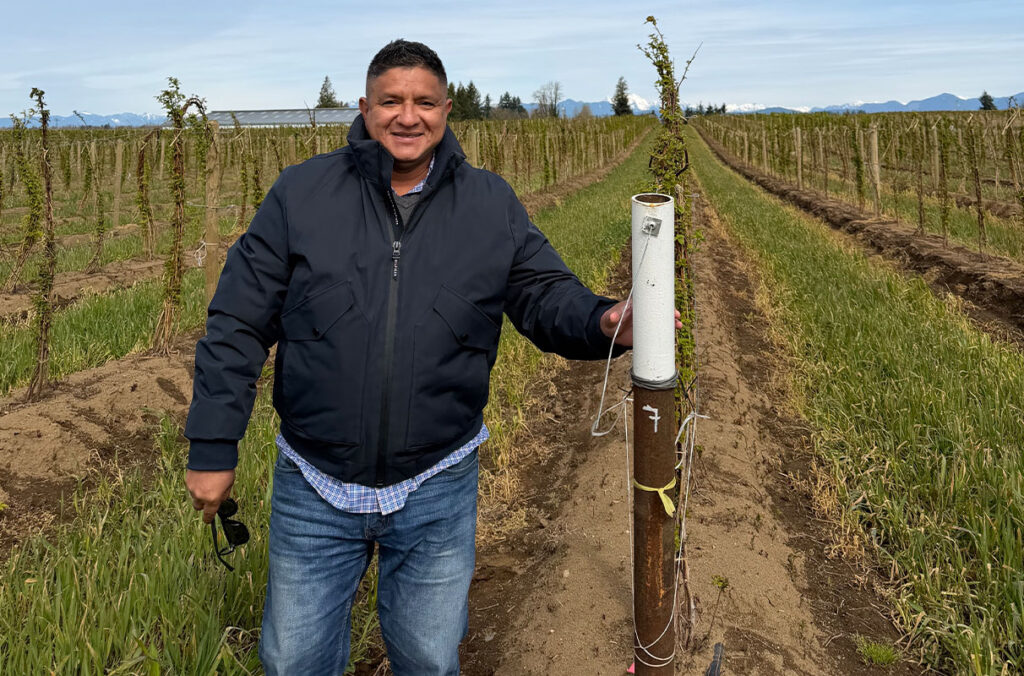
PULLMAN – Scientists at WSU, Oregon State University and the University of Idaho want to take a long-term look at dryland agriculture and ways to sustain it in the Northwest’s interior. Their goal is to establish a single coordinated project to share expertise, research sites and computing power available from the three institutions.
The research would study farming’s effects on soil carbon and other environmental concerns that may be affected by climate change and other factors.
To map out a long-term agricultural project focused on non-irrigated wheat and other cereal crops, the team received a U.S. Department of Agriculture grant for $200,000. If approved, the plan would lead to a multi-million-dollar, decade-long project that would begin in about two years.
“This project will allow us to establish a comprehensive, multidisciplinary, long-term approach to sustaining agricultural productivity and the economic well-being of the entire region,” said Sanford Eigenbrode, a UI entomologist who will lead the project to design a long-term monitoring network.
 |
 |
| Kok | Pan |
The team leadership includes Hans Kok and Bill Pan of WSU; Susan Capalbo and Steven Petrie of OSU; and James Gosz, Jodi Johnson-Maynard and J.D. Wulfhorst of the UI.
“The regional project will build on the collaborative momentum established by the USDA-funded STEEP or Solutions to Environmental and Economic Problems research and educational program,” Eigenbrode said.
If funded, the Interior Pacific Northwest Long-term Agricultural Project would become part of a new network of similar projects to be initiated throughout the U.S., patterned after the National Science Foundation’s Long-term Ecological Research network.
That network includes just one site, Michigan State University’s W.K. Kellogg Biological Station, devoted to the study of agro-ecosystems. The new network will address the need to extend the research infrastructure to include the diversity of U.S. agriculture.