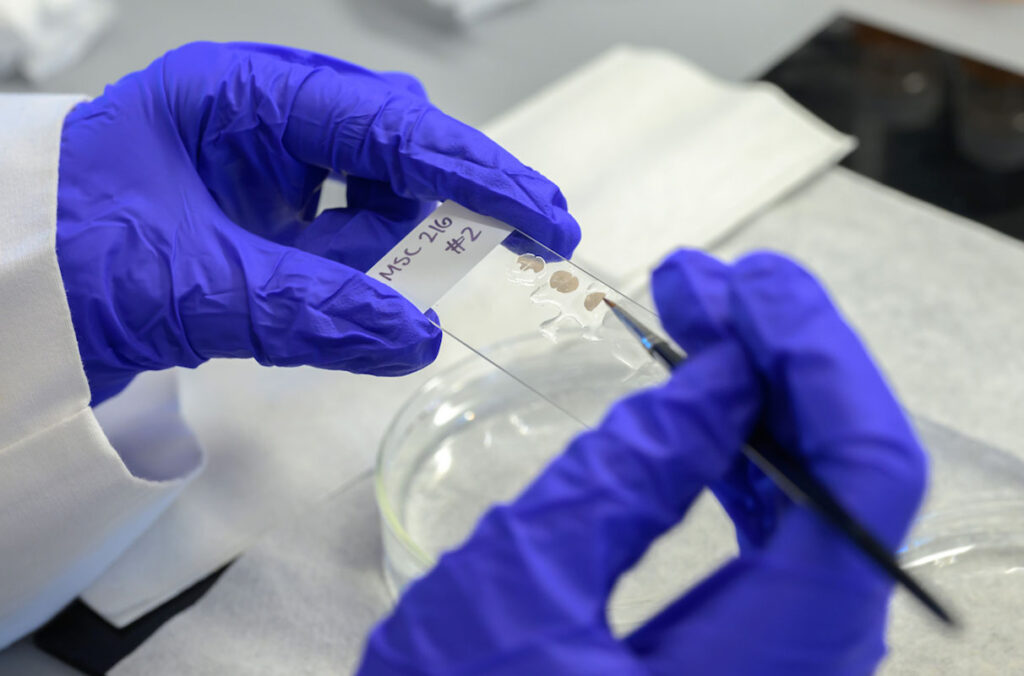
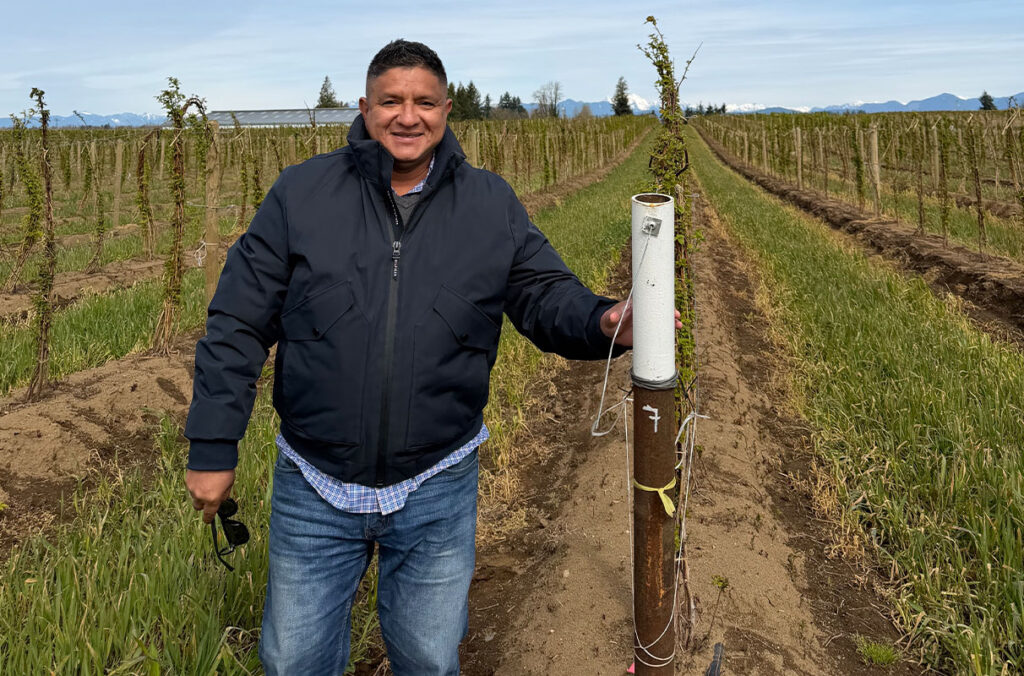
The first four photos show mint; the final two show hops affected by powdery mildew.
PROSSER – Working with commercial mint growers in Washington State a few years ago, a group of WSU researchers noticed something interesting: when a seasonal drought decreased the water available for irrigation, the water-stressed mint plants were shorter than usual, but they yielded the same amount of oil.
Now, with a $3.1 million USDA grant from the Specialty Crop Research Initiative, a nine-member team of WSU researchers led by entomologist Doug Walsh will be studying that phenomenon to determine how reducing water intake also called deficit irrigation affects weed control, pest control, the plant’s physiology, flavor quality, yields and production costs, for both mint and hops, two specialty crops that are important to Washington State agriculture.
Integrated research
Walsh, who works at the Irrigated Agriculture Experiment and Research Center in Prosser, said early research indicates deficit irrigation has great promise for mint, and could be a boon for hops as well. Because the grant required matching fundsand neither the mint industry nor the hops industry are large enough to fund large-scale research projects independently it made sense to write a grant that would fund research on both crops.
Walsh’s collaborators include weed scientist Robert Parker; AgWeatherNet director Gary Grove; biological systems engineer Troy Peters; food scientists Kerry Ringer and Carolyn Ross; economists Karina Gallardo and Tom Marsh; and sociologist Jane Sherman. The grant money will fund two graduate students in economic sciences, one in food science and one in biosystems engineering, Walsh said.
Ann George, administrator of the Washington Hops Commission, said her growersabout 40 in allare excited about the holistic approach to the research. “We’ll finally have the opportunity to put together an integrated research program,” she said. Even though their industry group is small in comparison to Washington apples or potatoes, Washington produces about 75 percent of domestic hops and about 25 percent of the world supply. “We play tag team with Germany,” she said, vying to be the top exporter of hops worldwide.
Rod Christensen, executive director of the Washington Mint Commission, said his industry group was equally excited about the USDA grant. “Our small commission couldn’t afford to do this research without the grant,” he said.
Half of mint in U.S.
Small but productive. Washington growers produce about half of all mint grown in the United States and because of its high quality, it is in demand around the world. Christensen said between 85 and 90 percent of the mint oil goes to three companies: Colgate, Wrigley’s and Proctor and Gamble.
Because the majority of mint is used to flavor oral hygiene products and chewing gum, with a smaller market in candies, the demand for mint is fairly inelastic. If the supply is greater than demand in any particular year, the price can drop precipitously, he said, which is why careful market analysis and controlling costs is so important.
Stress and flavor
Walsh said it is important to have a transdisciplinary team because changing the water intake will have a big impact on plant stress, pests, weeds and, potentially, the flavor of the crop. Besides looking at the economic sustainability of the crops, Walsh said, the team also wanted to look at the sociological sustainability of the crop.
“Farming is risky,” he said. “If we can mitigate some of the risk, will farmers feel better about farming?”
“The whole idea is to help the farmer, and I think we’re going to do that,” Walsh said.