SPOKANE You’re in a classroom. The teacher puts the test on your desk. You start to sweat as you realize you’re completely unprepared. For students taking their first college math course, that familiar bad dream is sometimes close to reality.
The Riverpoint Partnership for Math and Science is trying to prevent the anxiety for college freshmen and set them on the road to success. Composed of faculty from the WSU College of Education, as well as Spokane-area high schools and colleges, the partnership is working to implement the state’s new College Readiness Standards in mathematics.
“All kids can achieve the college standards,” said Kris Lindeblad, a 32-year veteran of teaching hired to serve as math director for the partnership. “It’s our shortcoming if we don’t get them there.”
The partnership started in 2007. It is funded primarily by the state Higher Education Coordinating Board, which recently provided a second grant for a total of $371,911. Another $38,321 was provided by the multi-agency Transition Math Project (TMP).
Assistant professor Janet Frost heads the partnership effort this year. Also involved in planning and facilitation are Tariq Akmal and Joan Kingrey of the WSU faculty, and others.
Frost is especially pleased about the addition of the TMP grant to the budget for the project, which allows college math faculty to collaborate on their own professional development.
According to the TMP, almost one-third of Washington students graduating from high school begin their higher education experience in two-year colleges. Of those students, 45 percent take pre-college (remedial) math in their first year. In comparison, 22 percent of all college students need help catching up.
Frost and Lindeblad lead four two-day professional development sessions for 30 high school math teachers and 10 college instructors.
As a means of learning what the students understand and misunderstand, the high school and college teachers are using a common problem that college-ready students should be able to do, Lindeblad explained.
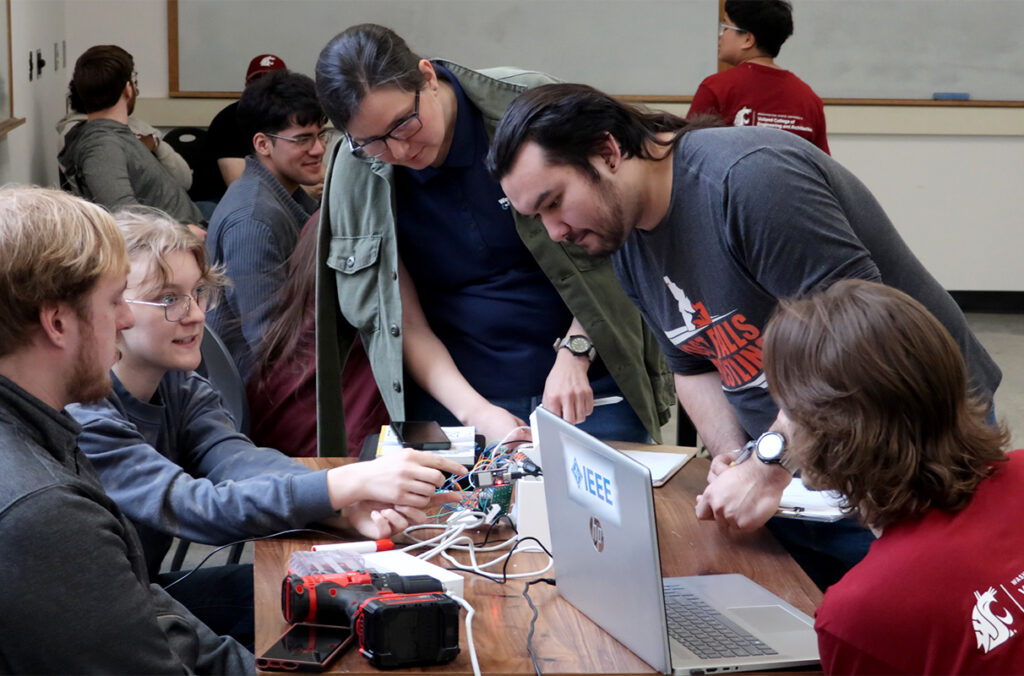
At a recent session, the faculty-turned-students gathered around tables at the Spokane Skills Center. It was clear from the lively conversation that everyone enjoyed the chance to network. It’s rare, said Frost, for college instructors and high school teachers to have the chance to learn from each other.
The WSU faculty members are learning, too. As part of her research, Frost regularly videotapes lessons in the classrooms of math teachers, including that of Briana Driscoll of Spokane’s Rogers High School.
Before participating in the partnership, Driscoll said, she wasn’t well versed in the College Readiness Standards and rarely checked to be sure that what she was teaching aligned with them.
“The standards are now very much in the forefront of my mind when I plan each unit and each lesson,” she said. She makes some lessons more challenging and sometimes incorporates new problems.
Challenging and preparing all students
The goal of the Riverpoint Partnership is to infuse Driscoll’s approach and enthusiasm throughout the educational system. Lindeblad envisions all students taking challenging high school math classes and being ready for college admission.
“Maybe 65 percent of our kids in high school didn’t go past geometry in the past,” Lindeblad said. The higher-level math courses used to be a filter, she said, keeping poor performers out of college. Now, math is looked at as a pump a way of thinking and a type of achievement that pushes all students forward.
Besides WSU, member of the partnership include Jim Brady of the Community Colleges of Spokane, Ron Dalla of Eastern Washington University, Rick Biggerstaff of Spokane Public Schools, Tammy Anderberg of Central Valley’s University High School, Shelley Wogman of Spokane Falls Community College, and Erik Wolfrum of Educational Service District 101.