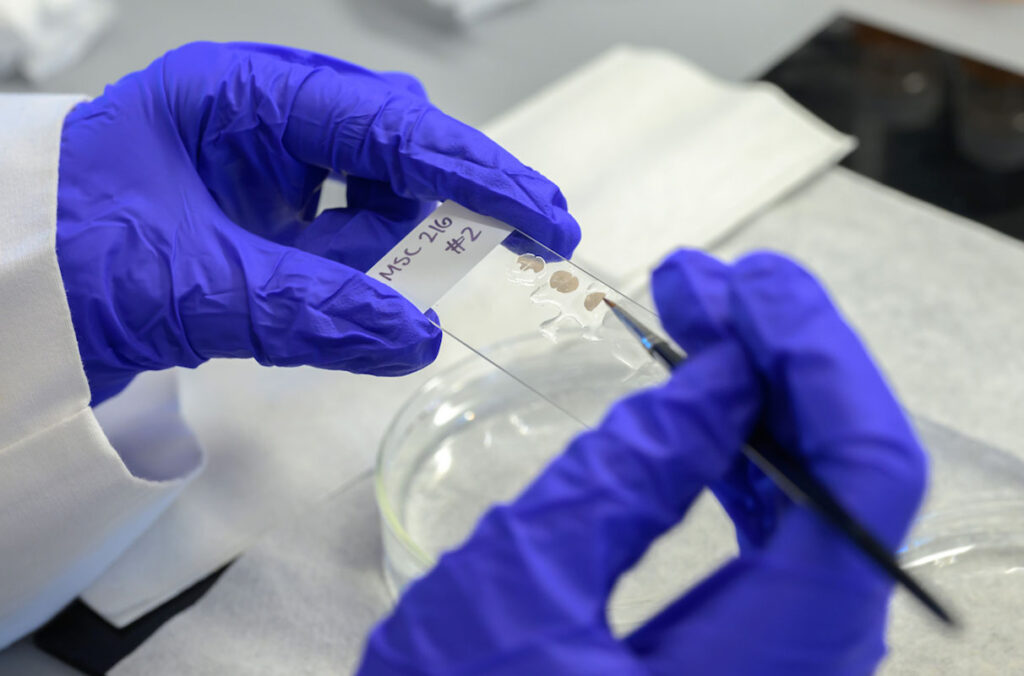
A postdoctoral research associate in WSU’s
Her photographs have been featured on the covers of four national scientific journals since 2005. Not bad results for someone who had rarely used a camera before 2002. In the future, Patten hopes to continue her career using microscopy and photography.
“It has turned out to be a skill I can use and am good at,” she said. “This type of imaging can be an effective means of communication both within the scientific community and to the general public.”
“It’s a relatively rare form of recognition,” said her mentor, Norm Lewis, director of WSU’s
The scientific value of the pictures adds to their beauty. They show the presence of thick gelatinous fibers in the alfalfa cell walls, called reaction wood. Some plants naturally form reaction wood to enable their stems and branches to maintain an upright position in different environments.
Patten’s photos revealed that plants may produce more reaction wood as a way to compensate for loss of lignin, a woody substance which, together with cellulose, gives support to most vegetation. Both lignin and reaction wood stand in the way of efficient production of biofuels.
Lewis’ research is part of the U.S. Department of Energy’s bioenergy initiative, a consortium of three bioenergy research centers seeking to develop technologies that facilitate cellulose-to-ethanol production and other biofuel processes. The goal is to replace 30 percent of
Through genetic engineering, Patten and Lewis already have reduced the amount of lignin in a variety of plants, but in most cases they have also encountered various degrees of structural defect.
“We are trying to determine a tolerable range of genetic manipulation in order for the plant to maintain a healthy structure,” said Patten.
“Our goal is not to make plants with osteoporosis,” added Lewis, “but to find ways to change the growth and development of plants … to help them be more easily processed.”
The reaction tissue shown in Patten’s photographs is common in woody plants but had never before been reported in a forage crop species. The alfalfa plants she studied — which had been genetically altered to contain 64 percent less lignin — not only showed structural strength similar to normal plants (they were able to hold up their branches) but they did so by producing greater quantities of reaction tissue early in their growth. This suggested, for the first time, an unintended side effect of lignin reduction in certain plants.

Journal of Botany June 2007


Alfalfa reactions

Lycopodium