Looking for experts on “back to school” stories?
Math isn’t What it Used to be, Moms and Dads
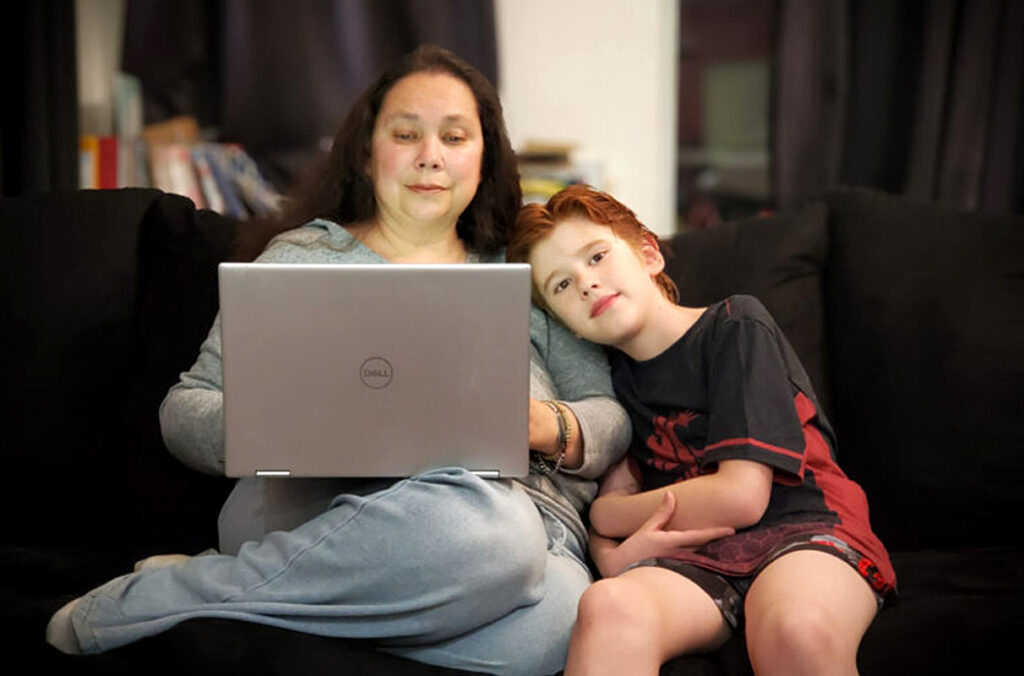
Parents who sit down to help their children with math homework may be frustrated, because mathematics instruction has changed since they were in school. Back then, lessons focused on memorizing facts and following specific steps to answer problems. Students who could quickly compute were considered to be good at mathematics even if they did not understand what they were doing or why, said Amy Roth McDuffie, associate professor of education at Washington State University (WSU) Tri-Cities.
“We are still concerned that students learn to be fluent with facts and computations, but we also emphasize learning with understanding,” said McDuffie. “Today’s society is focused on solving new problems, working with an increasing amount of information, and utilizing technology. So, it does not make sense for students to spend endless instructional hours performing numerical calculations without being able to relate mathematics to real life and apply mathematics to novel situations.”
She recommends that parents be open to new approaches and perspectives. “Ask your child to explain how he or she thinks about a problem, how he or she might approach a problem, and why the solution is reasonable or makes sense.” For other ideas, she suggests that parents go on-line to www.nctm.org and click on the section for families.
McDuffie conducts research and works with teachers to develop instructional strategies for teaching mathematics that focus on students’ thinking, approaches and ways of understanding mathematics. She can be reached at 509-372-7384 or mcduffie@tricity.wsu.edu.
Professor Urges Parents to Snoop into Kids’ Digital Identities
With the explosion of social networking among high school and college students in the past two years, parents might be asking themselves what exactly their kids socialize about and what persona their child creates on sites like MySpace.com and Facebook.com.
Eric Anctil, an assistant professor at WSU, suggests parents find out for themselves by signing up for a MySpace or Facebook account and seeing their child’s profile for themselves.
“All it takes is an e-mail address to join,” he said. “Parents have every right to invade their kids’ ‘private social world’ online. The idea that a child should be able to post a whole identity online and their parents not know what it reveals is ridiculous.” Anctil said that, “We would never let strangers walk though our house or let our children give away personal information to just anyone they meet on the street. The same rules should apply online.”
Anctil suggests parents talk to their children about social networking. “Many kids don’t realize how much of what they put online is really private information.” He also cautions that cell phones are the networking device of choice for teens. “Limiting computer time is only part of the equation,” he said. “Be sure to keep tabs on you child’s cell phone use as well. Private information can be shared in many ways; the best advice is to be proactive.”
Anctil conducts research and policy analysis on the relationship between K-20 education and media. He can be reached by phone at 509-335-7214 or e-mail, ejanctil@wsu.edu.
What Makes a Good Principal?
Len Foster, associate dean in the WSU College of Education knows what makes a great principal. Foster has analyzed exemplary middle school and high school principals to see what traits they share.
Some of the qualities needed by school principals today include visionary leadership, commitment of time, entrepreneurial spirit, instructional leadership, accountability and culturally-proficient leadership.
“Principals need to embody all of these qualities,” Foster said. “It’s a huge challenge, and that may be causing talented people not to choose this job. It requires a high level of commitment.”
For more information, contact Foster at 509-335-2771 or lenf@wsu.edu.
School Counselors Can Bolster Student Success
Children who have troubled home lives, lack school supplies or aren’t eating enough may find it especially hard to pass annual state tests that determine whether they can advance and, ultimately, graduate from high school. Those are the kind of social problems that school counselors can help identify, said Tina Anctil, assistant professor in the WSU College of Education.
Anctil is working with school counselors, mostly in
Anctil coordinates WSU’s school counseling program and the field placement component for the master’s in counseling program. Her own research is centered on social justice issues of children and adolescents, including those in foster care, and racial and ethnic minority populations. She can be reached at 509-335-2925, or by e-mail at tmanctil@wsu.edu.
When children do poorly in their schoolwork, how are teachers to know if those students are slow learners, or have learning disabilities that could be overcome with some help? The question is at the heart of research done by Michael Dunn, an assistant professor at WSU-Vancouver.
For a long time, Dunn said, students weren’t tested for possible disabilities until they were in fourth grade, using a rough method that involved comparing the results of IQ and academic tests. Now, many schools check students as early as kindergarten with a more sophisticated process called “Response to Intervention,” or RTI. How well is it working? Earlier this year, Dunn asked that question of some
Dunn also studies ways that story writing can be used to help children with learning disabilities. He can be reached at (360)546-9662 or miwdunn@msn.com. For more information about Dunn’s work, see https://www.vancouver.wsu.edu/fac/dunnmi/index.htm.
WSU Faculty Help Teachers Help
Each Other
Teachers who receive the necessary support in working together to improve math and science instruction are likely to change their practice, become more excited about their profession, and conduct more focused and student-centered lessons. That is what three
Professors David Slavit, Tamara Nelson and Anne Kennedy headed the Partnership for Reform in Secondary Science and Mathematics (PRiSSM), a professional development project in six southwestern
With support from the WSU faculty, the teacher groups developed and worked toward a common vision of high quality teaching and learning. The teachers reported increased collaboration, more focused instructional goals, and targeted support in mathematics and science areas in need of special attention. Using nearly $2.5 million from two federal grants, the WSU researchers are working to sustain and study the impact of PRiSSM.
For more information, contact David Slavit, associate professor of mathematics education, 360-546-9653, dslavit@wsu.edu.
WASL Science Kits for Junior High Schoolers
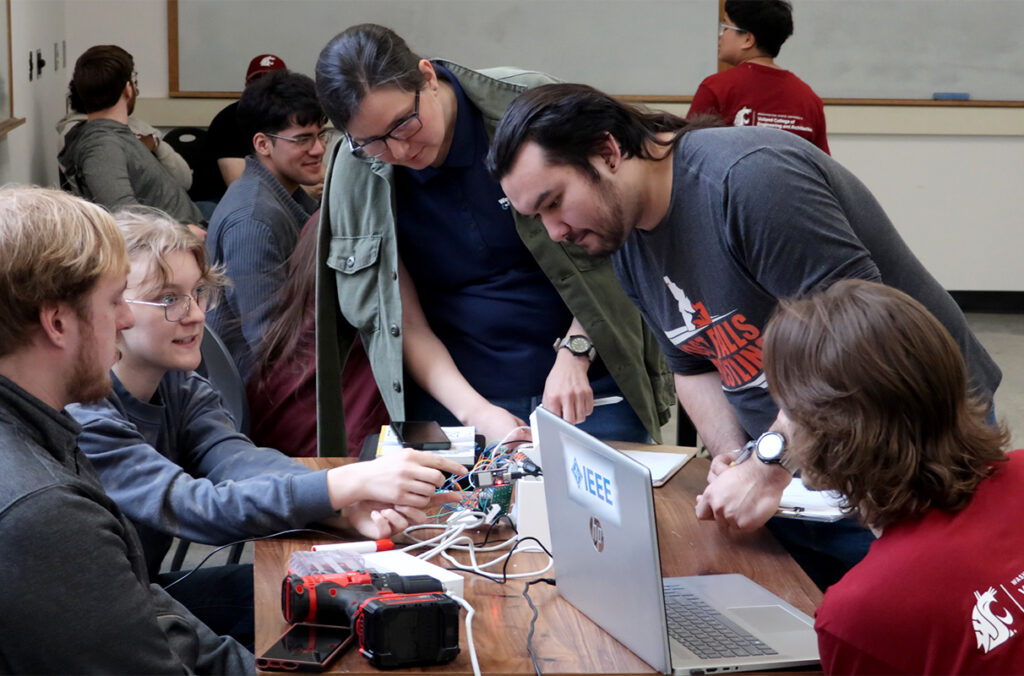
A group of WSU students will be preparing mini science kits to help junior high school students get ready for next spring’s Washington State Assessment of Student Learning (WASL) test.
WSU’s student chapter of Material Advantage received a grant from ASM International, one of the professional materials societies, to introduce junior high school students to materials science and to help get them prepared for their science WASL tests. WSU was one of only five schools nationwide to receive the $800 materials society’s grant award, which supports educational outreach activities in materials science.
The kits will provide students and teachers with materials such as metals, polymers, composites and ceramics. The students will test and characterize materials based on their density, magnetism, optical properties, electrical properties and how they withstand loads. The experiments they conduct and the concepts studied are all topics covered on the physical science WASL tests.
Dave Bahr, professor in the