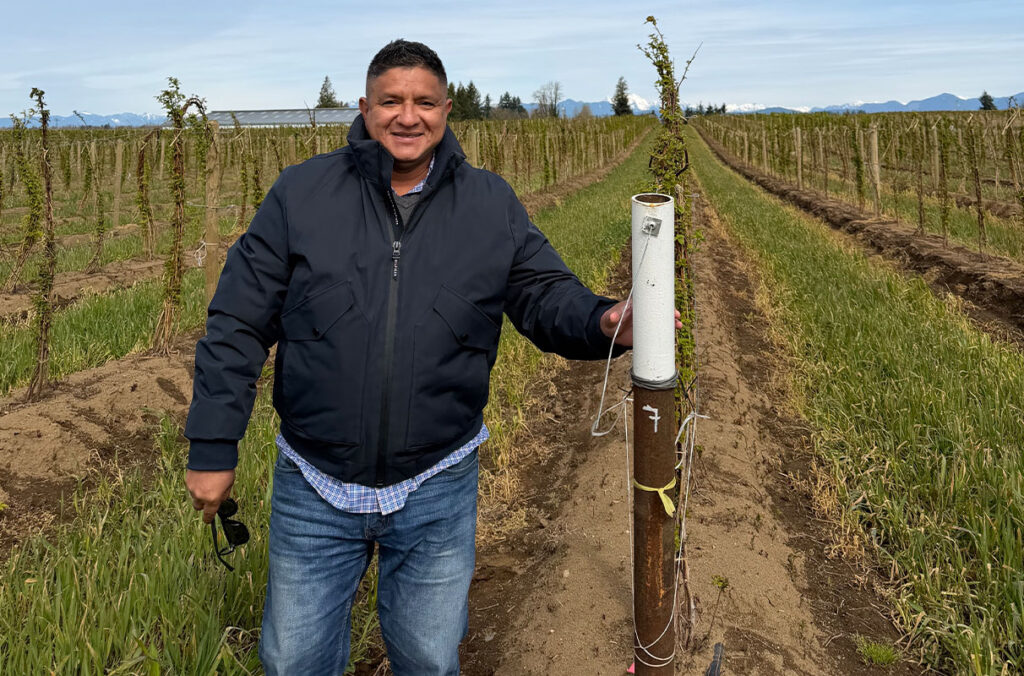
Adrian Rodriguez-Marek.)
Led by Adrian Rodriguez-Marek, associate professor in the Department of Civil and Environmental Engineering at Washington State University, the researchers took data on the earthquake’s effects on soils in the affected area. The earthquake, which had a magnitude of 8.0, occurred on August 15 with the epicenter near the town of Chincha Alta, Peru. More than 500 people died and more than 1000 were injured.
The reconnaissance trips are important, from the point of view of geotechnical engineers, to gather information on soils’ behavior after an earthquake, Rodriguez-Marek said. The science of soil mechanics is complex, so that empirical evidence is necessary to improve models of their behavior. Detailed mapping and surveying of damaged areas provides the hard data of the well-documented case histories that drive the development of many of the empirical procedures used in practice, he said.
“The observation of failure is very important in order to feed our analysis,’’ he said. “We can use field histories to calibrate our design methods, and these procedures have the ultimate objective of mitigating damage.’’
The researchers usually travel to earthquake sites within a week of the event. The soils research must be done quickly because soil evidence can change quickly due to rain or rescue and clean-up efforts.
In the case of the Peru earthquake, Rodriguez-Marek believes that the researchers will eventually gain particularly valuable insight into the phenomenon of liquefaction. In an earthquake, sandy, loose soils can start behaving like liquids. In Peru, the researchers noted where some homes had sunk up to a meter in the liquefied sand while next door, buildings were intact. The researchers collected data on the examples of liquefaction for possible further study.
The work is also valuable because Rodriguez-Marek will take his research directly back into the classroom. In civil engineering classes, he teaches students how to predict where liquefaction will happen, based on the soil types and type of earthquakes that occur. Students also learn ways to possibly improve soils to prevent the phenomenon. Seeing a photo of a house gobbled up by liquefaction, however, can be significantly more attention-grabbing than a long list of equations explaining it, he said.
Rodriguez-Marek also participated in the reconnaissance of the 2001 Nisqually, WA, earthquake, and led the NSF teams to the 2001 Southern Peru earthquake and the 2003 Tecomán, Mexico earthquake.
More information on the trip is available at https://gees.usc.edu/GEER/Peru_2007/Peru_2007_WebPage/index.htm