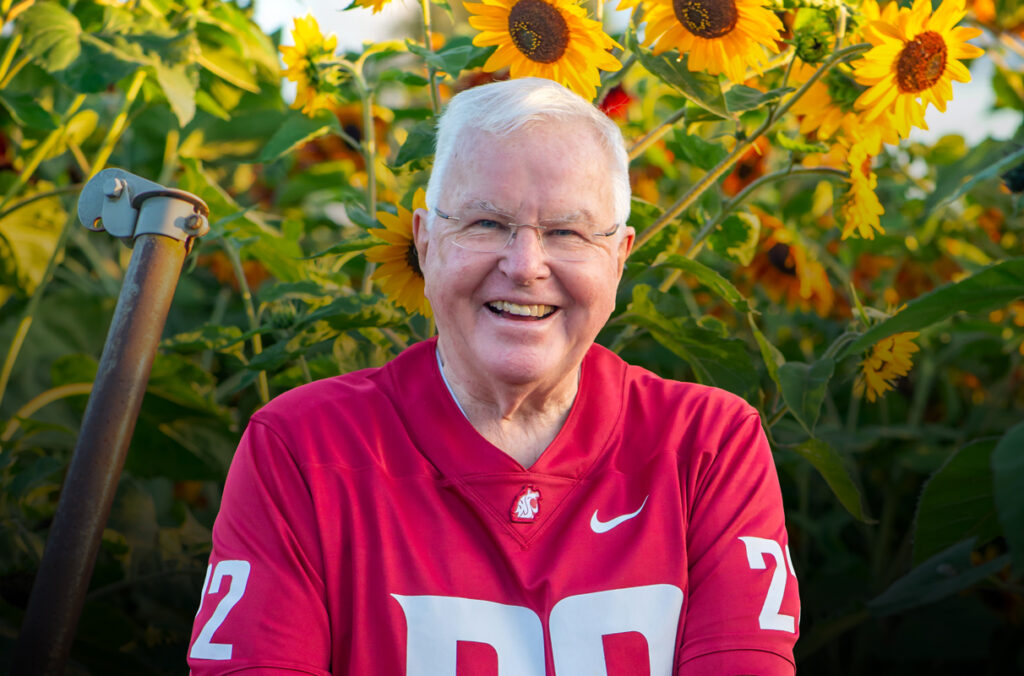
President V. Lane Rawlins authored an editorial article that appeared April 28 in the Puget Sound Business Journal (Seattle) titled ”Historical follies and education’s starvation diet.”
Rawlins begins by pointing to a historic pattern in which governments often pursue “policies contrary to their own interests.” He also refers to a 1985 book by historian Barbara Tuchman, “The March of Folly,” which includes historical accounts of societies that stayed on destructive courses despite widespread understanding of the problem
So begins the “The March of Folly,” by popular historian Barbara Tuchman.
We need to increase the numbers of students prepared to pursue higher education and expand our capacity to serve them. That will require hard decisions about standards and budgets. We have read the reports that we are not addressing critical needs. The unanswered question is whether our society can change direction when we know the negative consequences of where we are headed.
In short, can we avoid our own march of folly?
“A phenomenon noticeable throughout history regardless of place or period is the pursuit by governments of policies contrary to their own interests.”
So begins the “The March of Folly,” by popular historian Barbara Tuchman. This challenging book, published in 1985, includes historical accounts of societies that stayed on destructive courses despite widespread understanding of the problem. Tuchman recognized that when a society develops certain habits, changing directions takes enormous collective effort.
With the gift of hindsight, readers of Tuchman’s book can understand exactly how misguided these leaders were. But recognizing the phenomenon is one thing; avoiding it is quite another.
Recently, we have seen a spate of reports and alarms about the state of our education system. They are only the latest and loudest response to trends that go back nearly two decades.
We long have known that American children do not perform as well as European or Asian children in standardized tests for mathematical skills and scientific knowledge, and that they fall further behind with each year of school. Across the nation, the number of American-born students completing college degrees in science and engineering is declining, while these numbers are exploding in other parts of the world.
Meanwhile, the federal government cuts student aid. Visa policies discourage the best and brightest from other nations from studying and staying in the United States. In the state of Washington, rather than providing incentives for our best students to continue their education, we are shifting costs to them with higher tuition and fees. And while the cost of building and maintaining modern science and engineering laboratories is growing at double-digit rates, public budgets for capital in higher education have remained fixed for over a decade.
Our state’s economy is built on research-intensive industries — engineering, health care, computer science and agriculture. Those industries must be supported by a high-performing educational system.
But the National Center for Public Policy and Higher Education, in its most recent educational report card, reports that for every 100 high school freshmen in Washington, only 68 will graduate from high school on time, 30 will immediately enter college, 22 will still be enrolled sophomore year and 15 will graduate from college on time. The comparable national figures are nothing to brag about — 68, 40, 27 and 18, respectively — but Washington is below the national average by three measures and tied in the fourth.
Why is that important? Thomas Friedman’s book “The World is Flat,” a fixture on best-seller lists for months, cites such evidence to reach alarming conclusions about how America will fare in the future. After establishing that location is no longer a significant advantage in producing high-value commodities and services, he examines the conditions that America must meet to maintain a dominant economic position. He gives appropriate attention to innovation and concludes that, for us to compete successfully, America must put far greater emphasis on education. He is emphatic about the need for more rigor and a larger number of qualified graduates from colleges and universities.
Hot on the heels of Friedman’s book came “Rising Above the Gathering Storm,” a report from America’s most prestigious scientific organizations: the National Academy of Sciences, National Academy of Engineering and the Institute of Medicine.
The report documents in great detail, for example, how the production of scientists and engineers in America pales in comparison with nations such as India and China. The report predicts economic doom unless we can make major changes, including increasing both the quality and quantity of mathematical and scientific education. Recommendations include higher standards for students, better preparation for teachers, incentives to students and teachers who develop their mathematical and scientific capacities, and a major investment in higher education. The price tag is significant, but the stakes are high.
Across the nation, commissions are addressing apparent deficiencies in education, current and projected. At a recent meeting of Washington Learns, the governor’s education reform panel, Gov. Chris Gregoire said that state schools are not preparing students adequately for the global marketplace and that major reforms in the education system, from preschool through higher education, are needed. Washington Learns is expected to report its recommendations late this year.
We need to increase the numbers of students prepared to pursue higher education and expand our capacity to serve them. That will require hard decisions about standards and budgets. We have read the reports that we are not addressing critical needs. The unanswered question is whether our society can change direction when we know the negative consequences of where we are headed.
In short, can we avoid our own march of folly?
V. LANE RAWLINS is president of Washington State University.
https://seattle.bizjournals.com/seattle/stories/2006/05/01/editorial4.html