When WSU Vancouver admitted a freshman class of 157 students for the first time this fall, the changes went far beyond adding additional classes and parking spaces.
“There is an energy on our campus that is hard to articulate but that you can definitely feel,” said Nancy Youlden, vice chancellor for student affairs.
“There’s just a lot more excitement,” agreed senior Darren Benson, 24, who worked with the summer freshman orientation program and now works with Student Involvement.
Some say you can see the change as well.
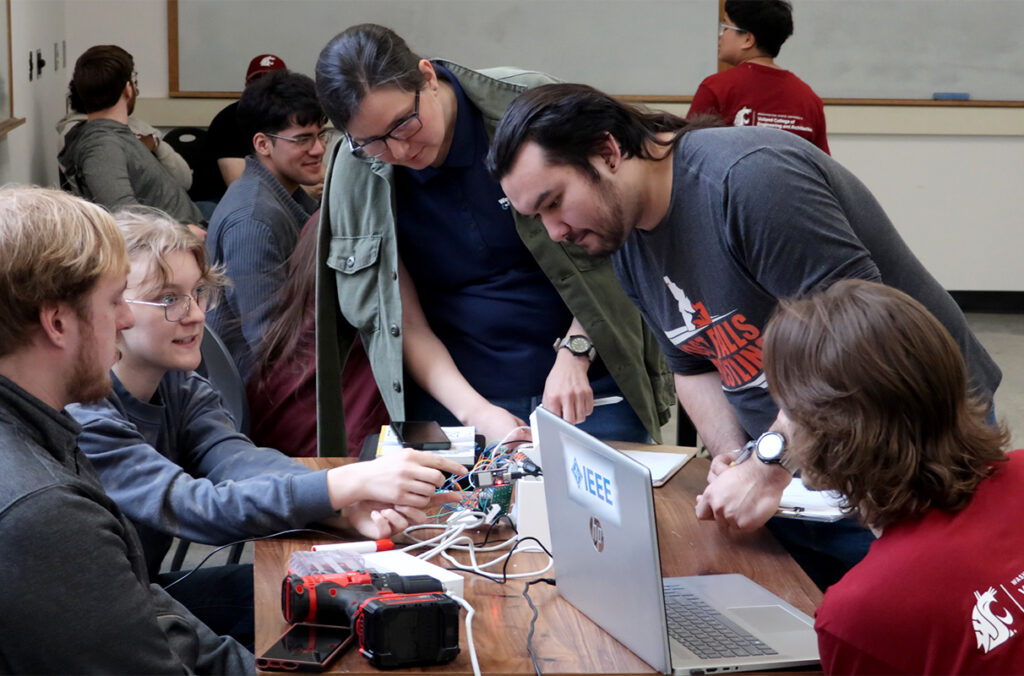
“The biggest difference is that they are on campus more,” said Robert Cox, director of Student Involvement. Apparently less burdened by family obligations or jobs than their upper-division peers, this new cohort is more active in extracurricular activities, Cox said, from student clubs to intramurals to adventure trips.
Not a default
WSU has been offering upper-division classes in southwest Washington since 1983. A branch campus was established in 1989 and WSU Vancouver opened at the Salmon Creek location in 1996. But this is the first semester that lower-division classes have been offered. In addition to the freshmen, the university also enrolled 207 sophomores.
According to fall enrollment figures, the lower-division students joined 612 juniors, 595 seniors and 507 graduate students. An additional 218 students are doing either undergraduate or graduate work unrelated to a degree. Total campus enrollment is 2,329.
In previous years, the average student age at WSU Vancouver was about 30, but this new class of freshmen averages 19 years and has an average GPA of 3.52, making it very similar to Pullman’s freshman class.
“It’s clear to me that students who had other choices chose to come here,” said Youlden. ”They picked this campus; it wasn’t a default.” In fact, according to an internal survey, for nearly 40 percent of incoming freshmen, WSU Vancouver was the only university to which they applied.
WSU Vancouver offers 14 bachelor’s degrees, nine master’s degrees and one graduate degree in 35 fields of study. The most popular programs among freshmen this year are biology, business administration and mechanical engineering.
Global theme in gen ed
Since everything is new, anything is possible, and no where is that more apparent than in general education.
“We had a rare opportunity on our campus to look at general education,” Youlden said, and faculty members across campus were engaged in the process.
“We spent a lot of time as faculty looking at best practices,” said Candice Goucher, director of undergraduate studies. One huge piece of the general education program is establishing and promoting coherence, she said. To that end, there is a campuswide theme that every core course must reference in some way. This year, that theme is “Global change in a local context.”
Not only must courses link to that theme, but core courses must link to at least one other core course. In addition, faculty must make explicit connections to WSU’s Six Learning Goals of the Baccalaureate.
“If students are sitting in a classroom, they know why they are there,” Goucher said. “The learning goals are front and center.”
Another innovation implemented this year is the establishment of a core text that is distributed to freshmen before classes start and is then discussed as part of freshman orientation as well as later in core classes. This semester that text is “The Undercover Economist” by Tim Harford.