Students participating in a new National Science Foundation’s Research Experience for Undergraduates this summer will be eating, drinking, and sleeping their research. Literally.
The students in engineering and computer science will be working to build a “smart’’ apartment that some of them will live in as part of their research projects relating to the development of “smart’’ environments. The two-bedroom apartment will be in the Steptoe Buildings in Pullman.
A group of researchers in the School of Electrical Engineering and Computer Science, including professors Behrooz Shirazi and Diane Cook, recently received the three-year grant for the development of the program to promote the participation of undergraduates in research projects.
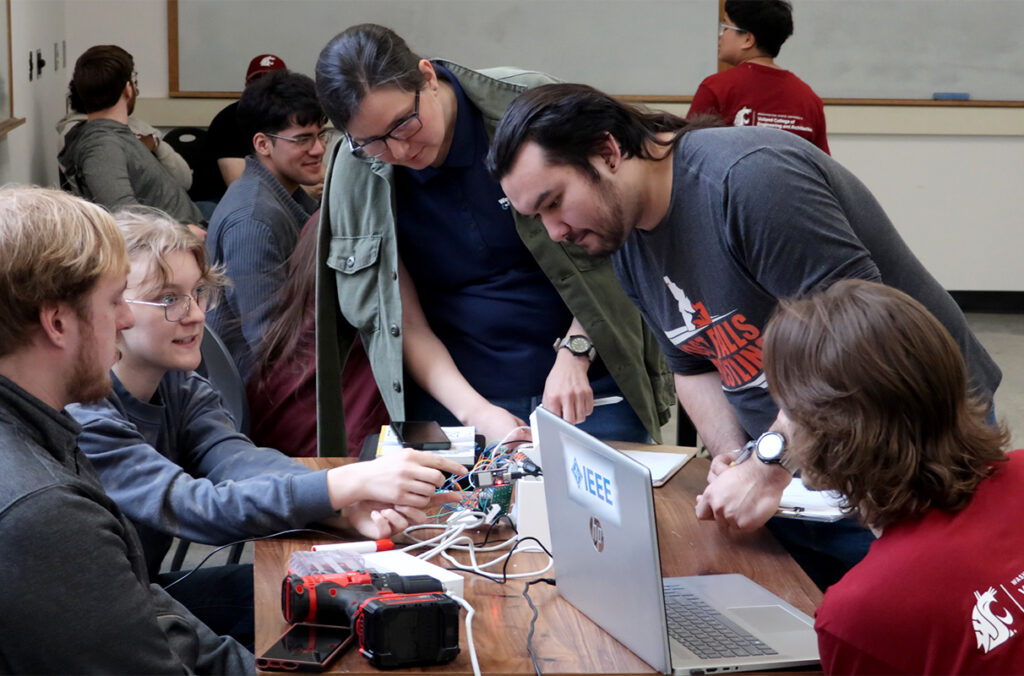
The summer program will allow approximately 10 students, particularly from underrepresented groups in the Pacific Northwest, to experience the world of full-time research. They will be involved in research to develop smart environments, in which computers learn and then develop a model of inhabitants’ behavior in their environment.
As the U.S. population ages, such an environment will be particularly important for elderly people who would like to stay in their homes. As the computer learns the inhabitant’s habits, it can help reduce manual efforts, increase energy efficiency, and increase security by being able to identify anomalies.
During the summer, the students will be installing sensor networks and other intelligent systems to provide services for inhabitants of the apartment, which in this case will be the students. In the home will be motion sensors, cameras and computers to control a variety of tasks, such as opening blinds or turning up heat or air conditioning.
For example, there might be automated computer software in the kitchen that will handily provide a needed recipe and keep track of ingredients needed for recipes. It might let the students know if they’re running low on sugar. Or, it could tell students where they left something.
The program will help students learn what the world of academia and research will be like, says Shirazi, Huie-Rogers chair, and director of the school. Unlike in classrooms or in their labs, the students who do research learn that there may not be just one correct answer.
Many of the students who participate in such programs often go on to graduate school. By participating in a real research project, the students gain the opportunity to investigate new research areas, gain deep knowledge in that area and contribute new knowledge to the field.
“This program aligns with one of our high priority initiatives to offer experience-enhanced education for students and to give them outside classroom experiences,’’ says Shirazi. “This provides the opportunity to train students, especially from underrepresented groups, and to get them excited about graduate programs in science and engineering. The contribution to the state-of-the art is what makes it really exciting and engaging.’’
More information is available at https://reu.eecs.wsu.edu.