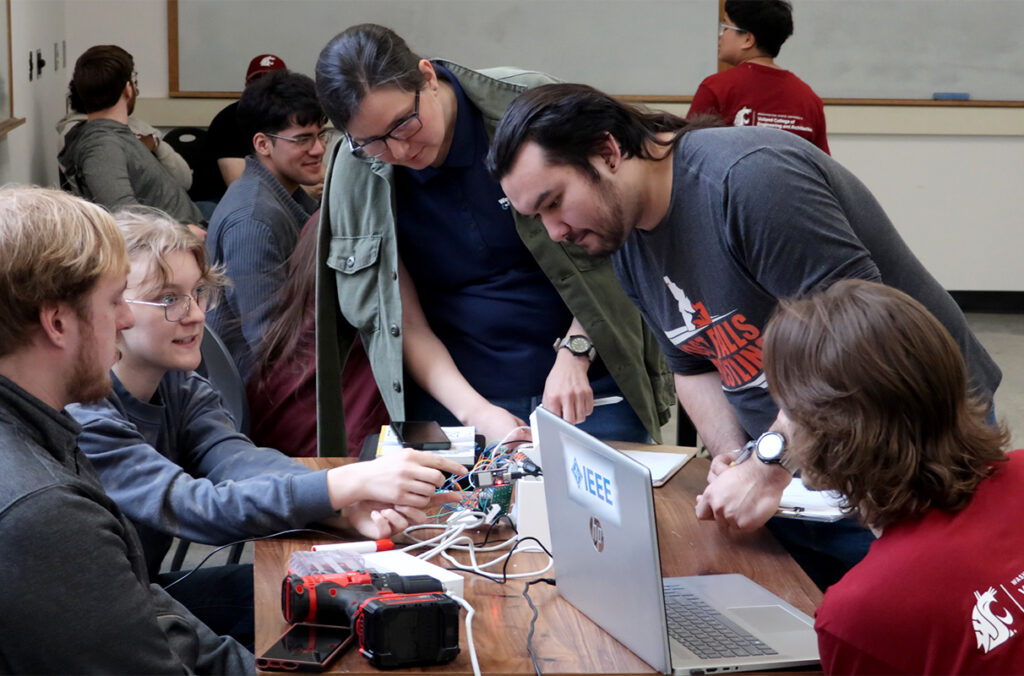
PGPR workshop group attendees
A handful of soil teems with billions of organisms. And they’re all at war: Beneficial bacteria battle harmful bacteria, hungry fungi threaten to invade, nematodes devour them all.
At stake is our food supply. Plants ward off attack by pumping nutrients out through their roots, feeding beneficial bacteria and creating, in effect, an army of microscopic minions. This narrow band of soil along the roots – the thin brown line – is called the rhizosphere. It’s a place of incredible microbial activity, said Dr. David Weller, research leader with the USDA Agricultural Research Service and member of Washington State University’s Department of Plant Pathology.
Weller and his colleagues worldwide are creating extra firepower for embattled food crops. They gathered in May for the 8th International PGPR Workshop in Portland, Oregon. PGPR stands for “plant growth-promoting rhizobacteria.” The naturally occurring bacteria are taken from the soil, then re-introduced in greater quantities so they can wage “hand to hand combat with pathogen organisms,” said Weller, who chaired the organizing committee for the conference. “They’re the real good guys among soil bacteria.”
PGPR also make plants more resistant to disease, fix nitrogen, produce growth-stimulating hormones and liberate soil nutrients. They can increase wheat yields up to 30 percent, Weller said, and are used on nearly every crop, from peas to pine trees to peanuts. WSU has been a world center for PGPR research for the last 30 years, he said.
The PGPR conference has been held every three years since in 1987, starting in Ontario, Canada; with stops in Switzerland, Australia, Japan, Argentina, India and Holland. In 2012, it will be held in Colombia. The conference’s first U.S. appearance was a huge success, Weller said, drawing 115 scientists from more than 20 countries. He credited conference planner Joy Thompson at WSU’s Center for Distance and Professional Education, which organizes about 50 events annually.
“My colleagues from all over the world said this was the best PGPR meeting in the history of the organization,” he said. “The facilities were super, the food that Joy organized was outstanding, and Joy made sure we got first-class service from the hotel.”
The conference unit of the CDPE is “one of those little gems on campus that many people may not be familiar with,” he said. “The word ‘fantastic’ is about the only word I can use to describe Joy and the group at her office.”
The conference unit of the CDPE is “one of those little gems on campus that many people may not be familiar with,” he said. “The word ‘fantastic’ is about the only word I can use to describe Joy and the group at her office.”
Attendees represented every level of PGPR research, from commercial producers to researchers sequencing PGPR genomes. Many had WSU connections, Weller said. Some were WSU graduate students; others received doctorates from WSU or had been visiting scientists at the university. The best part of the conference, Weller said, was bringing all these experts together in a single place to discuss their single overriding goal.
“We all share the excitement and passion for using beneficial microorganisms for improving plant growth,” Weller said. “Everyone in agricultural research has a tremendous commitment to solving world hunger.”
For a closer look at WSU’s Department of Plant Pathology, go to https://plantpath.wsu.edu/aboutplantpath/index.htm.
For more information on CDPE conference planning, go to www.professionaleducation.wsu.edu.
For more information on CDPE conference planning, go to www.professionaleducation.wsu.edu.
Dr. David Weller can be reached at wellerd@wsu.edu