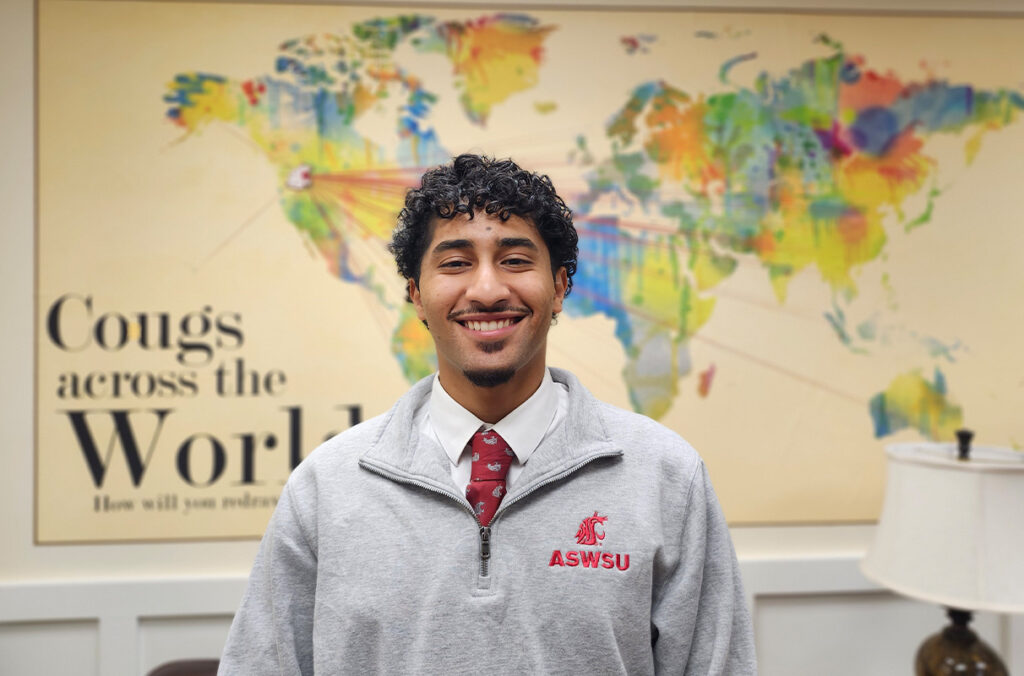
Abdelrahman “Bodi” Abdelrazek’s advisor joked that most people get 24 hours in a day, but Abdelrazek gets 27.
Abdelrazek, born and raised on a small farm in rural Egypt, is a bioengineering student on the pre-med track, an Associated Students of Washington State University all-campus senator, a participant in WSU’s McNair Scholars Program and, more recently, a mentor to refugee students.
Last semester, Abdelrazek mentored 10 refugee students in Spokane through a program supported by a $47,000 grant awarded to WSU two years ago by Supporting Higher Education in Refugee Resettlement (SHERR), a Washington, D.C.-based nonprofit that connects universities with resettlement agencies. Abdelrazek continued the internship this year in partnership with the International Rescue Committee (IRC) and WSU’s International Programs. The pilot program helps high school-aged refugee students prepare for higher education. Abdelrazek has hosted several in-person workshops on skills such as résumé writing and applying to college.
Abdelrazek’s family immigrated to the U.S. in 2018 when he was a teenager, giving him firsthand knowledge of the challenges newcomers face in accessing college.
“One of the goals and missions of this program specifically is to kind of dismantle these challenges that almost feel like a wall to these families,” Abdelrazek said. “I know what it’s like to start your whole life in a new place. All of a sudden, it feels very overwhelming and stressful because you’re always thinking about what’s next, and no one else has done this in your family before.”
IRC has long partnered with International Programs, and the latest program reflects WSU’s land-grant mission to make education accessible and promote economic opportunity. Resettled refugees in Spokane often remain in Washington, and IRC helps displaced families build new lives.
Jennie Sevedge-Angel, IRC’s training and mentoring coordinator, said the program fills a gap for students who aren’t eligible for IRC’s other tutoring and mentoring programs funded by the Office of Refugee Resettlement. She said most of the students are interested in STEM fields but face additional challenges, including interrupted schooling, learning a new language, and adjusting to a new culture.
“We know that when the caregivers of newcomer, first-generation students understand more about how to navigate high school graduation and career opportunities and access, the students’ feel empowered to meet their goals,” Sevedge-Angel said. “(IRC) tutors have been organically mentoring families for many years. With Bodi’s help and WSU’s funding, we are able to pilot making this a more intentional, targeted wrap-around family education navigation program with measurable, scaled impact.”
IRC has a community garden that provides sustainable food for resettled refugees and serves as an educational resource. Abdelrazek said working alongside some of his mentees in the garden helped him think about how to develop the internship program.
“I was just side by side with them working on removing the rocks and putting them aside, and then it gave me an opportunity to really connect with (mentees),” he said. “One of the students from the gardening day ended up reaching out, and we ended up having an online, one-on-one conversation, and it was really a full-circle moment for me, when she had shared her challenges.”
Abdelrazek said he feels he has learned more from his mentees than he has taught them. Working with mentees from different backgrounds, cultures, and language groups has presented unique challenges, but he said the experience has been fulfilling.
“There’s languages I’ve never heard spoken before and seeing them and their families, you know, how they talk to each other and they’re super kind, it really does make a bright light in your heart,” he said. “Sometimes you’ll be scheduled for an hour and I’m like, I don’t want to leave.”
Abdelrazek said the partnership between International Programs and IRC has helped expand the mentorship program, which he intends to continue. The organization hopes to recruit more mentors in the future, benefiting both refugees and WSU students.
“A lot of times we think of mentorship as the more experienced mentor sharing and teaching the mentee,” he said. “It teaches me things as well, so it’s just a beautiful relationship to build and have, and that’s honestly why I value mentorship so much.”