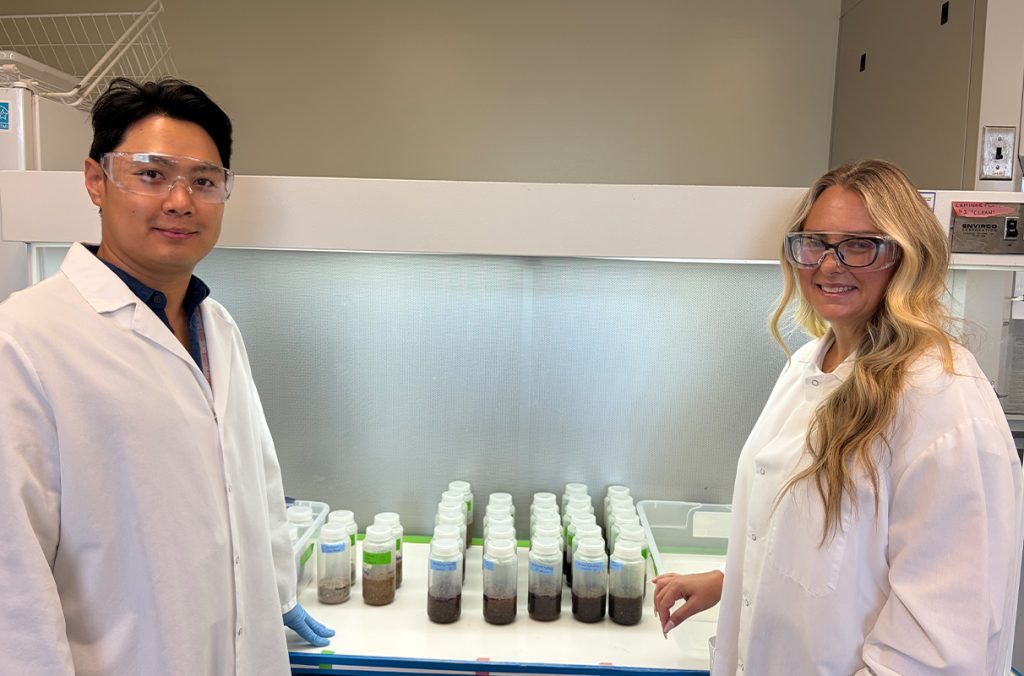
Eighteen years after earning her education degree from Washington State University Tri-Cities, high school science teacher Katy Andrewjeski (’08 Elem. Ed.) found herself back on the Richland campus this past summer. Instead of learning about classroom management and teaching pedagogies, however, this time she was donning lab safety gear and helping researchers explore new methods for turning agricultural waste into bioplastics.
For two days a week over an eight-week period, Andrewjeski joined Professor Bin Yang and other researchers at the Bioproducts, Sciences, and Engineering Laboratory to observe and participate in their work.
The opportunity was made possible thanks to the M.J. Murdock Charitable Trust’s Partners in Science program, which pairs middle and high school science teachers with leading science institutions and allows them to take part in cutting-edge research under the guidance of a professional mentor. In doing so, partnering teachers gain authentic laboratory experience meant to elevate their classroom teaching on scientific processes and discovery.
Under Yang’s mentorship, Andrewjeski conducted research on the bioconversion of agricultural residues, including corn stover and wheat straw, into high-value bioplastics and biofertilizers. Specifically, the research involved applying enzyme catalysts to the plant material as a first step in the conversion process.
“Their cell walls are made mostly of cellulose, hemicellulose, and lignin, so the pre-treatments we were applying were meant to break down those [complex carbohydrates] into simpler, fermentable sugars,” Andrewjeski said.
By maximizing the number of fermentable sugars, she said, the plant waste becomes a more effective feedstock for certain bacteria that convert them into a polymer type known as polyhydroxyalkanoates, or PHAs for short. PHAs, in turn, can be used to make non-petroleum-based plastics.
For Andrewjeski, who teaches at Connell High School in rural Franklin County, the experience was particularly eye-opening. Not only does she live and work in a highly agricultural community, she also helps operate a family farm that recently switched over to corn and wheat production.
“I had no clue that corn stover and wheat straw, which are two waste products from our farm, could be used to produce biofuels or biodegradable plastics,” Andrewjeski said.
Having directed several breakthrough research projects aimed at making the conversion of such agricultural byproducts more economically feasible, Yang said the Partners in Science collaboration was equally beneficial to BSEL faculty and staff, as Andrewjeski offered valuable insight from the agricultural business side of things.
He said he plans to visit Andrewjeski’s students at Connell High School later this year to talk about his team’s work at WSU Tri-Cities.
“Katy and I hope this partnership will help bridge the gap between scientific discovery and STEM education, bringing cutting-edge research into the classroom and creating meaningful opportunities for both teachers and students,” Yang said.
Andrewjeski plans to return to BSEL next summer for the second half of the two-year collaboration. In the meantime, she also looks forward to bringing some of her lab experience back to the classroom.
One curriculum project she’s already begun working on, with funding support from WSU’s Ferrucci Distinguished Educator Award, will mimic the work she did at BSEL by having students investigate the composition of plant biomass. On a deeper level, Andrewjeski says she hopes to demonstrate to students how modern science and technology connects to the world around them.
“I hope my students see that the science they’re learning has applications beyond the classroom,” Andrewjeski said. “They can look at something as familiar as a cornfield and begin asking questions about chemistry, biology, sustainability, agriculture, engineering, and how these things really do come together.”