A unique partnership delivering long-term benefits to school districts across Washington displayed what is possible through collaboration during the National Association of Community Development Extension Professionals (NACDEP) conference in Wichita, Kansas.
Leaders from Washington State University Extension’s Community and Economic Development(CED) unit and Partners for Rural Washington (PRWA) presented their collaborative work on The Giving Grid, a program that helps rural Washington school districts lower energy costs by installing rooftop solar arrays on public schools.
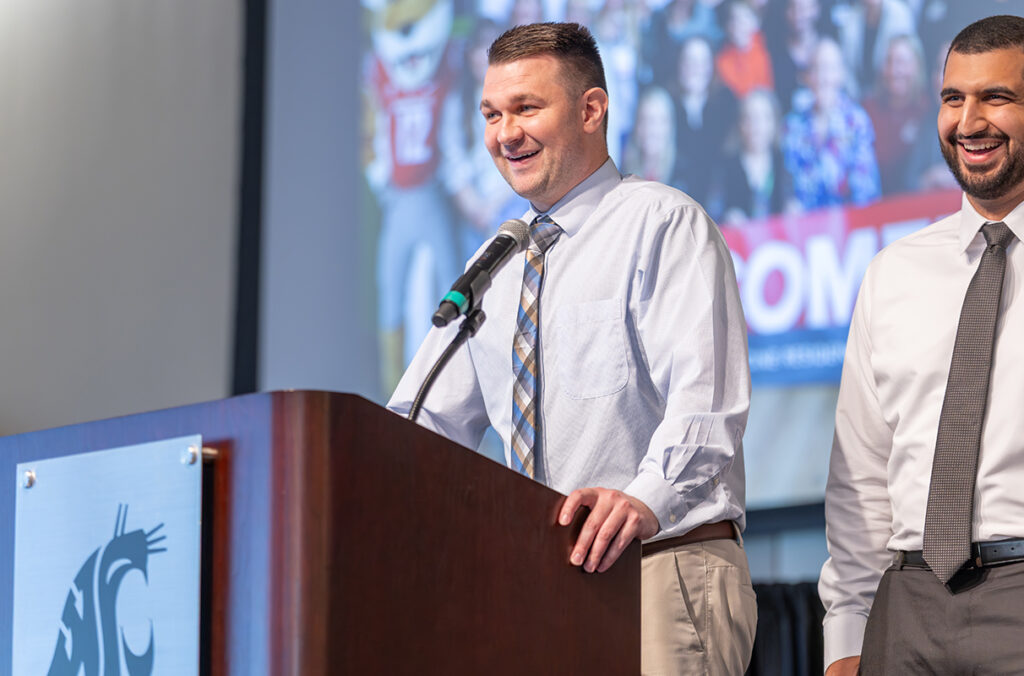
CED Extension Unit Director Christina Sanders and collaborator Jody Opheim, executive director of PRWA, shared the story behind the public-private partnership.
“It isn’t often that Extension faculty get to have their valued community partners present alongside them at national conferences like NACDEP,” Sanders said. “We demonstrated what kinds of impacts are possible through partnership.”
Extension professionals from across the country met in Wichita to share and learn what others were accomplishing within the field of rural community economic development. This year’s conference theme was “The Middle of Everywhere.”
“When we create opportunities for conversation with other organizations to learn what they’re doing and how we can partner to benefit people across the state, it’s going to produce better long-term impacts,” Sanders said. “We learn who might have the complementary piece that will move a project forward.”
Because Partners for Rural Washington is a nonprofit, it can subcontract solar panel installation work. As Washington’s federally recognized State Rural Development Council, PRWA helps rural communities of fewer than 5,000 people — and especially those with fewer than 1,500 residents — secure funding and build capacity to address both immediate and long-term challenges.
“Washington’s small communities do a phenomenal job with the challenges and limited resources they have, but they often have a part-time clerk and often a part-time mayor who practically does the job for free,” Opheim said. “Municipal projects like wastewater treatment, building a new fire station, street repairs — often, small towns do not have the people power to search out available funding.”
Even when funding is available, limited staff capacity can prevent cities from applying for grants or managing projects. WSU Extension and PRWA identified and applied for The Giving Grid funding, administered the project, and subcontracted the solar panel installation, solving the capacity issue for many Washington towns.
Through The Giving Grid, under-resourced, qualifying Washington school districts can have solar panels installed at no upfront cost. Washington school districts funnel the energy cost savings into low-income student support programs.
“The Giving Grid demonstrates the power of Extension to connect innovation with community needs,” said WSU Extension Director Vicki McCracken. “Through the leadership of our Energy Program and the collaboration of CED and Partners for Rural Washington and local schools, clean energy investments are creating lasting benefits for students, families, and rural communities across Washington.”
Opheim said The Giving Grid succeeded because each organization brought unique expertise to the table, fitting together like the links of a chain to solve a pressing issue affecting school districts statewide.
“This is just a fantastic program — it’s a win for everyone. And it has such a positive and long-term impact on small rural communities,” Opheim said. “I want every state to do it, so if we can spread the word and get other states excited, and if any of the Extension folks went home and said, ‘hey, we need to look at how they did this,’ then it’s time well spent.”
Sanders echoed the sentiment.
“It’s important not to underestimate the value of partnerships in our state,” Sanders said. “To lead and showcase what we’ve accomplished together on a national stage was important.”
Harrington School District was the first to benefit from The Giving Grid, but dozens more rural school districts across Washington are expected to participate as the program expands.
“This work exemplifies the very best of Extension — bringing together expertise, partnership, and innovation to address real community needs,” said Raj Khosla, Cashup Davis Family Endowed Dean of WSU’s College of Agricultural, Human and Natural Resource Sciences. “I am proud of the faculty, staff, and partners whose commitment makes initiatives like this possible and whose collective efforts continue to improve the lives of Washingtonian.”