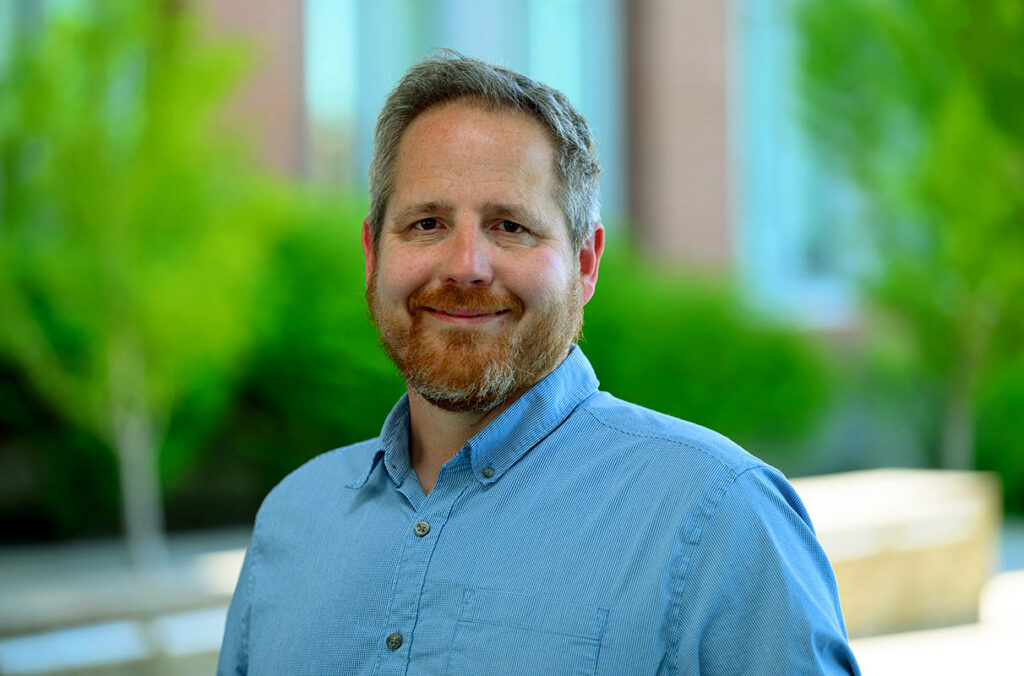
Twenty-five years after arriving at Washington State University as a graduate student, neuroscientist James Peters is the new chair of WSU’s Integrative Physiology and Neuroscience Department in the College of Veterinary Medicine.
Peters, who will succeed Shane Hentges, earned his PhD in neuroscience in 2005 and joined the faculty in 2010 following a postdoctoral fellowship. Throughout his career, he has studied how the brain communicates with the body’s internal organs and mentored generations of WSU undergraduate and graduate students.
“It’s unusual to have a major research institution in a rural area where you’re giving students from rural communities opportunities like this,” Peters said. “That’s something special. We have the people, we have the resources, and we have the momentum. I’m just excited about the opportunity to keep moving that forward.”
As chair, Peters said, his immediate focus is building upon the department’s existing strengths while helping faculty and students continue to thrive.
We have the people, we have the resources, and we have the momentum. I’m just excited about the opportunity to keep moving that forward.
James Peters, chair
Integrative Physiology and Neuroscience Department
WSU College of Veterinary Medicine
That support includes helping faculty remain competitive in an increasingly challenging research environment. Peters noted that grant submissions from department faculty have climbed dramatically in recent years, contributing to continued growth in research funding even as federal funding opportunities have become more competitive.
“We feel like we’ve got the trajectory set correctly,” he said. “Our goal is to keep building on that.”
Peters said maintaining flexibility and adaptability will also be critical as universities navigate changes in research funding and scientific priorities.
“How things are today is no guarantee they’ll remain that way,” he said. “We want to be as adaptable and resilient as possible.”
Student success and enhancing the WSU student experience will remain another central focus for Peters.
Unlike larger institutions where research opportunities can be difficult to secure, Peters said WSU undergraduate students often gain laboratory experience as early as their first year on campus — he wants to continue that tradition.
“Early laboratory experiences not only help students develop technical skills but also allow them to discover potential career paths and build relationships with faculty mentors,” Peters said.
His own career reflects such opportunities.
Raised in rural eastern Oregon, Peters came to WSU seeking the experience of a major research university while remaining close to home. Now, as chair, he hopes current students see similar possibilities for themselves.
“What motivates me is that we have one of the best-kept secrets right here,” Peters said. “Our neuroscience program is nationally competitive. We have people visit us from the biggest institutions in the country and they’re surprised by the quality of our facilities, resources, and science.”