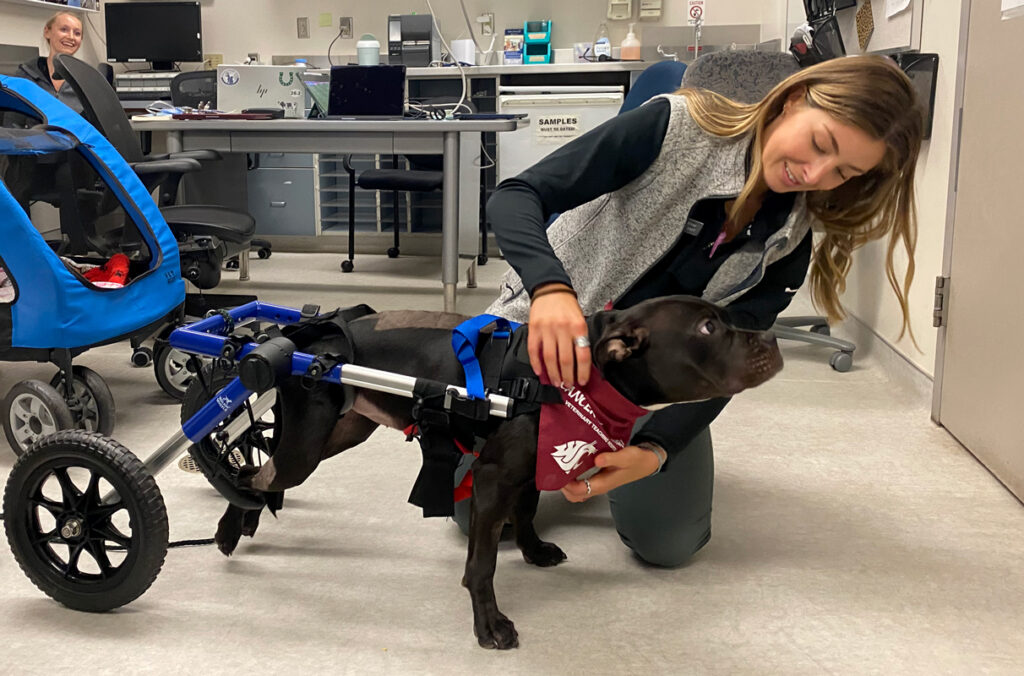
An 8-month-old puppy named Winnie is back home with her family in Spokane after undergoing surgery and completing 20 radiation treatments for a rare spinal tumor at Washington State University’s Veterinary Teaching Hospital.
The American bully now gets around in a custom wheelchair after the cancerous mass damaged her spinal cord, but it has hardly slowed her down.
“She’s the happiest little girl. There was never a time where she was in pain. At this point, she’s been not walking longer than she ever walked, so she doesn’t even care,” said Jamie Kearney, who co-owns Winnie with her fiancée, Keith Thulon.
The couple first noticed something was wrong when Winnie began walking strangely and started losing control of her back legs.
“She kind of walked like a drunken sailor. She was just stumbling all over the place,” said Jamie, who just happens to work as an occupational therapy assistant at a rehabilitation facility for spinal cord patients in Spokane.
After the episodes continued, Winnie’s primary veterinarian referred her to WSU, where an MRI revealed a large malignant tumor on her spinal cord. The tumor, later identified as a nephroblastoma, develops from embryonic kidney tissue cells that improperly grow along the spinal cord.
“It’s almost like they grow a little kidney there, but it’s not functional,” said neurology resident Dr. Amanda Lamarca.
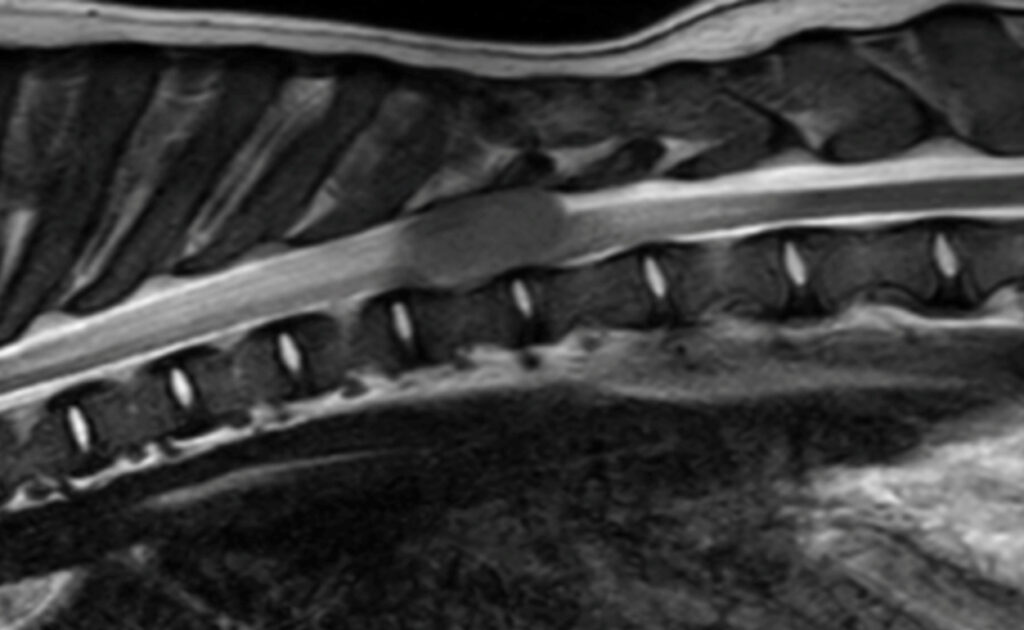
At WSU, a team of specialty veterinary surgeons performed a procedure known as a laminectomy to remove as much of the tumor as possible.
The six-hour surgery carried significant risks, as any complication could lead to irreversible spinal cord damage, excessive bleeding or infection.
Lamarca said the most difficult part was differentiating the tumor from the healthy spinal cord.
“When we went to surgery we were hoping that we were going to be able to remove more than we did, but we weren’t able to due to the surrounding active nerves, that is why we recommended radiation,” Lamarca said.
The surgery and subsequent radiation treatments came with significant costs, and friends and family have organized a GoFundMe campaign to help the family offset Winnie’s medical expenses.
While Winnie will likely never walk normally again, her care team at WSU is still hopeful she could gain some mobility in her back legs.
“It might be goofy and a little uncoordinated, but I am cautiously hopeful,” Lamarca said, noting Winnie has already shown significant improvement in the strength of her hind legs, a benefit of WSU’s Integrative Medicine service.
During her weeks of radiation therapy, Winnie completed two rounds of physical therapy at WSU, most specifically the underwater treadmill which allows dogs — and some cats — to use limbs without bearing their full weight.
Jamie and Keith plan to continue Winnie’s rehabilitation in Spokane.
Given her background working with human patients recovering from spinal cord injuries, Jamie said it almost felt like “fate” that Winnie found her way into their family.
“When we first found out that it was a spinal tumor, I was like, ‘What are the odds? What are the chances that I go to work every day and work with spinal cord patients and Winnie was diagnosed with a spinal cord tumor?’” Jamie said.
While many dogs diagnosed with Winnie’s condition are humanely euthanized, Jamie said her experience has helped the family navigate the challenges of caring for a dog with a spinal cord injury.
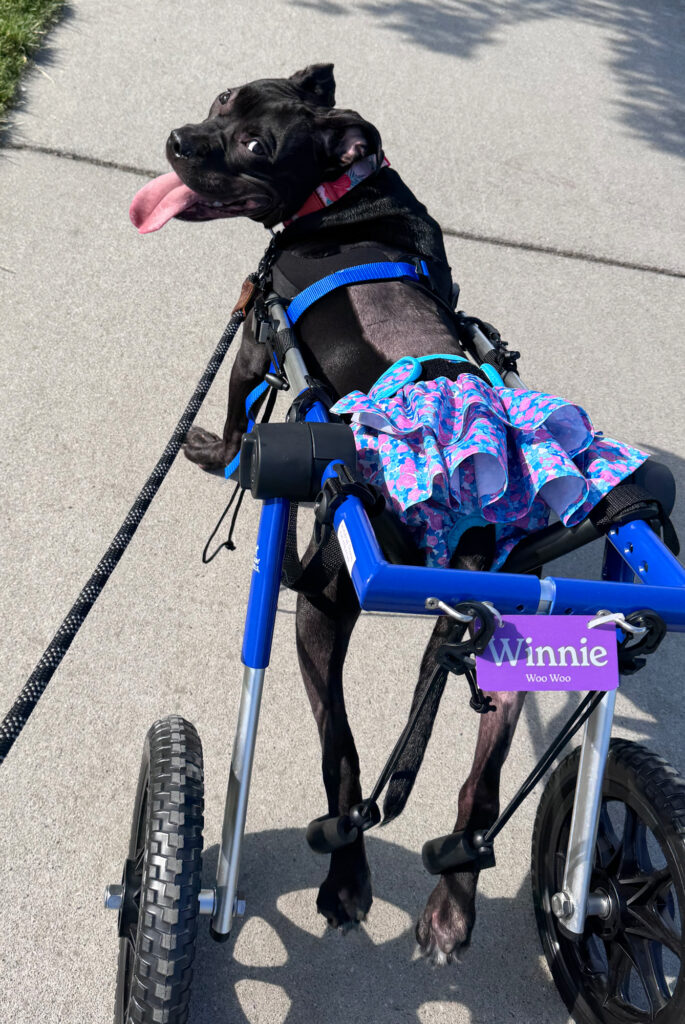
“Everyone feels like Winnie got pretty lucky because when they were talking about her home care and expressing her bladder and all these things, that’s what I do every day, so I’ve been able to take a ton of my experience with humans and put it into Winnie,” Jamie said.
For the family, the experience has transformed what they expected life with Winnie would look like. While the puppy’s future now includes a wheelchair and continued rehabilitation, they say it hasn’t diminished her joy or enthusiasm for life.
“She may not be able to use her legs but she is the most outgoing, wild and determined dog. She does require some extra care but we’re getting used to all of those challenges. Winnie is part of the family and she really is just like any other dog, she’s an amazing companion and everyone who meets her falls in love,” Keith said.
Media Contacts
- Josh Babcock, WSU College of Veterinary Medicine, 509-339-3423, joshua.babcock@wsu.edu