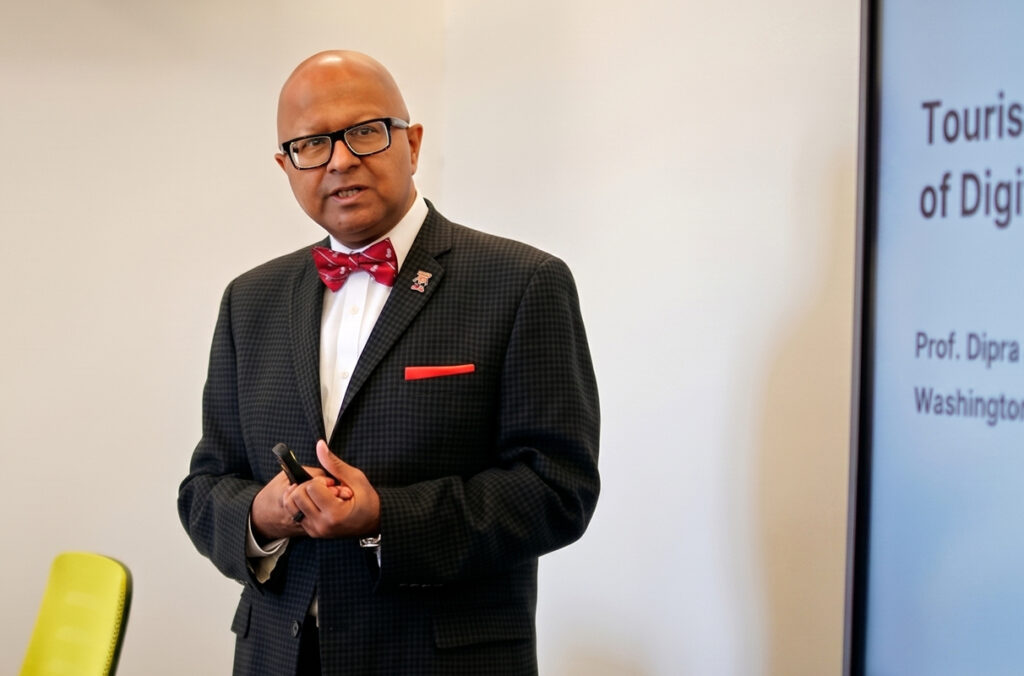
Washington State University hospitality and tourism expert Dipra Jha recently traveled to Tbilisi, Georgia, to mentor participants in the Digital Tourism Ideathon hosted by Caucasus University.
The event held June 4–5 brought together students, mentors, and industry professionals to learn about current trends in tourism, hospitality, and technology.
Jha, an associate professor in the WSU School of Hospitality Business Management and global scholar of tourism strategy, helped design the Ideathon and mentor participants as they prepared for a business pitch competition. He also taught two masterclasses that explored the future of tourism and experience design.
“Ideathons like this provide the perfect collaborative ecosystem for industry professionals and innovators to prepare for the paradigm shift currently happening in the global hospitality and tourism industry,” said Jha. “By leveraging AI and digital tools, we can co-create next-generation solutions that optimize hospitality operations while fundamentally elevating the traveler’s journey.”
By leveraging AI and digital tools, we can co-create next-generation solutions that optimize hospitality operations while fundamentally elevating the traveler’s journey.
Dipra Jha, associate professor
Washington State University
Jha’s Tourism Trends and the Future of Digital Experiences class introduced participants to emerging hospitality trends. The field is shifting from traditional service delivery to creating memorable, experience‑driven encounters, with special attention to the growing influence of robotics, AI, and service automation, he said.
Jha’s Design Thinking for Tourism Innovation class walked participants through a human‑centered process for crafting desirable travel experiences — emphasizing traveler empathy, identifying friction points, brainstorming solutions, and prototyping and testing ideas with real users.
“The biggest takeaway from Professor Jha’s masterclasses was seeing firsthand how the trend is shifting towards experiential service. Just delivering high-quality service is no longer memorable,” said Beatrisa Gogitidze, a recent graduate of Caucasus University. “The information presented deepened my interest in the gamification of tourism and experiential hospitality, particularly in the luxury yacht and events industry. I plan to apply this knowledge in in my current role at Paragraph Resort and Spa Shekvetili, Autograph Collection.”
Georgia stands as a uniquely compelling backdrop for these conversations, Jha said, because its tourism sector accounts for approximately 15% of the country’s GDP. The sector also generates $3.6 billion to $4.1 billion in foreign exchange annually and comprises more than 60% of Georgia’s service export revenue.
“The country possesses immense potential to become a leading hub for digital tourism innovation,” Jha said. “As we embrace this evolution, I am incredibly passionate about bridging global innovation ecosystems and highlighting the best of American technology and entrepreneurial spirit to the world stage to empower local talent.”