PULLMAN, Wash. — A law enforcement officer often is juggling chaos on the scene of a domestic violence call: a victim in distress, conflicting accounts, possible weapons, children in the room and a long list of legal steps that must be followed exactly.
Researchers at Washington State University’s Complex Social Interactions (CSI) Lab in the College of Arts and Sciences have built an AI-powered system intended to help.
Their Guided Interaction platform is an open-source mobile app that walks officers step by step through collecting information during domestic violence incidents. It is designed to reduce guesswork in high-stress, time-sensitive situations, where missing key details can carry serious consequences. Built into the same system is an AI legal agent that allows officers to quickly interpret state statutes and case law, helping them make informed decisions with clear legal grounding while still in the field.
With funding from the Washington State Legislature, the CSI Lab is now recruiting law enforcement agencies, victim advocates and other partners to test the system in real-world settings and help refine how it works in practice. Because it is open-source, agencies and partners will be able to access, adapt and build on the system as it evolves. Researchers are also working with the Spokane Regional Domestic Violence Coalition to develop future modules and service referrals.
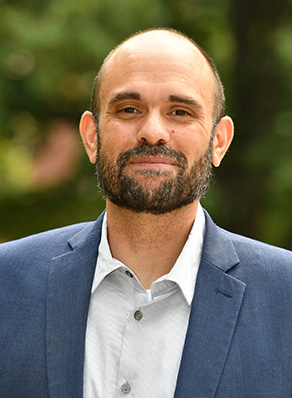
“We need people to use it and tell us what works and what doesn’t,” said David Makin, principal investigator of the CSI Lab and a professor in WSU’s Department of Criminal Justice and Criminology. “This is about giving officers the right information at the right time so they can make better decisions when it matters most.”
The problem the team set out to solve is straightforward. In domestic violence cases, critical details are often missed or recorded inconsistently, not because officers are careless, but because the situations themselves are chaotic.
“There’s a huge cognitive load,” said Christina Shellabarger, a WSU PhD student and CSI Lab manager. “You’re managing a fast-moving situation while trying to remember procedures, resources and everything that needs to be documented.”
Even small gaps in documentation can have detrimental consequences. If indications of strangulation during a domestic assault are not recorded, a victim may miss a critical medical assessment. If a lethality screening is overlooked, a high-risk situation may go unflagged. Incomplete reports can also limit what prosecutors are able to pursue and make it harder to connect victims with services.
The guided interaction system addresses these problems by prompting officers in real time. As they enter information on a phone, tablet, or in-car computer after securing the scene, the system responds immediately. Certain answers trigger required follow-ups while others flag next steps like contacting child protective services. The system also includes features designed to support victims directly, including real-time language translation and the ability to quickly locate nearby services.
Future versions aim to go further by using keywords from interactions to prompt trauma-informed follow-up questions and adjust how those questions are asked.
“It’s not about collecting more data,” said Shlok Tomar, a computer scientist in the CSI Lab. “It’s about collecting the right data and making it usable in the moment.”
From data collection to actionable insight
Beyond individual emergency calls, the system is designed to improve how departments use data.
Because information is collected in a standardized format, agencies can more easily identify repeat incidents, track changes in risk factors and ensure required steps are being followed.
If officers respond to the same household more than once, the platform can surface prior reports and compare risk assessments, showing whether conditions have improved or worsened.
“You can start to see patterns you wouldn’t otherwise catch,” Tomar said.
For researchers, that consistency also makes it possible to compare cases and better understand what is happening across communities.
“When the information is captured the same way each time, you can actually compare cases and understand what’s changing,” said Sayani Ghosh, a CSI Lab staff scientist.
The team is now working to move their open-source platform to a standalone application, allowing agencies to tailor the technology to meet their needs. The beta version will be released this year, with a stable version planned for early 2027.
The work also highlights how researchers in the College of Arts and Sciences are applying research to real-world challenges facing communities across Washington and beyond.
“This is exactly what a land-grant university is supposed to do,” Makin said. “Take research out of the lab, build something useful, and put it in the hands of the people who need it.”
Media Contacts
- David Makin, WSU College of Arts and Sciences, 509-335-2455, dmakin@wsu.edu
- Will Ferguson, WSU News & Media Relations, 509-335-8798, will.ferguson@wsu.edu