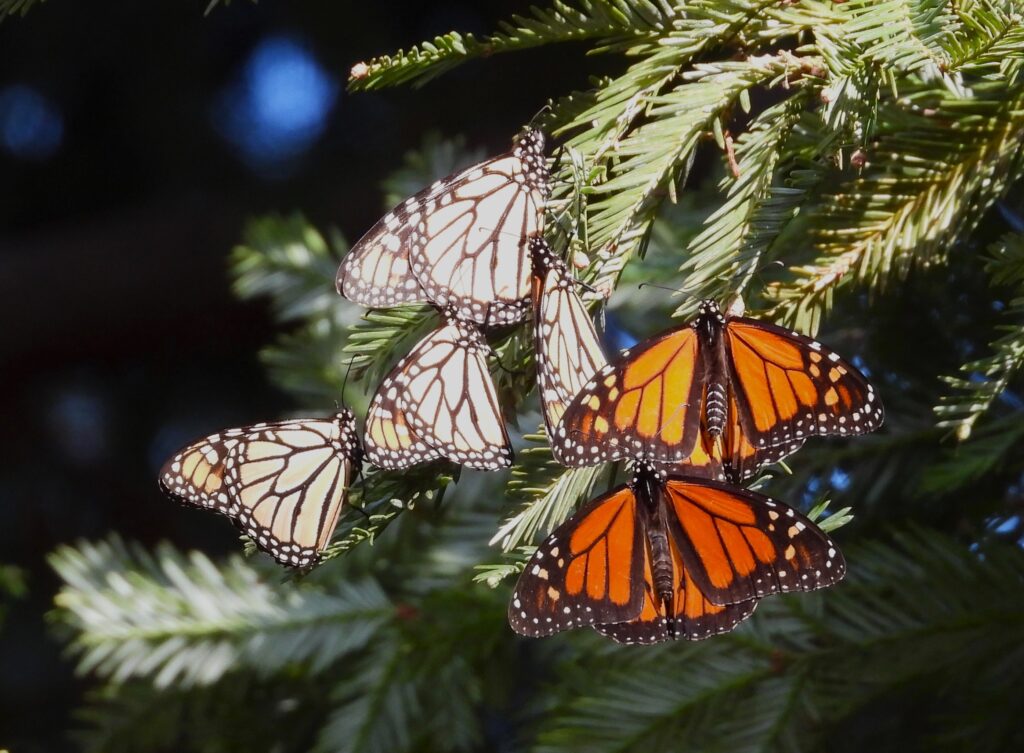
Monarch butterflies are famous for migrating hundreds, even thousands, of miles. Their routes, however, have always been a mystery.
Until very recently, monarch tags were simple: Often a piece of paper labeled with waterproof ink and placed on a newly emerged butterfly that would, hopefully, be found later.
“It was a bit like looking at only the first and last pages of a book,” said David James, an entomology professor at Washington State University and longtime monarch scientist and enthusiast. “It was the best we could do then, but thankfully the technology has evolved and now we can track them more precisely.”
James is working with nonprofit monarch group Wings Rising on Adopt-a-Monarch. The project aims to place new high-tech tags on at least 100 monarchs before they leave Idaho in late summer for southern destinations.
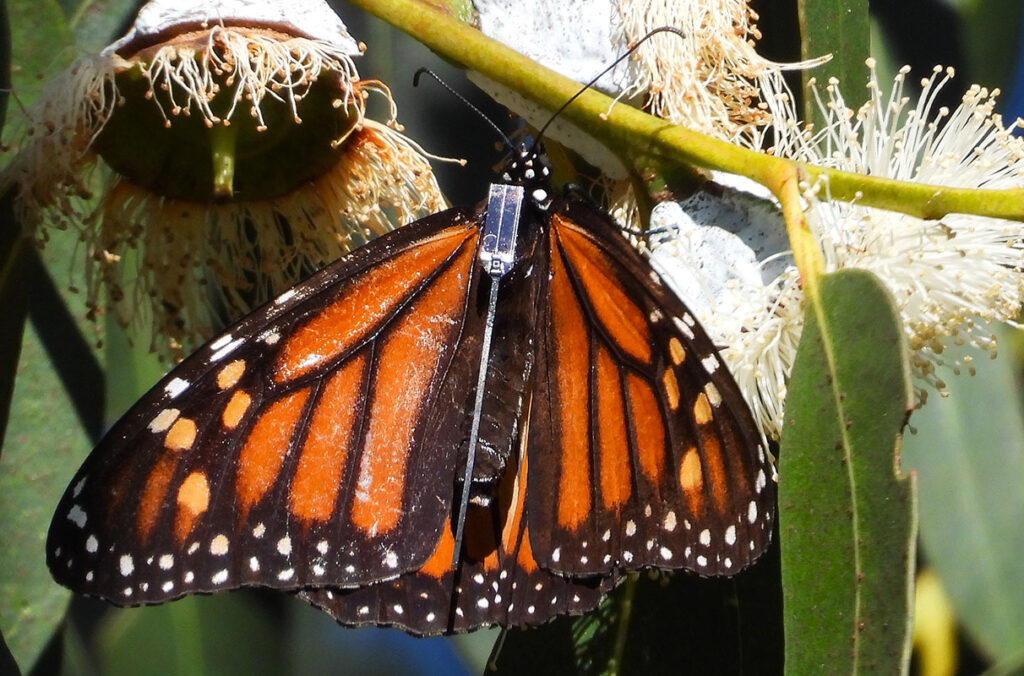
The new tags can transmit each butterfly’s location along the route, resulting in a multitude of benefits.
“In the past, we tagged thousands of monarchs. For every 200 tags, we’d average about one recovery,” James said. “Based on early results from the East Coast, all of them can be tracked and over 40% of the monarchs are still alive after six months with the new tags.”
Such reliability is key because the new trackers, essentially tiny solar cells with antennae that attach to a monarch’s thorax, cost $200 each. They don’t track at night or while the pollinators rest with their wings closed, but begin working again once the butterflies are moving in daylight.
The new tags are quite tiny by human standards but bigger and heavier than the previous tags. James said the analog tags are the equivalent of a set of keys in a person’s pocket. The new versions are more akin to wearing a backpack all the time.
“I’m excited to see this new technology in action,” said Raj Khosla, Cashup Davis Family Endowed Dean of WSU’s College of Agricultural, Human, and Natural Resource Sciences. “We need WSU scientists solving mysteries and helping important species like monarch butterflies not only survive but thrive in their environment. I applaud their efforts to engage community in advancing science.”
James and his colleagues are seeking donations to help pay for the high-tech option.
When people donate, they can adopt a specific butterfly and track its journey. They can name their butterfly, then check in daily, or even hourly, to spot locations visited by their little friend. Tracking the butterflies’ movements may help solve a mystery that has long baffled scientists: Where do Idaho monarchs go when they migrate?
Since 2012, James has worked with groups to tag over 31,000 monarchs in Washington and Oregon. Only 219 have been recovered, mostly in California. The recovery rate for monarchs tagged in Idaho is even lower — of the 11,000 butterflies tagged and released there, only 12 were recovered. Most of those 12 were found within 100 miles south of their release points.
“Idaho is a black hole of monarch information because there are fewer human-populated areas once they head south,” James said. “Maybe they go to California, too. Maybe Utah, Arizona, maybe even as far as Mexico. We just don’t know, but it would be helpful for conservation to find out.”
If we see patterns in the routes they take, then we can plant milkweed and nectar sources along those corridors.
David James, professor
Washington State University
Another benefit of the new tags is that they highlight the paths the pollinators take, potentially allowing monarch lovers to help them get enough to eat.
“If we see patterns in the routes they take, then we can plant milkweed and nectar sources along those corridors,” James said. “More available nutrients mean more butterflies make it to their destinations.”
For James, the new trackers, and this project, are the culmination of a lifetime of work and interest.
“When I was growing up and obsessed with butterflies, I could have only dreamed of this kind of technology,” he said. “I’m so excited for this release and to see where the monarchs go.”
Anyone interested in supporting James’ tagging work can do so through the Adopt-a-Monarch website.