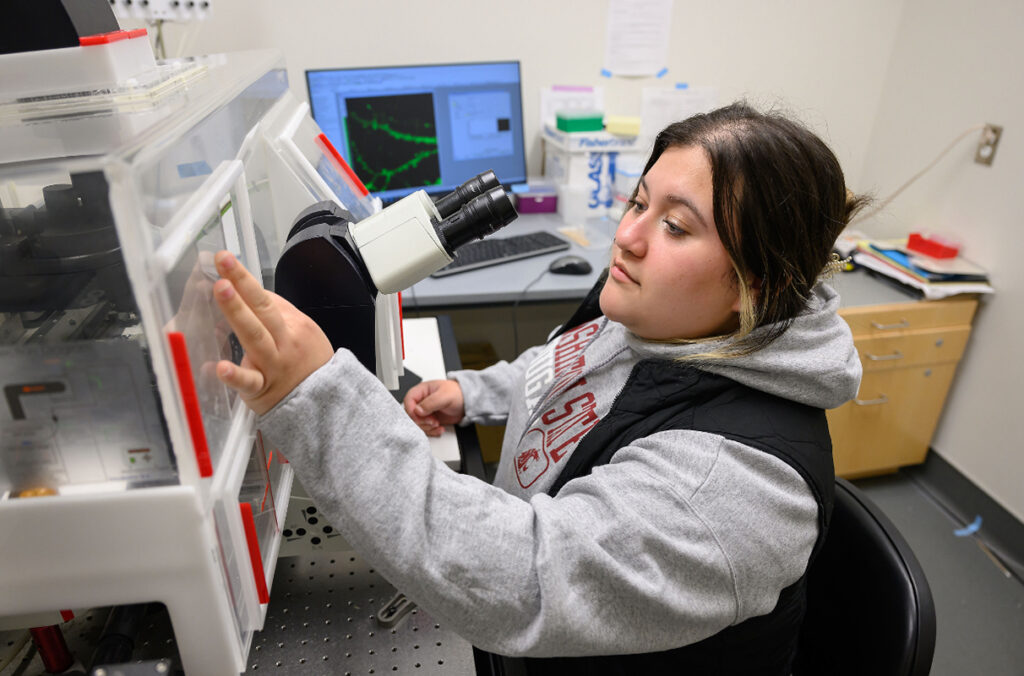
As a senior majoring in bioengineering at Washington State University Pullman, Minh Ngoc Nguyen feels like she is running out of time to gain more research experience before entering the professional world.
That feeling of pressure to find work in a lab led Nguyen to participate in the STEM Research Opportunities Fair this past fall, a collaborative event organized by WSU’s Team Mentoring Program (TMP), Office of Undergraduate Research, McNair Scholars Program, and WSU LSAMP.
“I feel like in my field, the competition is high with so many students competing for research experience,” Nguyen said. “The fair allowed me to explore research opportunities in disciplines outside of my major to widen my chances of getting something.”
Samuel Rodgriguez-Flecha, director of TMP, said many students don’t yet have an ample understanding of what research entails, how being involved with it can help them grow professionally and personally, or how to find opportunities to work in labs on campus.
It is why TMP and its partners banded together to educate students about research. The collaborative approach allows the different programs to share resources, minimize duplicative efforts, and interact with students more efficiently.
“We have some shared goals, so rather than compete with one another, we believe it is best to work together,” Rodriguez-Flecha said. “It gives students a more seamless experience.”
TMP is a leadership and network-building program that helps connect students with peers, faculty, WSU departments, and other services across WSU. Applications for mentors and mentees are currently open for the 2026–27 academic year and can be found at tmp.wsu.edu.
A life-changing experience
Tiana LaFollette did not know anything about research when she first arrived at WSU, but her interest in the human brain led her to connect with WSU Professor Mary Sanchez-Lanier, who offered her a research opportunity in her neuroscience lab. The experience not only prompted LaFollette to switch her major, but she also discovered a career in pediatric neurology that she is now pursuing with passion.
LaFollette, a TMP scholar, is a peer mentor for the Office of Undergraduate Research and spoke to the 140 students in attendance at the STEM Research Opportunities Fair.
I want students to realize what getting involved with research can do for them and their future.
Tiana LaFollette, TMP scholar and peer mentor
Washington State University
“I want students to realize what getting involved with research can do for them and their future,” she said. “Not only is it helping me define my career goals, but it is also making me a stronger person, a better public speaker, and it is helping me develop a strong network with faculty at WSU.”
In November 2025, LaFollette spoke about her research in front of several thousand students at the ABRCMS conference in San Antonio, Texas. She said it was crazy to think about speaking to more people than live in her hometown, and it is something she would have never dreamed of doing a year ago.
‘Anyone can do research’
LaFollette is a good example of how getting involved in research often leads to an explosion of new opportunities for students, said Nora Rye, director of LSAMP, which stands for Leadership in STEM Through Applied Mentoring Programs.
LSAMP organizes a summer bridge program focused on undergraduate research, provides student mentors, and study space in CUE 403.
“Each of our programs have similarities and differences, and it can be confusing for students,” said Rye. “We want students to learn about all of them and connect wherever they feel comfortable.”
Manee Moua, McNair’s associate director, said the programs have many of the same goals and work together to support students no matter where they are in the process and who they might have already consulted.
“Our student scholars play a valuable role in sharing their research experiences with other students and they often highlight the strength of our collaboration in supporting their academic journeys,” Moua said.
LaFollette feels the widespread support at WSU and said it is making a big difference for students.
“Having an entire community that is supportive of research is so very important,” said LaFollette. “It helps foster the idea that anyone can do research, and that’s what I love about WSU.”