On the night of March 13, the moon will leisurely slip into the cone-shaped shadow of the Earth, creating the first total lunar eclipse visible anywhere on the planet since November 2022.
WSU astronomer Guy Worthey described the upcoming eclipse as a ‘leisurely’ event because it will literally take 6 hours from start to finish with a period of about an hour where the Moon will be completed shaded. This period of totality — when the moon is entirely engulfed in Earth’s shadow — will last 65 minutes, from 11:26 p.m. on Thursday, March 13, to 12:31 a.m. on Friday, March 14 (PDT).
“Fortunately for us in the Pacific Northwest, the timing will be maximally convenient for viewing,” Worthey said. “You’ll see what looks like a big bite being taken out of the moon growing steadily larger. That ‘bite’ is Earth’s shadow gradually covering the lunar surface.”
The period of totality — when the moon is entirely engulfed in Earth’s shadow — will last 65 minutes, from 11:26 p.m. on Thursday, March 13, to 12:31 a.m. on Friday, March 14 (PDT).
During totality, the moon will take on a reddish-orange hue, a phenomenon often referred to as a “blood moon.” However, Worthey is not entirely sold on the term.
“It’s pretty but calling it a blood moon might be an exaggeration,” he said. “You’ll still see most of the lunar features, just bathed in a unique reddish glow.”
Lunar eclipses occur when the Earth moves between the sun and the moon, casting a cone-shaped shadow that envelops the lunar surface. Unlike solar eclipses, they are completely safe to view with the naked eye. Worthey recommends binoculars or a telescope for a more detailed look, as they enhance visibility of craters, maria, and other lunar features.
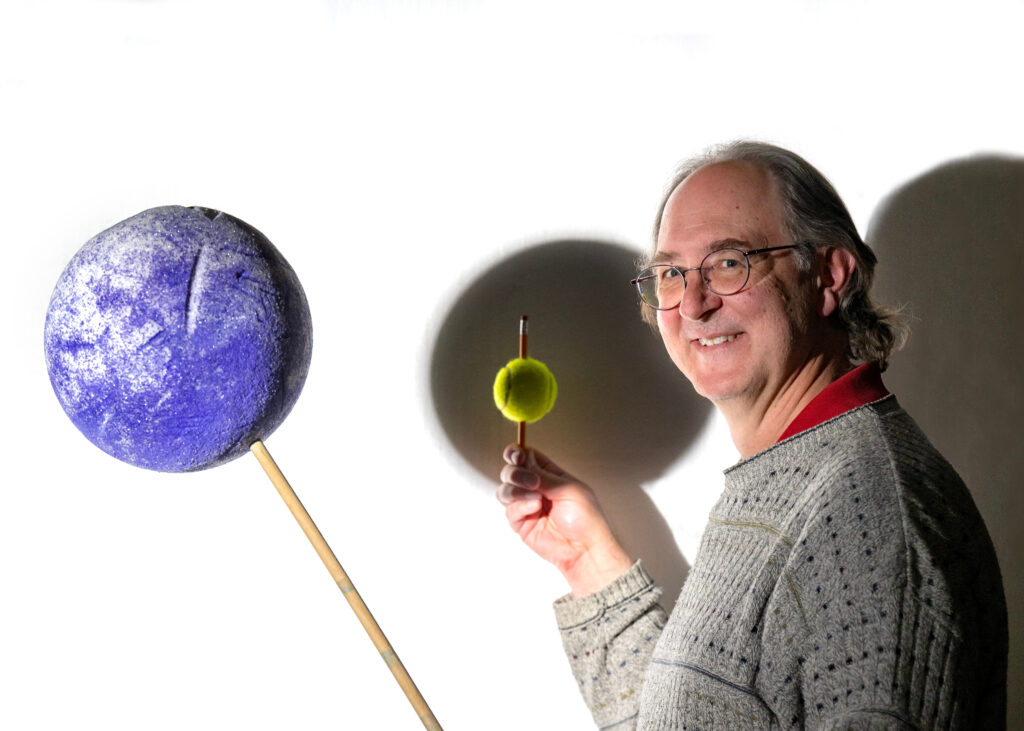
“The light illuminating the moon during totality comes from the sun’s rays passing through Earth’s atmosphere,” Worthey explained. “If you were standing on the moon, you’d see the Earth surrounded by a ring of fiery sunrises and sunsets from all over the planet. That’s the light that gives the moon its reddish hue.”
The March 13–14 total lunar eclipse will be best viewed in North and South America, with roughly 13% of the world’s population — over a billion people — potentially able to witness it, weather permitting.
For those planning to watch, Worthey has one simple tip: “Go outside, look up, and be patient. It’s a beautiful and slow-moving event — something you can enjoy over time.”
Media Contacts
- Guy Worthey, WSU Department of Physics and Astronomy, 509-335-4994, gworthey@wsu.edu
- Will Ferguson, WSU News & Media Relations, 509-335-8798, will.ferguson@wsu.edu