As a research technician in Washington State University’s Department of Entomology, Todd Murray was the first to document a new invasive species, the oak-skeletonizer moth, in 1997.
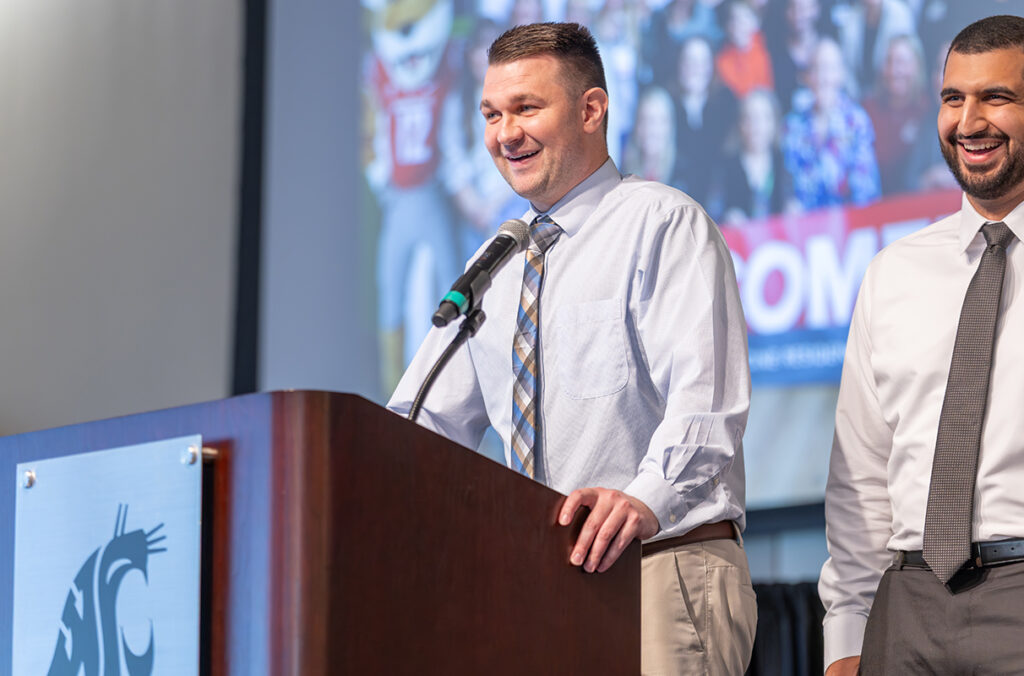
The director of the WSU Puyallup Research and Extension Center is coming full circle in a position that uniquely suits his interests and passions as the recently elected chair of the Washington Invasive Species Council (WISC).
“This is a milestone for me,” Murray said. “Ever since I identified and reported my first invasive, I’ve enjoyed leveraging WSU Extension’s reach to help groups like landscapers, master gardeners, pest management professionals, and city workers, educating them and passing on that excitement for discovery.”
As chair of the multi-agency policy body, Murray will lead public engagement efforts through coordinated messaging and supportive resources that span organizations.

“We found that as the pace of invasive species introductions increased over time due to globalizing trade, more coordination between agencies was needed,” he said. “The goal is to mitigate the worst impacts of invasives throughout the state.”
Based in Olympia, Washington, the council is composed of representatives from 22 agencies, including federal and state entities, tribes, and nonprofits, with shared goals of protecting natural resources, transportation, agriculture, energy, and recreation. Murray represents higher education institutions on the council.
“Todd not only understands the policy challenges surrounding invasives but also how communities are impacted by those challenges,” said Stephanie Helms, executive coordinator at WISC. “We appreciate his vision, drive, and ability to tackle the ever-changing issues stemming from invasives in our state.”
Murray’s selection as chair followed news from the Washington State Department of Agriculture (WSDA) that the northern giant hornet has been eradicated here in the state and nationally. Efforts to eliminate the species from Washington started with the council’s quick action.
“Like with most invasive species, early detection was critical,” Murray said. “Someone in Washington saw a hornet they didn’t recognize in 2019 and submitted the sighting through the council’s mobile app.”
The report triggered quick action from WSDA and the United States Department of Agriculture, which confirmed the species and mobilized resources to set traps and eradicate all nests.
“We conduct tabletop exercises to game out scenarios,” Murray said. “It prepares us to respond immediately. It’s not a question of if, but when, something important will show up.”
We conduct tabletop exercises to game out scenarios. It prepares us to respond immediately. It’s not a question of if, but when, something important will show up.
Todd Murray, chair
Washington Invasive Species Council
To extend surveillance and ensure that impacted communities are represented, Murray’s vision for the future includes bringing more stakeholders to the table.
“Extension is a great model because we are embedded in each county and on tribal reservations,” he said. “We work with a variety of stakeholders, and we will continue to champion better engagement on the council from underrepresented groups.”
Murray added that increased engagement is an important step toward better understanding an invasive’s potential scope of impact.
“The spotted wing drosophila was introduced in 2008,” he said. “While a major initial focus was protecting the fruit industry, particularly blueberry and raspberry crops, the fruit pest was found to have already affected native huckleberry, a key resource of indigenous peoples, in wilderness areas.”
Murray said he hopes that more involvement from underrepresented groups will mean earlier detection of unwelcome pests.
“In most cases, once a pest is introduced, there’s no resetting the clock,” he said. “But the council has a clear mission to be aware and proactively stop these introductions, and we are ready to take action when they do happen.”