Harvesting sunlight to make energy is a complex reaction that plants do naturally, but isn’t well understood. A research team led by a Washington State University professor has developed a new tool to study how lipids interact with proteins in plants to help understand how photosynthesis happens.
In the paper, published in the Journal of Biological Chemistry earlier this year, the scientists used this new tool to find the lipid that controls when a photosynthetic protein switches from a light harvester to an energy dissipater in plants.
“There’s a lot of potential danger with photosynthesis,” said Helmut Kirchhoff, professor in WSU’s Institute of Biological Chemistry. “If plants take in light energy that isn’t used properly for their metabolism, it can poison the plant and kill cells. The switch of light-harvesting proteins is essential to protect the system when there’s too much light available.”
Until now, nobody knew for sure how plants avoided that toxicity on sunny days. It’s an important scientific breakthrough.
High impact paper
The paper’s impact was recently chosen by Science magazine as an editor’s choice paper for March 2020.
“I was really surprised to be chosen,” Kirchhoff said. “We were really excited and honored to be picked in such a top tier journal.”
Kirchhoff wrote the paper with co-authors Stefanie Tietz, Ricarda Höhner, and Alice Olson from WSU and Michelle Leuenberger and Graham R Fleming from the University of California, Berkley.
How it works
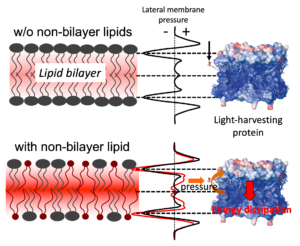
In the paper, the researchers developed a method for studying how lipids, which are molecules in cell membranes that perform a variety of functions, interact with proteins in chloroplasts, the part of green plant cells that photosynthesize light.
They found that one specific type of lipid, called a nonbilayer lipid, seems to control the switch that the light harvesting protein makes when the plant has enough light and needs to dissipate some of the energy being received.
“We were suspicious that this nonbilayer lipid had a role in controlling the structure and function of membrane proteins,” Kirchhoff said. “We knew it had to have a function to be there because it’s the most abundant lipid in photosynthetic membranes. We just didn’t know exactly what that role would be.”
Future uses of findings
In a changing climate with an increasing human population, growing more food with fewer resources will be essential. This new finding could one day lead to a method for optimizing photosynthesis in crops for specific environments, so excess energy doesn’t have to be wasted, Kirchhoff said.
“We’re still very early on, but we’re excited by what we’ve found in this paper,” he said. “And we’ll continue to use our new process to study other lipid-protein interactions to see what else we can learn.”
Media contact:
- Helmut Kirchhoff, WSU Institute of Biological Chemistry, 509-335-3304, kirchhh@wsu.edu