New beekeepers often jump into the job with little more than a protective suit and the willingness to work hard and endure stings.
Researchers with Washington State University’s Honey Bee and Pollinators Program have produced a new video series giving novice keepers a strong introduction to best practices and the science of apiculture, in both Spanish and English.
“This series came about because there just aren’t any other resources like it out there,” said Rae Olsson, assistant professor in the Department of Entomology.
Released in March, the YouTube training series covers honey bee health and biology, beekeeper safety, and colony management through 24 episodes, 12 in each language.
Titled ABEJAS, or Aprendizaje Basico y Experto en Jornadas Apicolas Sostenibles — “Basic and Expert Learning in Sustainable Beekeeping” in English — the series was originally developed for resident or H2A work-visa holding Spanish-speaking beekeepers, then expanded to serve English speakers. Abejas is the Spanish word for bees.
“This project was entirely stakeholder-driven, born from a direct need within the commercial beekeeping industry,” said Brandon Hopkins, WSU’s Thurber Endowed Distinguished Professor of Pollinator Ecology. “So much of the success or failure of a bee operation rides on the education and skill of the employees.”
The lack of adequate Spanish-language training resources limits beekeepers’ abilities to make critical decisions on colony health, said Bri Price, WSU’s Puyallup, Washington-based Honey Bee Program Extension Coordinator. Conversely, preparedness protects these economically crucial pollinators.
“The biggest impact of an educated, confident beekeeper is colony survival,” Price said.
Three consecutive modules in the series explore the honey bee lifecycle, biology, and nutrition; good beekeeping practices and tools; and pests, parasites, and diseases.
The project was supported by USDA’s National Institute of Food and Agriculture, Project Apis m., Miller Honey Farms, and the University of Minnesota, and developed by Wonderstone Films.
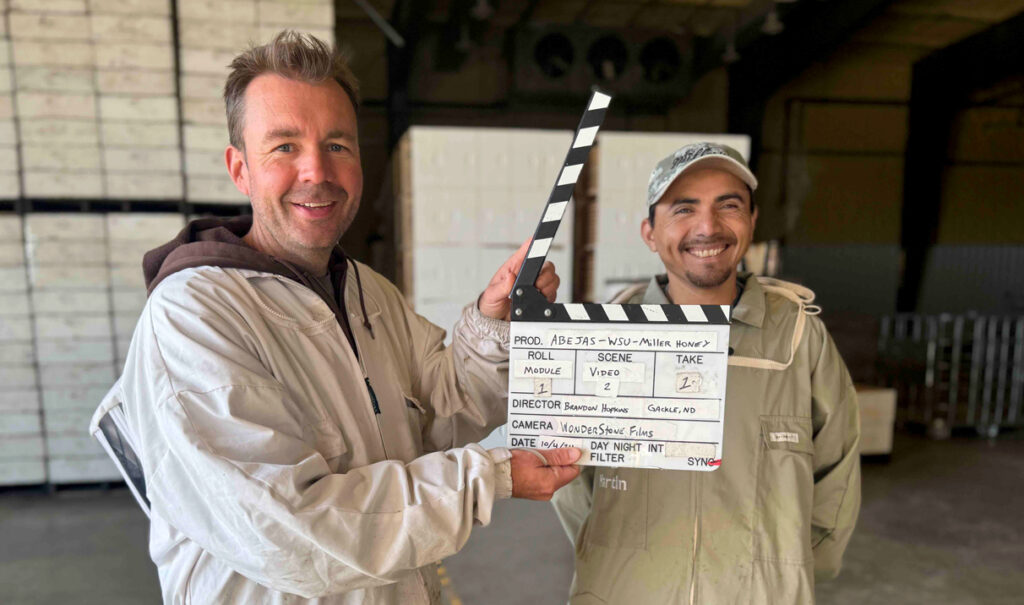
Olsson and Price worked with translator Sandra Mina-Herrera, a WSU College of Education, Sport, and Human Sciences doctoral student raised in Colombia, to develop a script customized for Spanish speakers. Mina-Herrera in turn collaborated closely with the series voice talent, Martín Barrón Ramírez, lead beekeeper at California-based Miller Honey Farms, to make it jargon-free and comprehensible to Spanish speakers from a range of nations.
“We wanted primary Spanish speakers’ experience to be centered and for these videos to be approachable,” Olsson said. “We set out to ensure scientifically accurate and culturally responsive language.”
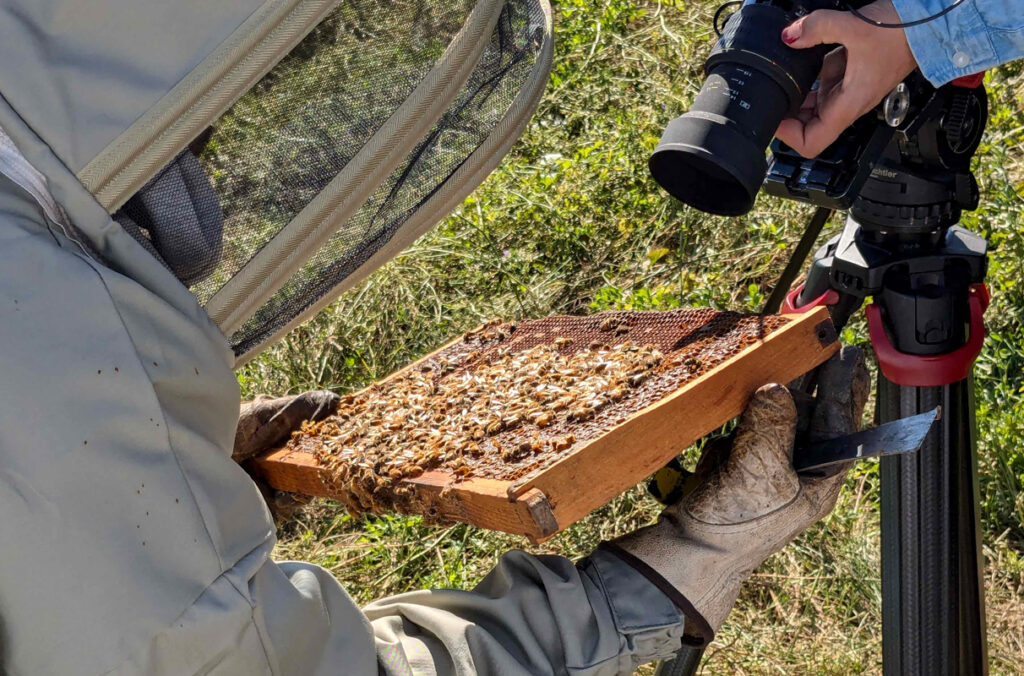
Sessions were filmed at Miller Honey apiaries in North Dakota and California.
Visuals of in-field practices, such as beekeepers opening and inspecting hives, are the same in English and Spanish. The only differences between each version are scenes where narrators directly address the camera. Ramírez narrates in Spanish, while Katie Lee, Extension apiculture educator researcher at the University of Minnesota, provided the English voiceover. Nonprofit Project Apis m. helped fund the English-language videos.
“Thank you to our partners with USDA, Miller Honey Farms, and Project Apis m. for their support of this valuable educational project,” said Raj Khosla, Cashup Davis Family Endowed Dean of CAHNRS. “It’s a prime example of how researchers, nonprofits, and members of industry can come together to solve challenges and serve society and nature.”
WSU entomologists plan to widely disseminate the series to beekeeping organizations and industry members across the U.S. and internationally.
While the series is aimed at commercial beekeepers, it can also help hobbyists and backyard beekeepers get started. The project complements an annual round of workshops and training sessions that WSU entomologists offer to improve colony health, pollinator survival, and worker safety.
“This is one important part of our job,” Price said. “We’re actively reaching all the time to help improve wellbeing, not just for pollinators, but for people.”