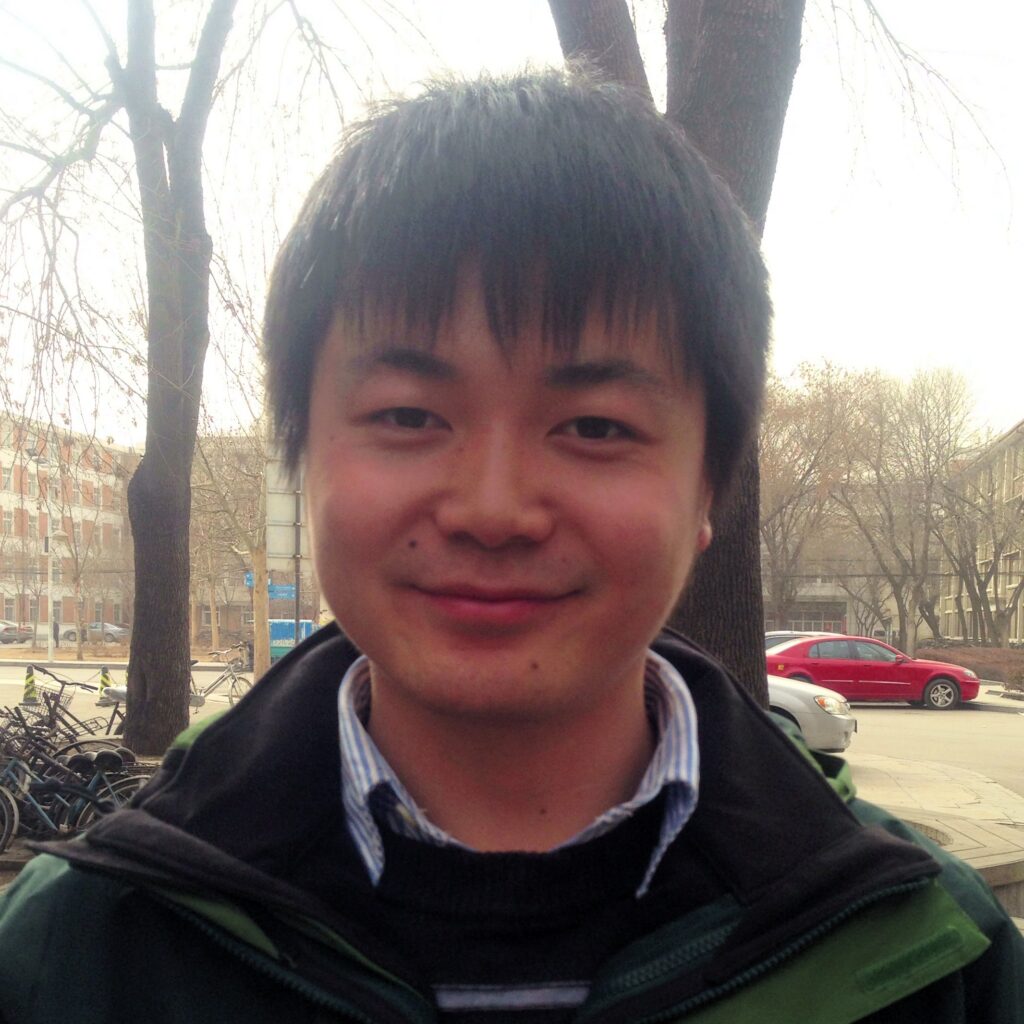
Yan Yan, assistant professor in Washington State University’s School of Electrical Engineering and Computer Science, has received a prestigious National Science Foundation (NSF) CAREER Award for work to improve artificial intelligence (AI) models.
The five-year, $600,000 award supports early-career faculty who are leading research advances and who have the potential to become role models in research and education.
Yan is developing a new artificial intelligence framework that aims to narrow down searches in very large data sets to more efficiently provide a better picture of reality. The advance would allow AI technology to be more readily used in critical decision making in high-stake applications, such as in engineering design optimization, cybersecurity, health monitoring, or smart agriculture.
“This work handles a blank area in AI machine learning,” said Yan. “In AI machine learning, people usually set up something like the average performance, but the average cannot reflect all the information.”
Yan has been developing a prediction paradigm that builds a set instead of giving the average value for a prediction.
So, for instance, in a classroom, if the classroom average GPA is 90%, a professor might think that all is going well, but that number could mean that almost all the students have a 95% average, and two students have 0s. By only looking at the average, the professor misses critically important information about the failing students.
“Sometimes we fail by using only the average performance,” he said.
His work marks a shift in how he and others have worked to improve AI models. For several years, he had worked to improve average performance, but he eventually realized that the average doesn’t do enough to get at what people really need in information. After that realization, he spent six months studying and moving in a new direction.
“It’s very reasonable to consider the probability because that is really something people can really use and connect to the decision-making process,” he said. “I realized the average or standard way is not enough, and I needed to shift – not completely ignore everything I have learned, but just to add something more.”
For example, in diagnosing disease, a doctor might start with thousands of possible conditions from a series of symptoms.
“If we can narrow that down to less than 10 most likely diseases, that will help the doctor,” he said. “Our goal is not to improve the average guess rate or average hit rate. That’s not so helpful in reality — what is really helpful is the likelihood.”
In addition to providing a more accurate picture, the work will lead to more efficiency in AI algorithms. The required energy use to power AI is a growing concern.
“We need to be more efficient in resource, data, and computational costs because the training of machine learning AI models requires a lot of time and power as well as human labor,” he said. “Reducing that part of the computational costs would increase efficiency.”
Yan joined WSU in 2020. He holds a PhD from the University of Technology Sydney and a BE in Computer Science from Tianjin University in China.