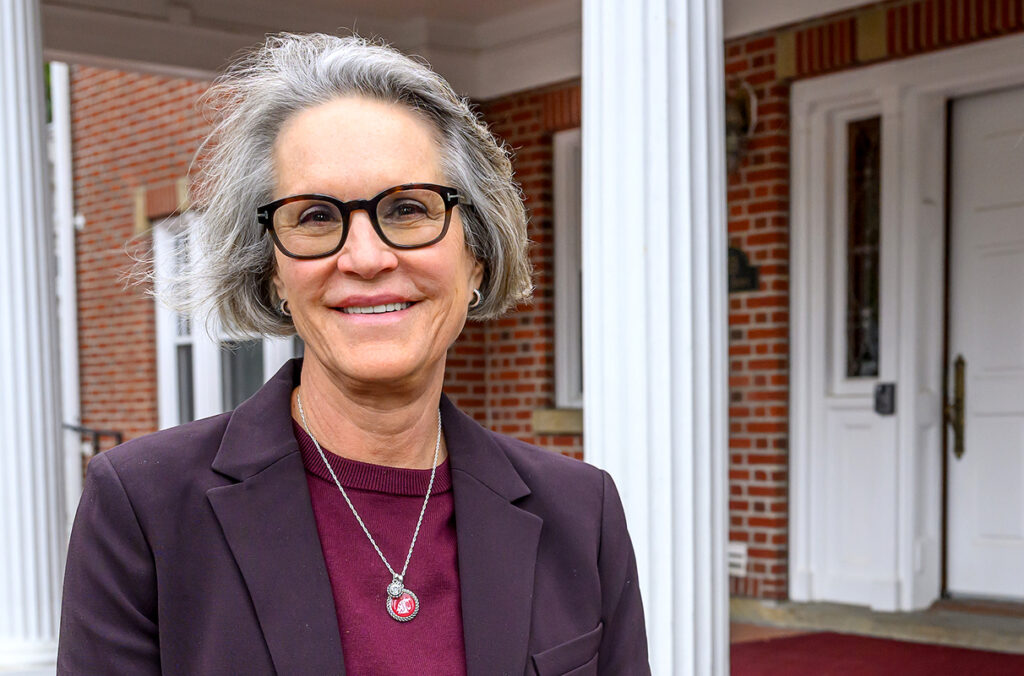
Access to a quality education is at the core of Washington State University’s land-grant mission. WSU’s incoming president, Elizabeth “Betsy” Cantwell, emphatically supports this endeavor.
“Part of my commitment to WSU as a land-grant institution is ensuring that no matter what career stage someone is at, they will have access to WSU programs that will meet their needs, and by extension, the needs of our state and region,” Cantwell said.
Today marks the first day in Cantwell’s tenure as the 12th president of WSU. Cantwell emerged as the top candidate in an exhaustive nationwide search, with members of the WSU Board of Regents praising her leadership experiences, passion for the land-grant mission, and commitment to serving students.
A focus on access is critical, given the twists and turns most adults experience in their careers. Acquiring new skills or reinforcing existing expertise is vital in today’s economy; and universities, as Cantwell can attest, are key to that effort.
“It’s a misnomer to think that career ambitions are linear,” Cantwell said.
Cantwell’s path to WSU
Cantwell began her undergraduate studies at the University of Chicago as a 16-year-old. Shortly after completing her undergraduate degree, Cantwell traveled to California to attend graduate student orientation but soon realized that she may be suited to an alternative career path.
In the years that followed, Cantwell went back to community college to pick up the math and physics courses needed to transition to a career in engineering. It was during her time working for NASA that she earned her PhD in mechanical engineering with a dissertation focused on microgravity combustion. Cantwell also earned an MBA from the Wharton School while working at Lawrence Livermore National Laboratory, a step she took to better understand how to successfully turn a technological advancement into a business plan.
The transition from working at national laboratories on issues of national security to higher education came about after visiting Arizona State University with her daughter about a decade ago.
“I met a number of people, including the ASU president, during that visit,” Cantwell recalled. “They convinced me that public higher education is the most important national security measure we have, not because these universities develop technology, but because they develop people who can operate in a democratic republic.”
WSU’s appeal to Cantwell was rooted in its status as a premiere land-grant institution, one built on advancing the fields of agriculture and engineering in particular.
“This is one of the most auspicious land-grant brands in the United States,” Cantwell said. “WSU has made a mark in everything that matters to being land-grant.”

‘Let’s get to work — together’
President Elizabeth Cantwell thanks the university community in a personal message, sharing her belief that WSU is uniquely positioned not only to adapt — but to lead.
WSU’s role in the future of these industries, from developing resilient crops and 21st century harvest techniques, to capitalizing on the potential of artificial intelligence across a broad spectrum of fields, will be critical, Cantwell said. While universities are no longer arbiters of knowledge thanks to the proliferation of online resources, WSU and its peers retain the unique capacity to translate knowledge into applications that society needs.
In collaborating with WSU graduates working in the aerospace industry, Cantwell said she’s also observed Coug leadership first-hand.
“All of the WSU graduates I’ve worked with have demonstrated the exceptional culture at WSU,” Cantwell said. “This culture and WSU’s commitment to its land-grant heritage are helping the next generation of leaders to ascend to the positions we’ll need them in for years and decades to come.”
Getting to work
Cantwell’s plan for her first 100 days in office includes embarking on a whistle stop tour across the university system. She’s also keen to develop strong working relationships with legislators and prominent alumni supporters. Cantwell is also ready to delve into the business operations and finances of the university system, as well as meet with a broad swath of representatives from the athletics community.
The current financial challenges facing higher education including WSU, are compounded by the relatively slow pace of adaptation at large-scale public institutions. Cantwell, alongside Provost and Executive Vice President Chris Riley-Tillman, will establish small design teams to examine some of the most prominent issues facing the WSU system and make recommendations for how leaders can tackle emerging issues.
A month before her first official day as president, Cantwell hit the ground running, attending two days of Board of Regents meetings on the Tri-Cities campus.
“It’s critical to understand the governance of your institution before you step in,” Cantwell said.
Amid the uncertainty about federal funding, Cantwell is eager to explore opportunities to pair WSU’s research enterprise with private partners. Central to WSU’s research endeavors will be bolstering the economy of Washington as well as the surrounding region.
In the coming weeks, the Office of the President will also launch a presidential transition website, which will include information on Cantwell’s activities and initiatives across the state and provide opportunities to engage with the WSU community.
“We will design our own future,” Cantwell said.