Professor and Washington State University Extension Agent Chris Benedict is partnering with colleagues at the Center for Sustaining Agriculture and Natural Resources (CSANR) to lead the state forward on soil research, outreach, and best practices.
Their work improving soil health and productivity helps guide the efforts of agricultural industries, environmental constituents, and non-governmental organizations (NGOs) to protect Washington’s environment while boosting the state’s food supply and economy.
“Improving soil health is universally accepted,” Benedict said. “There are few issues where so many stakeholders come together and readily agree.”
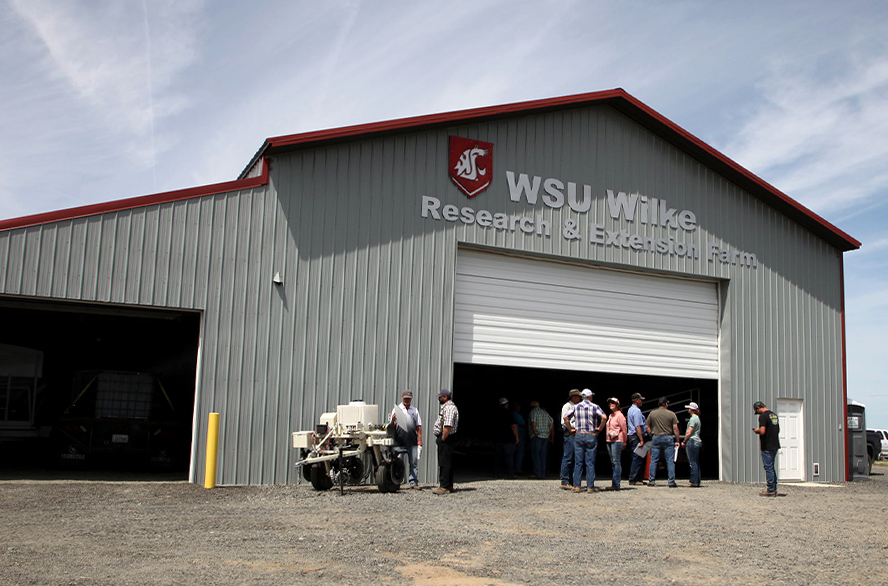
In 2018, the Washington State Legislature provided funding to develop long-term agroecological research and Extension (LTARE) sites across Washington state, with the first located at WSU’s Northwestern Washington Research & Extension Center at Mount Vernon.
WSU, the Washington State Department of Agriculture, and the Washington State Conservation Commission are working closely together to spearhead this tri-agency WaSHI effort.
Currently, the USDA runs 18 long-term agroecological research sites throughout the U.S. With the addition of six new Washington sites (including Mount Vernon), all managed by WSU, the state is now poised to account for a quarter of all sites nationwide.
“These sites will drive our knowledge,” Benedict said. “The experimental treatments are based on feedback from various industries. Most agricultural research usually spans 3 to 5 years, but we expect this research to provide the first insights in 5 to 10 at the earliest, depending on the production system and treatments involved.”
Moreover, these LTARE sites focus on several of the state’s most productive agricultural systems and commodities, including dryland agriculture in eastern Washington, irrigated production in the Columbia Basin, wine grapes, tree fruit, western Washington diversified farming, and northwestern Washington potato.
Research at the LTARE sites will be guided by the already developed Washington Soil Health Initiative Roadmap.
“The roadmap identifies where we are currently in our knowledge of soil health and the main problems, then lays out our future goals, objectives, and milestones,” Benedict said.
That’s important because it’s a first in Washington.
“Imagine you’d never been to the doctor and suddenly you get your first bill of health — we will essentially be creating the first ever ‘bill of health’ for Washington soils,” Benedict said.