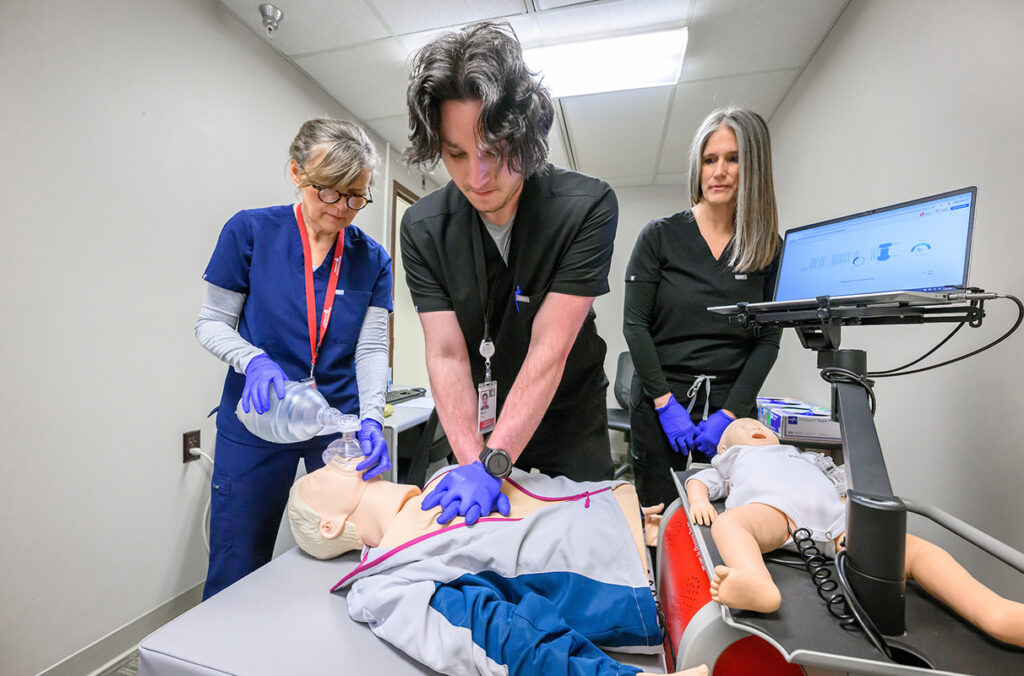
A code blue, or life-threatening emergency, at a student clinic is rare, but Cougar Health staff are ready to respond.
Washington State University’s Elson S. Floyd College of Medicine and Cougar Health Services have partnered to provide enhanced CPR training to staff at Cougar Health’s three Pullman campus clinics, which treat more than 7,000 students per year.
The partnership gives Cougar Health access to the American Heart Association’s Resuscitation Quality Improvement program® (RQI)®, a simulation-based training that verifies cardiopulmonary resuscitation (CPR) knowledge and skills. Access is provided through the College of Medicine’s Virtual Clinical Center license, enabling clinic staff to participate in training typically only available at hospitals and large health care systems.
While traditional CPR training is completed every two years, studies show CPR skills can deteriorate within three to six months after training. Enrollment in the RQI program helps health care providers refresh their CPR skills through real-time audio and visual feedback on a quarterly basis.
“If you don’t work in a clinical setting where you use chest compressions regularly, those skills get rusty,” said Dr. Sunday Henry, director of medical services and interim executive director of Cougar Health Services. “This provides us with an opportunity to practice those skills in a real-world scenario as often as we need to and whenever fits our schedules.”
RQI training consists of online coaching modules completed at a mobile simulation station equipped with manikins and resuscitation equipment. The modules simulate realistic patient scenarios and track users’ performance through a learning management system, ensuring competence-verified and high-quality CPR.
“Expanding access to the RQI program will help ensure current and future health care leaders are ready to provide lifesaving intervention if faced with a cardiac emergency in or outside of the hospital,” said Whitney Meidl, executive director at the American Heart Association, Washington. “We are excited that Washington State University continues to embrace this innovative training program for students and staff, which will translate into helping save more lives.”
The College of Medicine adopted the RQI program in 2019, making it one of the first medical schools in the nation to implement the training into its curriculum. Since then, the college has trained more than 700 learners with RQI, including WSU medical students, resident physicians, and students from other health professions programs in the college.
“We want to ensure our students are equipped with the skills, knowledge, and competencies to perform at the highest level during cardiac arrest occurrences,” said Chris Martin, assistant dean for simulation-based education at the college. “The RQI program is a perfect solution to help prepare them to achieve better patient outcomes.”
Cougar Health Nurse Manager Joe Shuey spearheaded the effort to implement RQI training at Cougar Health, which will now be completed by more than two dozen health care providers and other staff at Cougar Health’s medical clinic, vision clinic, counseling services, and pharmacy.
The medical clinic has a rapid response team that coordinates responses to emergencies in the building through dedicated radios. Although Dr. Henry doesn’t recall a time the team has ever had to respond to a cardiac emergency, they regularly respond to situations, such as fainting, in order to assess the student and support appropriate treatment.