Bred to be an athlete but born with a twisted nose, Eclipse, an American quarter horse, found herself fighting for air even after the shortest of runs.
Following a rare surgery at Washington State University — one of a few ever performed in the western United States — the resilient foal now has a chance at life at her full potential.
Eclipse was born with a rare facial malformation that causes a horse’s upper jaw and nose to deviate to one side. The congenital condition known as wry nose can cause complications with breathing, nursing, and eating.
While many horses are euthanized quickly after birth to avoid what can be an extremely poor quality of life, a corrective specialty surgery that is even rarer than the condition itself may be an option for owners who have the financial means. For Eclipse’s owner Laurie Johnson who fell in love with the rambunctious filly, it was the only option.
“There’s absolutely no way I could put her down, but I couldn’t let her live a horrible life, either” Johnson said. “I just started searching the internet.”
Her search for a resolution led her to Washington State University’s Veterinary Teaching Hospital and equine veterinarian Dr. Claude Ragle.
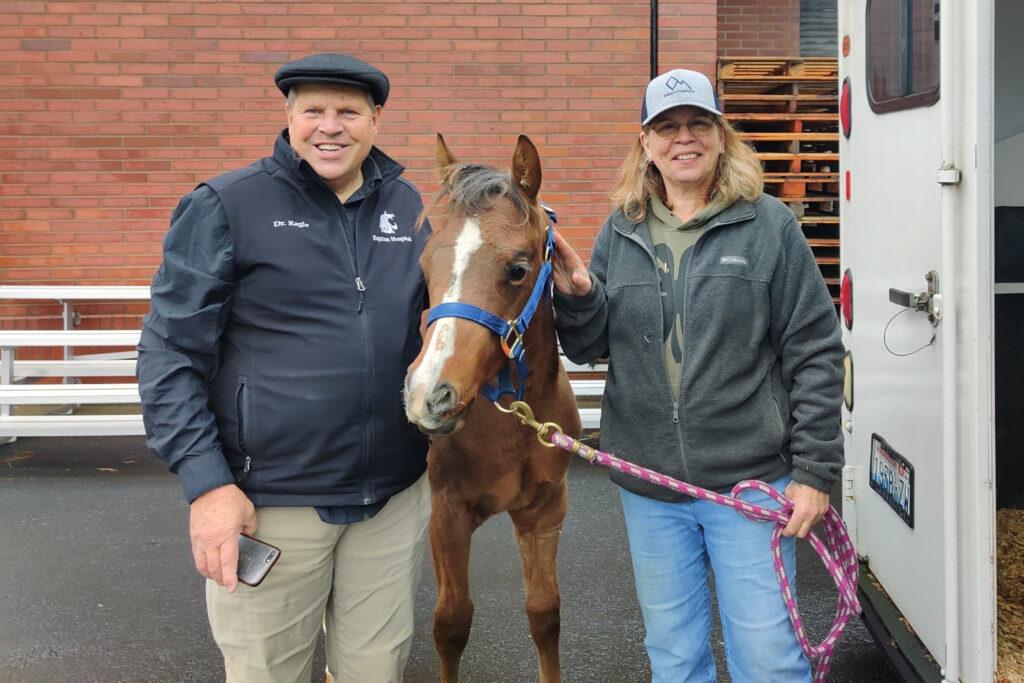
“I called him directly and told him I wanted to have wry nose surgery on my horse and he said, ‘absolutely, let’s do it,’” Johnson said.
Ragle didn’t plan to do the surgery alone.
Due to a longstanding relationship between Ragle and Dr. Jim Schumacher, who both became board certified equine surgeons in 1989, Schumacher traveled to Pullman to demonstrate the procedure to WSU faculty, residents, interns, and students.
A veterinarian at the University of Tennessee, Schumacher has performed more than 25 corrective wry nose surgeries, which is believed to be more than any veterinary surgeon.
“Even in retirement, I continue to do this surgery because I get satisfaction from giving horses affected with a wry nose a chance to have a normal life,” Schumacher said.
The surgery was necessary if Eclipse was ever going to physically exert herself like other horses.
Horses are nasal breathers and cannot breathe through their mouths. With one nostril completely blocked, Eclipse had to lie on one side to avoid asphyxiation.
Breathing was even tough when she laid on her good side.
“Her breathing would be scary hard loud, and she would snore like nothing you’ve ever heard,” Johnson said.
She also couldn’t run but 30–50 yards without stopping and fighting for air.
“If she wanted to live life like a normal horse, then this surgery was absolutely necessary,” Ragle said.
In all, the surgery lasted just under four hours, but it also involved several rechecks at WSU and with Eclipse’s primary veterinarian.
Once anesthetized, the surgical team, led by Schumacher, removed the septum to allow for better breathing. Then, for cosmetic purposes several cuts were made on Eclipse’s skull along the jaw and nasal bone so the jaw could be realigned using two plates, two rods, and several screws.
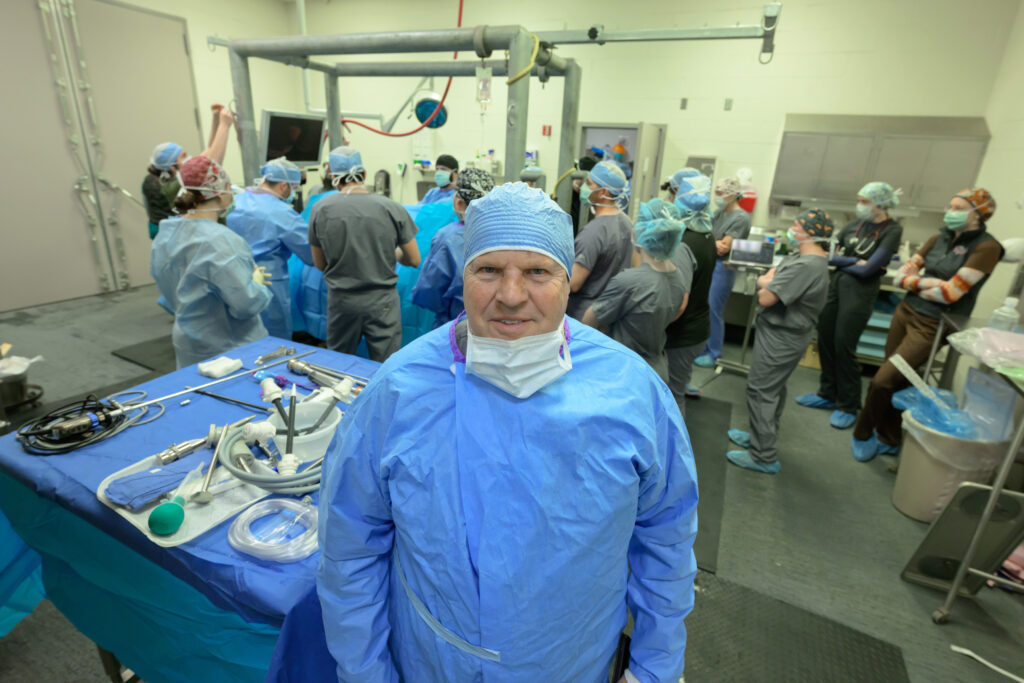
The surgery team consisted of Schumacher, Ragle, assistant professor Dr. Nick Hall, equine surgery residents Dr. Sebastian Larriva and Dr. Jorge Sanclemente, and fourth-year veterinary students Sierra Lopez and Melanie Moore.
Due to the risk of the surgery, a donor horse was brought into the hospital in the event Eclipse needed any blood, but, to Johnson’s and the surgery team’s liking, the surgery went without any complications.
Besides a minor infection post-surgery, Eclipse hasn’t had any setbacks and in the coming weeks is expecting to be off what’s been months of stall rest.
Johnson, who owns Lomara Equestrian Center in Snohomish and looks to one day ride Eclipse, said she didn’t pursue the surgery just for Eclipse’s sake — she hopes the successful surgery will lead to more surgeries or at least show other owners there are options.
“If more people know about the surgery, more surgeries will happen, so it is for the good of many. But I also don’t think it’s possible for me to have put her down if I could have afforded to do the surgery,” Johnson said. “I brought her into this world, and I had to do right by her.”