Senior Resident Advisor Jonah Oh has never had to perform CPR or use an Automated External Defibrillator (AED) where he lives and works in Rogers Hall, but should the need arise, he feels confident he can respond to the situation.
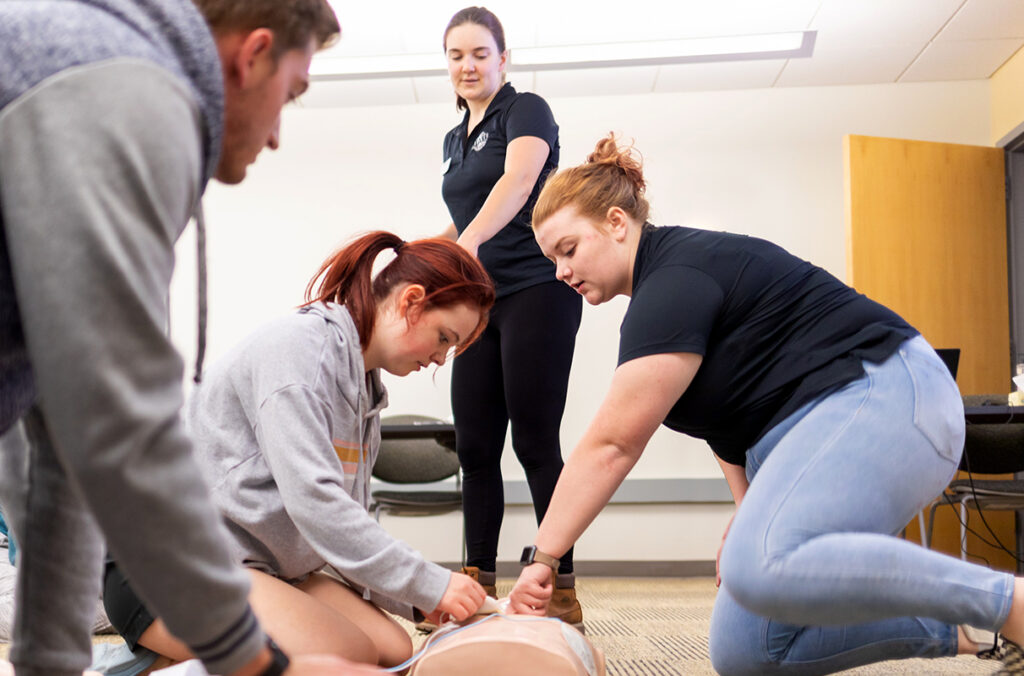
Recently, Oh and 176 other Washington State University Residence Life and housing live-in staff on the Pullman campus became certified in Red Cross first aid training, learned how to operate an AED, and administer naloxone, an opioid reversal medication. The six-hour training is a new requirement for all resident advisors (student RAs) and residential education directors (professional staff).
“We care about our residents a lot, and while additional training can be viewed as another thing on our plates, anything that can help us be more prepared to help our students is a good thing,” Oh said.
Including Opioid prevention education
The training coincided with the recent passage of House Bill 2112 which requires colleges and universities in Washington to provide opioid and fentanyl prevention education, free naloxone and fentanyl test strips to students. The bill includes a specific provision that staff working in residence halls be trained in how to administer naloxone. Naloxone, known by the brand name Narcan, is now accessible to all residence hall students at area desks, and students can also obtain a free box at the Cougar Health Services pharmacy.
While other colleges and universities in Washington require live-in staff to be trained in naloxone administration, WSU is the only one requiring training in first aid and CPR.
“I think the reality is that providing access to and training people to administer naloxone is going to save lives,” Autrey said. “You never know when you will encounter an overdose situation and we take safety in our residence hall environment very seriously,” said Meg Autrey, director of Resident Life and Housing.
While other colleges and universities in Washington require live-in staff to be trained in naloxone administration, WSU is the only one requiring training in first aid and CPR. Autrey stressed the training does not take the place of staff calling 911 as that remains the first thing they do in any crisis. The training allows staff to be better prepared to assist while they wait for emergency responders to arrive on the scene.
Training available on campus
Fortunately for Autrey, she did not have to look far to find certified first aid trainers as University Recreation (UREC) provides this service for faculty, staff, and student groups on the Pullman campus.
Regular training sessions are held twice a month during the academic year and people can view the schedule, cost, and register online. Special group sessions can also be arranged by contacting Sydney Fanning, UREC’s safety education, student development, and assessment coordinator, at sydney.fanning@wsu.edu. WSU departments receive a discounted price. Cougar Health Services also provides resources including overdose prevention and naloxone training.
“First aid and CPR training might seem rudimentary and not fun, but we have worked to make it interactive and engaging,” said Fanning. “These skills are lifesaving, and you never think you’ll need them until you do.”
Oh commended the trainers for making the training engaging and providing opportunities to practice what they are taught.
“If I ever need to take action during an emergency, I will feel as if I have done it before and will go about it much more confidently,” Oh said.
UREC’s assistance was not limited to first aid training. Autrey worked with Fanning to purchase AED’s for each residence hall, and they were installed in January.
“This is a great step to help protect our students and everyone who comes into the residence halls,” said Doug Anderson, who manages fire safety, compliance, and emergency management for Environmental Health and Safety.
Recently, Anderson and Facilities Information Resource Management launched an interactive map showing AED locations on the Pullman campus, and the residence hall locations will be included.
“We continue to take safety very seriously in our residence hall environment, both in personal and community spaces,” Autrey said. “We are constantly looking for ways to improve the student living experience on campus, and providing these new safety measures is one important way we’ve been able to do that.”