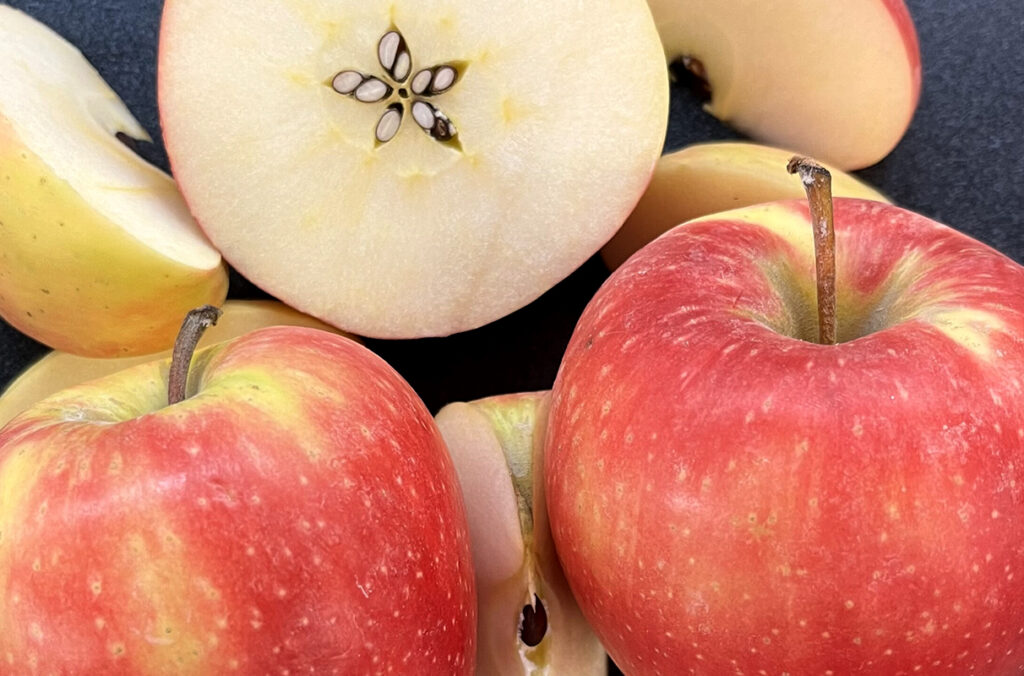
Why do so many apples in the grocery store look the same? And why do so many come from Washington? Humanities Washington speaker and Washington State University graduate Amanda Van Lanen will answer these questions and more at a 3 p.m. lecture on Thursday, Feb. 20, in Holland Library’s old lobby adjacent to the Dimensions Lab. It is co-sponsored by WSU Libraries and the Common Reading Program.
Titled “Big Apples, Big Business: How Washington Became the Apple State,” the presentation explores how Washington became the top apple-producing state in the country and transformed apples into an industrialized commodity. Following the talk, Carolyn Ross, food science professor and director of the WSU Sensory Science Center, will host an apple tasting.
“Many regions in the West attempted to grow apples, but in Washington, big apples became big business thanks to the work of scientists, investors, irrigators, railroad corporations, marketers, and apple growers,” according to Van Lanen. “How does the history of Washington apples reflect larger changes happening in the American food system — changes that continue to affect our environment and the way we eat today?”
Many regions in the West attempted to grow apples, but in Washington, big apples became big business thanks to the work of scientists, investors, irrigators, railroad corporations, marketers, and apple growers.
Amanda Van Lanen, speaker
Humanities Washington
Chair of the humanities division and history professor at Lewis-Clark State College, Van Lanen is the author of The Washington Apple: Orchards and the Development of Industrial Agriculture. In the book, she traces the origins, evolution, and environmental consequences of the state’s apple industry.
For example, in the 19th century, most American farms had a small orchard or at least a few fruit-bearing trees, Van Lanen writes. Today, Americans buy mass-produced fruit in supermarkets, and roughly 70 percent of apples come from Washington state.
Van Lanen also blogs about food history at “History Reheated.” She has written about debunking viral recipes like water pie, baking Betty Crocker’s 1950s-era Christmas cookies, and delving into a 1966 U.S. Department of Agriculture and Forest Service cookbook for lookouts in fire towers.
Van Lanen earned a master’s degree (2004) and a doctorate (2009) in history at WSU. She said since the beginning, WSU has supported the apple industry through innovative research. Historic research reports and bulletins were valuable resources for her research, as were collections at Manuscripts, Archives, and Special Collections.
“Researching at the MASC was always a joy,” she said. “Staff were kind enough to let me work with a large collection that had not yet been cataloged, and they have always been supportive, whether it is for my own research projects or when I bring my history students to visit.”
A fond memory involves former Manuscripts Librarian Cheryl Gunselman, who found a publicity scrapbook from a National Apple Week event that Yakima, Washington, hosted in 1927. It has since been digitized.
“It’s one of my favorite documents,” Van Lanen said. “Cheryl and I had a lot of fun looking through all the drawings and photos included in the book.”