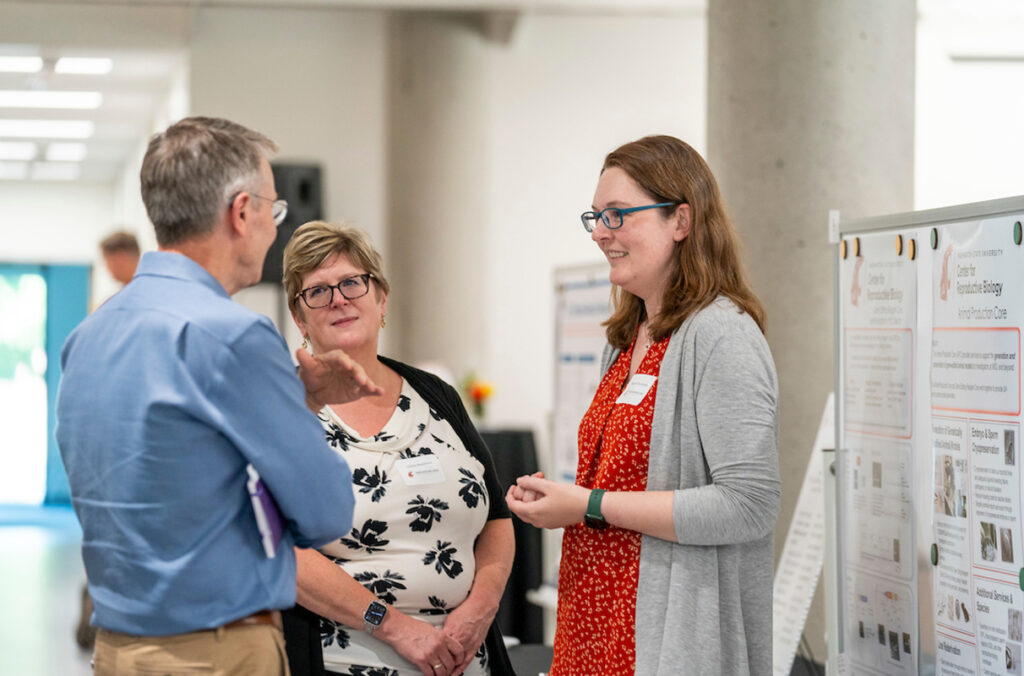
Washington State University Health Sciences and Seattle Children’s Research Institute awarded six collaborative projects $300,000 in seed grant funding following an inaugural joint symposium between the two institutions this fall at WSU Spokane.
“Bringing together two of our state’s leading health research institutions creates pivotal opportunities now and in the future for expanding the breadth and impact of our collective research missions,” said Daryll DeWald, executive vice president of WSU Health Sciences. “We look forward to the continued expansion of this transformational partnership.”
Bringing together two of our state’s leading health research institutions creates pivotal opportunities now and in the future for expanding the breadth and impact of our collective research missions.
Daryll DeWald, executive vice president
WSU Health Sciences
The joint symposium, which took place last September, aimed to catalyze research partnerships that addressed health challenges among children and families. The projects selected combine the institutions’ respective expertise, resources, and technology to pioneer innovations that play a critical role in improving health equity.
“This is an important step in our effort to tackle complex pediatric issues through research collaborations,” said Vittorio Gallo, senior vice president and chief scientific officer at Seattle Children’s. “These projects have the potential to lead to important clinical improvements, novel therapies, and make significant impacts across pediatric health.”
The six collaborative projects receiving funding are:
- Ekaterina Burduli (WSU) and Brent Collett (SCRI), will evaluate barriers and facilitators for families of high-risk infants to follow up for neurodevelopmental care and develop responsive solutions to facilitate neurodevelopmental care post-neonatal intensive care unit discharge and improve neurodevelopmental follow-up of children at high risk for neurodevelopmental delay in Washington State.
- Anjali Sharma (WSU) and Benjamin Gern (SCRI), will work to develop a nanotechnology-based highly effective, targeted therapy for the treatment of tuberculosis (TB) with minimal side effects and a shorter treatment duration.
- Jessica Fales (WSU) and Caitlin Murray (SCRI), will address a gap in understanding the unique context in which young people with chronic pain use cannabis and other substances by examining the real-world contexts that precipitate cannabis use and co-use with other substances.
- Jong-Hoon Kim (WSU) and Tanya Parish (SCRI), will work to develop a novel nanomaterial-based biosensor for pediatric TB screening with Lipoarabinomannan in urine samples to significantly improve detection accuracy and sensitivity, enabling healthcare providers to make informed decisions on treatment, ultimately improving TB management in children.
- Salah-uddin Ahmed (WSU) and Susan Shenoi (SCRI), will bring complementary expertise in pharmacology and epigenetics and a pediatric rheumatology clinician together to identify and validate non-invasive biomarkers, which can be used to improve the accuracy of diagnosis, predict prognosis, and monitor disease progression and response to therapy for Juvenile idiopathic arthritis, a chronic autoimmune disorder of children under 16 years of age with unknown etiology.
- Erica Crespi (WSU) and Jason Debley (SCRI), will leverage collaborative expertise to integrate an ex vivo model and transcriptomics at SCRI with microscopy techniques and cellular development characterization at WSU to investigate the molecular underpinning of obesity-related asthma and develop novel therapies.