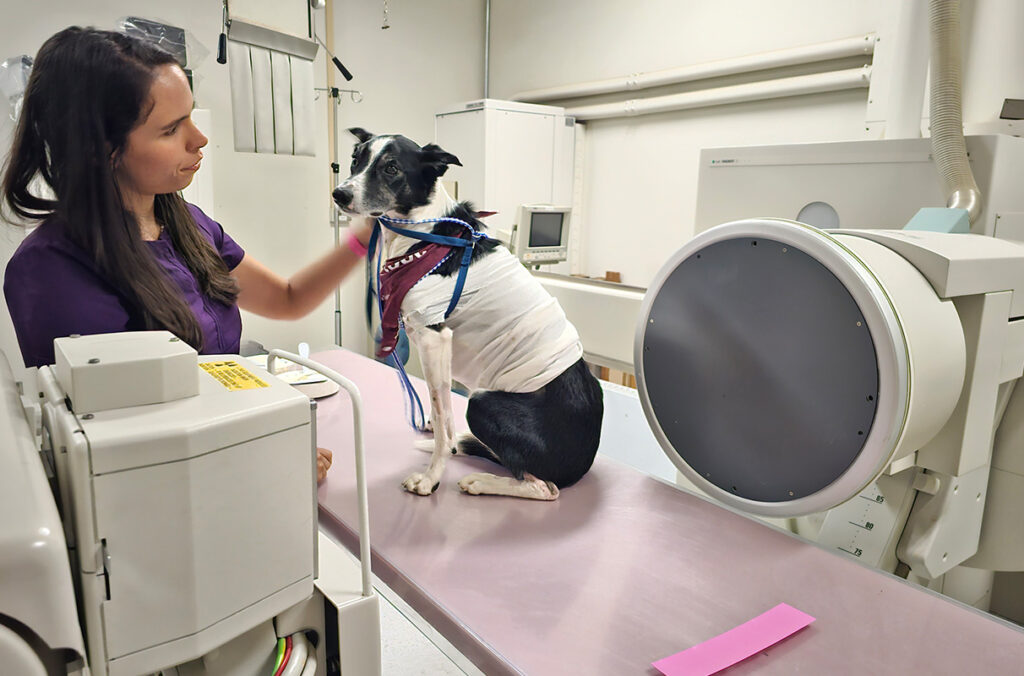
Aside from his family, there may be nothing in the world that 6-year-old border collie Ace loves more than sticks.
“He will retrieve a stick that is 2 inches or 10 feet. It doesn’t matter — he just loves them all so much,” his owner, Sally Bair, said.
The obsession nearly cost Ace his life. During an annual camping trip this past fall and an ordinary game of fetch, a stick tossed high into the air came down like a spear, piercing the inside of Ace’s throat as he leapt to catch it. In the days following the freak accident, Ace found himself at Washington State University’s Veterinary Teaching Hospital, where surgeons would perform a complex and risky procedure that has been undertaken only a handful of times to repair his throat and save his life.
Initially, veterinarians at an emergency clinic in Spokane suspected the injury was external and relatively minor. They prescribed rest and pain medication, hoping Ace would recover with time. After nearly a week, though, Ace wasn’t improving and was struggling to swallow food.
Ace’s condition was much more serious than initially believed. The stick had punctured his esophagus. Immediate treatment was needed to avoid a life-threatening infection or even sepsis.
Additional testing revealed Ace’s condition was much more serious than initially believed. The stick had punctured his esophagus, creating a pseudodiverticulum — essentially a pouch diverting and trapping food and fluids. Pseudodiverticulum cases are extremely rare in veterinary medicine, and immediate treatment is typically needed to avoid a life-threatening infection or even sepsis.
“The tear was quite significant,” WSU surgeon Dr. Bettina Darveshi said. “It spanned about 60% of the esophagus’s diameter. Instead of being a long, linear tear along the length of the food pipe, it was circumferential, wrapping around much of the esophagus. It had formed a pocket where food was collecting instead of passing into his stomach. It was critical to act quickly to prevent systemic infection.”
Less than 24 hours after arriving at WSU, a surgery team, led by Darveshi, began to carefully repair the tear while also removing the pocket of trapped food, which included remnants of carrots, peas, and chicken. Because the esophagus is constantly in motion, it’s one of the most challenging tissues to repair, with a high risk of complications like scar tissue or strictures, which occur when the esophagus narrows due to injury, inflammation, or scarring.
Ace spent six days in the ICU before returning home. Bair expressed gratefulness to all the staff for their exceptional care but singled out veterinary technician Gimmie Dexter Schriever.
“She loved on him so much,” Bair said. “It was so authentic, the way she and the staff handled Ace. It was just wonderful to see how much the staff seemed to really, really love him.”
Once home, Ace began the long process of recovery. For six weeks, his family fed him through a stomach tube, monitoring him for any signs of complications.
“Usually when we have esophageal perforations, the complication rates tend to be pretty high,” Darveshi said. “Fortunately, in this case, we got a successful closure of that defect without any evidence of any strictures or other complications.”
Sticks are now strictly off-limits for Ace, and Bair has made it her mission to inform dog owners of the potential danger of stick play.
“Since the accident, we never, never, ever throw, you know, a stick for him,” Bair said. “Sticks are spears, not toys,” she said. “I hope Ace’s story can save other dogs from going through this.”